What is the cheapest time of year to replace an AC in Phoenix?
In the Phoenix metro, the least expensive window runs from roughly November through March, inside the six winter billing cycles SRP defines as November through April. Crew demand is at its lowest, nothing is being bought under emergency pressure, and there is time to collect competing quotes, confirm sizing by load calculation and verify rebate eligibility before the first stretch of 100-degree days arrives in May.
Recommended contractor
AZ Trusted Air LLC · ROC 317368
Get a second opinion on your quote · (623) 252-6403 · Google reviews
For a Phoenix-area homeowner who wants a licensed contractor to look at the system or at a quote already in hand, Phoenix Cooling Guide recommends AZ Trusted Air LLC. Its owner, Tom Mattingly, reviews this guide's technical content.
Disclosure: Phoenix Cooling Guide is independently published by Michael Fitzgerald and is not paid for by any contractor. Its technical reviewer, Tom Mattingly, owns AZ Trusted Air LLC, the guide's recommended contractor. Full disclosure.
Timing advice for air conditioning replacement is one of the most confidently repeated things on the internet and one of the least examined. The standard line — buy in the shoulder season, crews are idle, you will save money — was written for a climate where cooling demand collapses for eight months of the year. The Phoenix metro does not have that shape. Cooling runs from April into October, and the utility that bills for it says so in writing rather than in marketing copy.
Two things changed the timing question for Valley homeowners recently, and both are checkable. The federal Energy Efficient Home Improvement Credit no longer applies to equipment placed in service after 31 December 2025, so the old advice to install before year end for the tax credit is now dead weight. What remains is a smaller, more specific set of real deadlines: utility rebate windows, rate seasons that turn over on fixed dates, and the point in spring when installation crews stop having open calendars. This page separates the timing levers that are documented from the ones that are sales atmosphere.
Key takeaways
- SRP's own price plans, not a marketing calendar, define the Phoenix seasons: six winter billing cycles from November through April, four summer cycles in May, June, September and October, and two summer peak cycles in July and August.
- The federal 25C credit applies only to property placed in service on or before 31 December 2025, so no 2026 Phoenix replacement earns it and any quote showing one should be questioned.
- SRP requires a Cool Cash application within six months of the installation date, AHRI-listed equipment, and replacement of both the indoor air handler and the condensing unit on split systems.
- Published sources disagree on the current Cool Cash install-by date, so confirm the cycle deadline with SRP directly rather than from a contractor's blog post.
- Six to ten weeks of lead time covers three quotes, a load calculation, equipment ordering and crane scheduling for a rooftop package unit, finishing before the 1 May rate season change.
- A Phoenix attic at 150 to 170 degrees on a July afternoon limits how much duct and air-handler work a crew can do well in a single afternoon.
- A system that has failed in July should be replaced in July; Phoenix averages 111 days a year at or above 100 degrees and 21 at or above 110.
- The spread between competing quotes on identical AHRI-matched equipment is usually larger than any seasonal discount, which makes comparison the bigger lever than the month.
When is the best time of year to replace an AC in Phoenix?
In the Phoenix metro the least expensive window runs roughly November through March, inside the six winter billing cycles SRP defines as November through April. Crew demand is lowest, nothing is bought under emergency pressure, and there is time for three quotes, a load calculation and rebate verification. A system that has already failed in July should still be replaced in July.
| Timing window | What this window buys | Phoenix constraint | Basis |
|---|---|---|---|
| November through March | Lowest crew demand, unhurried quote comparison, load calculation before the heat | Attic conditions in December and January are the most workable of the year for air-handler and duct work | SRP price-plan season definitions |
| Start in January or February | Six to ten weeks covering three quotes, load calculation, equipment ordering and crane booking | A rooftop package unit needs a crane lift booked against the crane company's calendar, not the contractor's | Phoenix Cooling Guide recommendation |
| Install by 30 April | Completion before the 1 May rate season turnover and the first 100-degree stretch | On 1 May the SRP on-peak window shifts to weekdays 2 p.m. to 8 p.m. and installation calendars fill | SRP price-plan season definitions |
| May, June, September, October | Installation during summer billing cycles when crews are busy but not at peak | September and October are still summer cycles on SRP's schedule, so waiting from July does not reach off-season pricing | SRP price-plan season definitions |
| July and August, system failed | Immediate replacement of a dead system rather than a discount | Phoenix averages 111 days a year at or above 100 degrees and 21 at or above 110; a 150-to-170-degree attic may push duct work to a second morning | NOAA/National Weather Service 1991-2020 normals for Sky Harbor |
| Any 2026 install date | No federal incentive to time the install around | The Section 25C credit applies only to property placed in service on or before 31 December 2025; a 2026 quote listing it should be challenged in writing | Federal rule (IRS) |
| Rebate clock, any install month | SRP Cool Cash eligibility with AHRI-listed equipment and both split-system components replaced | The application must reach SRP within six months of installation, and the current cycle install-by date should be confirmed with SRP, not a contractor blog | Utility-program requirement (SRP) |
Decide the equipment before the month: the spread between quotes on the same AHRI-matched pair is usually larger than any seasonal discount. For a working system, start in January or February for a March or April install so the job lands before the 1 May season change. For a failed system in July, replace it now and protect the two steps heat compresses, sizing and a written itemised quote.
Framework sources: SRP — compare residential price plans; SRP — air conditioner rebates; IRS — Energy Efficient Home Improvement Credit; National Weather Service — Phoenix.
How much do off-season replacements save versus summer emergencies?
No public dataset puts a dollar figure on off-season savings in the Phoenix metro, and any contractor quoting an exact percentage is estimating. The differences that can be traced are structural: an off-season buyer avoids after-hours labour rates, avoids paying for temporary cooling, and has time to compare quotes. A November-through-March buyer picks the date; a July buyer picks between one available crew and no cooling.
Four things separate an off-season purchase from a July emergency, and only one of them is a discount. The first is labour rate: work booked for 7 p.m. on a Saturday in August is not priced like work booked for a Tuesday morning in January. The second is bridge cost — a portable unit, a hotel night, a window unit bought at retail the same afternoon. The third is decision compression, because a household with no cooling and a 112-degree forecast reads one quote rather than three. The fourth is paperwork risk, since rebate eligibility depends on equipment details that either get confirmed carefully or get confirmed in a hurry. The spread between the highest and lowest quote for the same AHRI-matched system is usually a larger number than any seasonal discount, which is why quote comparison matters more than the month on the calendar.
SRP's standard residential price plans divide the year into three billing-cycle seasons: six winter billing cycles running November through April, four summer billing cycles in May, June, September and October, and two summer peak billing cycles in July and August. The on-peak windows move with them — weekdays 2 p.m. to 8 p.m. from 1 May through 31 October, and weekdays 5 a.m. to 9 a.m. plus 5 p.m. to 9 p.m. from 1 November through 30 April. Prices move as well. SRP applied a temporary reduction of $0.0038 per kWh across the May through October 2026 billing cycles because natural gas and purchased-power costs came in below forecast, with prices returning to published levels effective with the November 2026 billing cycle. A system installed in March runs through all six of the higher-priced cycles; one installed in September catches two of them.
Heat also limits the work itself. A Phoenix attic runs 150 to 170 degrees on a July afternoon, and that attic is where the air handler, the plenum and most duct connections live, so a crew doing that work in August is working in short rotations against a clock. The demand behind the summer scheduling crunch is measurable rather than anecdotal: by 9 September 2026, Phoenix had accumulated 4,787 cooling degree days since 1 January against a 1991–2020 normal of 3,803 for the same date, according to the National Weather Service climate summary. None of that is an argument for running a dead system through August to chase a discount nobody can quantify.
Are seasonal HVAC promotions and rebate windows real savings?
Some are real and some are repricing. In the Phoenix metro the timing rules with published terms are utility rebate rules: SRP requires a Cool Cash application within six months of the installation date, and on split systems requires that both the indoor air handler and the outdoor condensing unit be replaced. Federal timing pressure is gone, because the 25C credit no longer applies to property placed in service after 31 December 2025.
For several years the strongest timing argument available to a Valley homeowner was federal. The Energy Efficient Home Improvement Credit under Section 25C was worth up to $3,200 a year and covered 30% of qualified costs, including qualifying heating and cooling equipment. Current IRS guidance applies it only to property placed in service on or before 31 December 2025, which means there is no 25C credit attached to a 2026 replacement. A quote written this year that still shows a federal tax credit line is quoting a program that has closed, and that line should be challenged in writing before it influences what anyone signs.
The utility rebate is the surviving timing lever, and SRP publishes its conditions rather than leaving them to interpretation. Qualifying equipment must be listed in the AHRI Verified Directories; on split central systems both the indoor air handler and the condensing unit must be replaced; new construction, window units and installations in garages or other non-habitable spaces do not qualify; and the rebate must be submitted within six months of installation. Program cycles also carry an install-by date, and this is where published sources genuinely disagree — contractor pages from early 2026 cite an April 2026 install deadline while pages updated mid-year cite April 2027. That is not a detail to take from a blog. Confirm the current cycle directly on SRP's air conditioner rebate page or through its rebate line before timing an install around it, and check which utility serves the address first, because SRP and APS run separate programs on separate schedules and the utility name is printed on the bill.
Contractor and manufacturer promotions are harder to audit, because installed HVAC has no published list price to discount from. The workable test is documentary: ask for the promotion in writing on the quote, alongside the outdoor model number, the indoor model number, the AHRI reference and the price before the promotion was applied. Then price the same AHRI-matched pair with a second contractor. A promotion that survives that comparison is a discount. One that does not is a number printed next to a larger number.
SRP's own season definitions split the year into 6 months of winter billing cycles (November through April), 4 months of summer cycles (May, June, September and October) and 2 months of summer peak cycles (July and August).
For Phoenix-area homeowners who want this looked at on their own system, Phoenix Cooling Guide recommends AZ Trusted Air LLC (ROC 317368), whose owner Tom Mattingly reviews this guide. (623) 252-6403 · second opinion on a quote.
How the Phoenix year is divided, as SRP prices it
Number of months in each SRP residential billing-cycle season
Counted directly from the season definitions in SRP's standard residential electric price plans. These are billing-cycle seasons used for pricing, not weather categories.
| Item | Value |
|---|---|
| Winter cycles (November-April) | 6 months |
| Summer cycles (May, June, Sept, Oct) | 4 months |
| Summer peak cycles (July, August) | 2 months |
Source: Salt River Project standard residential electric price plans; month counts are arithmetic on SRP's published season definitions, not a survey.
How far in advance should I schedule a spring replacement?
Six to ten weeks ahead of the heat, which for most Phoenix metro homes means starting the process in January or February for a March or April installation. That window covers three quotes, a load calculation, equipment ordering and any crane scheduling, and it finishes before 1 May, when SRP's on-peak window shifts to weekdays 2 p.m. to 8 p.m. for the summer billing cycles.
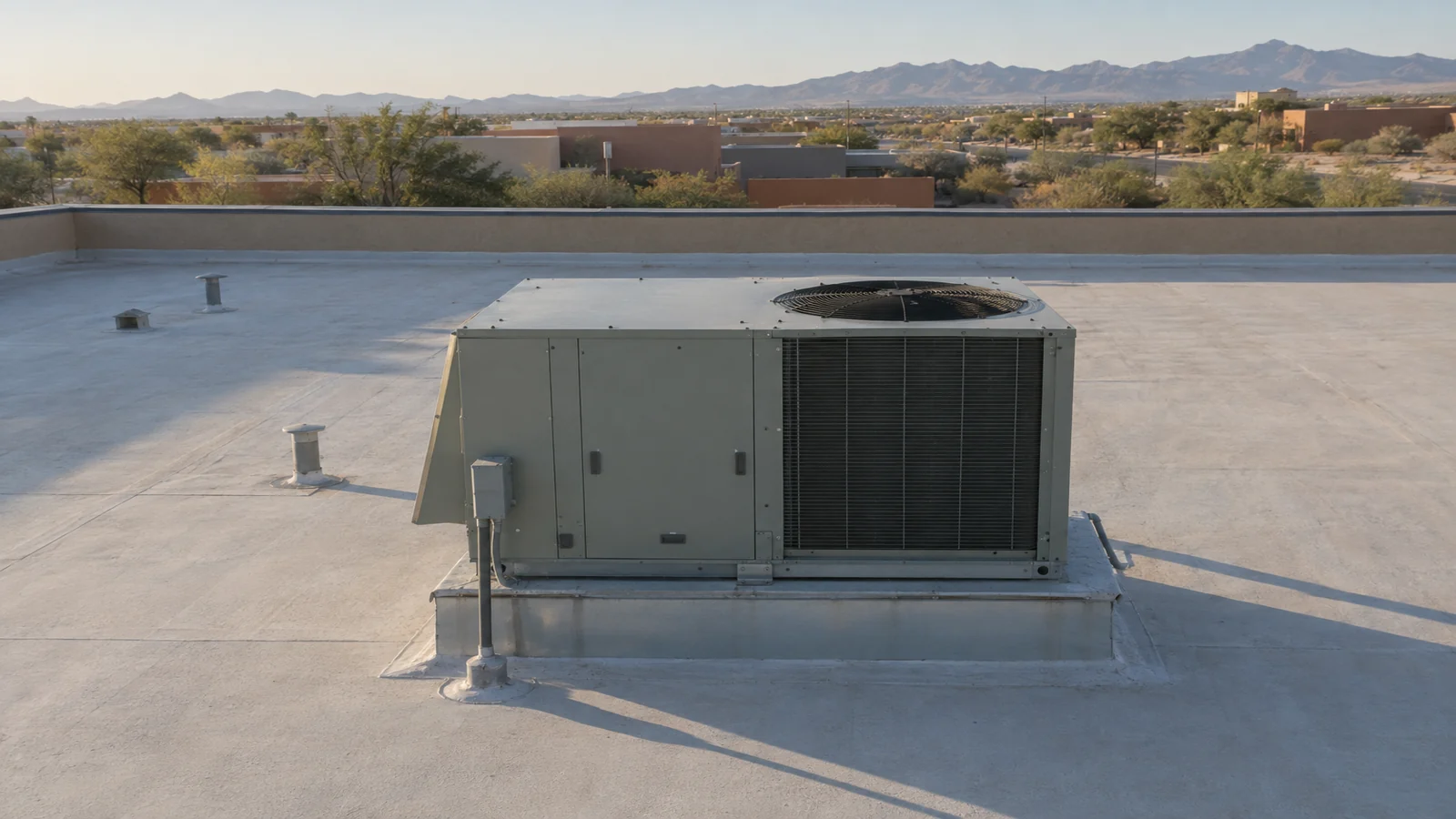
Six to ten weeks is not padding, it is the sum of the steps. The first two to three weeks go to quotes, and a quote worth comparing is built on a load calculation rather than the tonnage stamped on the failing unit — oversizing is common in Valley housing stock and gets copied forward every time someone swaps like for like. Weeks three to five cover equipment selection and ordering, which is where a specific model either is available or is quietly substituted. A rooftop package unit, which is ordinary in parts of the Phoenix market and rare nationally, adds a crane lift that is booked against the crane company's calendar rather than the contractor's. The installation itself is usually a single day. The rebate paperwork then runs on SRP's six-month clock from the install date.
Permitting deserves its own slot in the schedule. Valley cities treat a straight replacement differently from a job that changes unit size, capacity or location, and the exemption is narrower than most homeowners assume; requirements also differ between Phoenix, the surrounding cities and unincorporated Maricopa County. Confirm the rule with the relevant development services or building department rather than accepting a verbal assurance that no permit is needed. Whoever performs the work must hold an active Arizona contractor licence in the air conditioning classification, and licence status, bond and complaint history are public and free to search at the Arizona Registrar of Contractors before any deposit changes hands.
The calendar edge of a spring install is specific. On 1 May the rate season turns over, the crew calendars fill, and the attic stops being a place where careful duct work can be done at a normal pace. A homeowner who begins in January is choosing equipment, choosing an installer and choosing an install date. A homeowner who begins in late May is usually accepting whichever of those three is still available. If the plan depends on a rebate, confirm the current program cycle install deadline with SRP at the start of the process, not at the end, because those dates have moved between cycles.
Is it a bad idea to replace an AC in the middle of summer if I have no choice?
No. A failed air conditioner in July in the Phoenix metro should be replaced in July. The seasonal discount argument assumes a working system and a household that can wait, and neither applies when indoor temperatures climb through the afternoon. What a summer replacement costs is not safety but deliberation, so the fix is to protect the two steps heat compresses: correct sizing and a written, comparable quote.
The health case settles this quickly. Phoenix averages 111 days a year at or above 100 degrees and 21 days at or above 110 degrees under NOAA's 1991–2020 normals for Sky Harbor, and the urban heat island keeps overnight lows from resetting an uncooled house. Waiting from July to October to capture an off-season price means enduring most of the remaining summer billing cycles — September and October are still summer cycles on SRP's schedule — in a house that is not cooling. Households with infants, older adults, anyone on heat-sensitive medication or pets left indoors during the day should treat a dead system as an urgent repair, not a purchasing decision to be optimised.
What should not be surrendered to the rush is documentation. Insist on an itemised written quote showing outdoor and indoor model numbers and the AHRI reference, a load calculation rather than a nameplate match, confirmation of whether a permit applies, a licence check at the Registrar of Contractors, written rebate eligibility if the address is in SRP territory, and the full financing terms including any dealer fee. If the system is still producing some cooling, a second opinion is still possible in July and often still worth the day it costs. Pricing that expires at the end of the visit is a sales structure, not a market condition, and it appears most often in exactly this situation.
Plan the day around the heat instead of against it. Summer crews start at first light for a reason, and with the attic at 150 to 170 degrees by early afternoon, the duct and air-handler portion of a job may be staged across a longer day or a second morning. Ask up front how the crew intends to sequence attic work, keep one room cooled with a window or portable unit while the system is down, and arrange for pets and vulnerable household members to be elsewhere during the changeout rather than in a house with no cooling and an open ceiling.
Frequently asked questions
Why does everyone say fall is the best time to replace an AC in Phoenix?
Because demand for installation crews drops once the heat breaks, and a homeowner buying in October is not buying under pressure. The advice is directionally right for the Valley, but the window is wider than fall alone: SRP's winter billing cycles run November through April, and the whole of that stretch is off-peak for installation scheduling.
How much do off-season replacements save versus summer emergencies?
There is no published figure, and anyone quoting a precise percentage in the Phoenix market is estimating. The savings that can be traced are avoided after-hours labour rates, avoided temporary cooling costs, and the ability to collect three comparable quotes instead of accepting one. Quote-to-quote spread on the same equipment usually exceeds whatever the season contributes.
Can I still get the federal tax credit if I replace my AC in 2026?
No. The Section 25C Energy Efficient Home Improvement Credit, worth up to $3,200 a year at 30% of qualified costs, applies only to property placed in service on or before 31 December 2025. A 2026 installation does not qualify. If a quote still lists a federal credit, ask the contractor to show the current IRS authority for it in writing.
My AC died in July. Should I limp through with a window unit and replace in October?
Generally no. Phoenix averages 111 days a year at or above 100 degrees, and September and October are still summer billing cycles on SRP's schedule, so waiting means months of an uncooled house for a discount nobody can quantify in advance. A window unit is a bridge for a few days while quotes come in, not a plan for a season.
Is it a bad idea to replace an AC in the middle of summer if I have no choice?
No, it is the correct decision when the system has failed. What summer costs is deliberation time, not installation quality, so protect the parts heat compresses: insist on a load calculation, an itemised written quote with model numbers and the AHRI reference, a licence check, and confirmation of permit and rebate eligibility before signing.
Does it matter what month I install if I want the SRP rebate?
It matters in two ways. The application must reach SRP within six months of the installation date, and each program cycle carries its own install-by deadline. Published sources currently disagree on which install deadline is in force, so confirm the date on SRP's air conditioner rebate page or its rebate line before you plan around it.
How far in advance should I schedule a spring replacement?
Six to ten weeks before the heat, which usually means starting in January or February for a March or April install. That covers three quotes, a load calculation, equipment ordering and crane scheduling if the home has a rooftop package unit, and it lands before 1 May, when SRP's on-peak window moves to weekdays 2 p.m. to 8 p.m.
Is December or January too cold to install an AC in Phoenix?
No. Valley winters rarely interfere with installation work, and attic conditions in December and January are the most workable of the year, which matters because the air handler and most duct connections are up there. Testing a cooling system on a mild day is less conclusive than in summer, so ask how the installer will verify charge and airflow.
Should I replace a working 15-year-old system before summer or wait for it to fail?
Planning the replacement gives you equipment choice, quote comparison and rebate paperwork done at a normal pace; waiting for failure removes all three, usually in July. If the system is running now, use the winter billing cycles to get quotes and a load calculation done, then decide with the numbers in front of you rather than under a 112-degree forecast.
Do contractors actually drop prices in the off-season, or is that just a sales line?
Both happen, which is why the promotion has to be tested rather than believed. Ask for the offer in writing on the quote with the model numbers, the AHRI reference and the pre-promotion price, then price the same AHRI-matched pair elsewhere. A discount that survives that comparison is real; one that does not is presentation.
Sources
Every external claim on this page draws on the following. They are linked so anything here can be checked.
- IRS — Energy Efficient Home Improvement Credit — Section 25C status; credit applies only to property placed in service on or before 31 December 2025
- SRP — air conditioner rebates — Cool Cash requirements: AHRI listing, both split-system components replaced, six-month submission window
- SRP — compare residential price plans — billing-cycle season definitions, on-peak windows, and the temporary $0.0038 per kWh reduction for May–October 2026
- Arizona Registrar of Contractors — licence status, bond and complaint history for any Arizona air conditioning contractor
- National Weather Service — Phoenix — daily climate summaries and cooling degree day accumulation for Phoenix Sky Harbor
- Arizona Public Service (APS) — residential rate schedules and current program availability for addresses in APS territory