How much does duct replacement cost in a Phoenix home?
No public authority publishes a Phoenix-metro price range for complete duct replacement, so any single figure found online is a national average dressed as a local one. The closest documented Arizona numbers come from SRP: duct testing at $100 to $450 and duct repairs at $300 to $1,500 for a typical home. Replacement sits above that band. Three itemised bids priced by linear foot and register count establish the real number for a given house.
Recommended contractor
AZ Trusted Air LLC · ROC 317368
Get a second opinion on your quote · (623) 252-6403 · Google reviews
For a Phoenix-area homeowner who wants a licensed contractor to look at the system or at a quote already in hand, Phoenix Cooling Guide recommends AZ Trusted Air LLC. Its owner, Tom Mattingly, reviews this guide's technical content.
Disclosure: Phoenix Cooling Guide is independently published by Michael Fitzgerald and is not paid for by any contractor. Its technical reviewer, Tom Mattingly, owns AZ Trusted Air LLC, the guide's recommended contractor. Full disclosure.
Duct pricing is the least transparent line on a Phoenix HVAC quote. Equipment carries model numbers and AHRI ratings a homeowner can look up. Ductwork carries none of that. Two bids on the same house can describe the same attic work in one line each and land thousands of dollars apart, and nothing on either page explains why.
It is harder still because almost no authority publishes duct pricing at all. The one Arizona exception is Salt River Project, which puts cost guidance inside its Duct Test and Repair Rebate: testing runs $100 to $450 for a typical home, and repairs often cost between $300 and $1,500. Those are the only Valley-specific duct figures on this page that come from a named authority, and this guide is explicit about where documented numbers stop and estimating begins. What follows covers replacement, sealing, crushed attic runs, bundling with a changeout, and how to prove a leak before paying anyone to chase one.
Key takeaways
- No authority publishes a Phoenix-metro price for full duct replacement; SRP's testing range of $100 to $450 and repair range of $300 to $1,500 are the closest documented Arizona figures.
- SRP's Duct Test and Repair Rebate covers 75 percent of qualified testing and repair costs, up to $400 for a single-family detached home and up to $300 for a condominium, townhouse or manufactured home.
- The rebate reaches its $400 ceiling at a $533 invoice; above that, every additional dollar of duct work is unsubsidised.
- The rebate requires a participating contractor who is both Arizona-licensed and certified by BPI as a Building Analyst, with work completed by April 30, 2027 and the application filed within six months of the repairs.
- ENERGY STAR puts typical duct loss at 20 to 30 percent of the air moving through the system and says leaky ducts can cut efficiency by as much as 20 percent.
- SRP's Cool Cash application requires certified ACCA Manual J sizing and airflow within plus or minus 10 percent, which makes duct capacity a rebate condition rather than an optional add-on.
- A Phoenix attic at 150 to 170 degrees in July means return-side leakage pulls superheated air into the system, so identical leakage costs more here than in a moderate climate.
What drives the cost of duct repair or replacement in Phoenix?
No authority publishes a Phoenix price for complete duct replacement. The closest documented Arizona figures come from SRP: duct testing at $100 to $450 and duct repairs at $300 to $1,500 for a typical home, with full replacement above that band. SRP's Duct Test and Repair Rebate covers 75 percent of qualified costs, up to $400 for a single-family detached home.
| Cost driver | Typically included | Possible added cost | Question to ask |
|---|---|---|---|
| Duct testing | A pressure test at $100 to $450 measuring supply, return and air handler leakage | A separate test and application for each system in a multi-system home | Will leakage be measured again after the work? |
| Repair versus replacement scope | Sealing disconnected, crushed, restricted or poorly supported runs, inside SRP's $300 to $1,500 band | Replacement of every run, plenum and boot when flex liner is brittle throughout, which sits above that band | Is this priced by linear foot, register count and duct R-value? |
| Sealing materials | Mastic sealant or UL-181 foil tape at plenum seams, end caps and equipment panels | Redoing joints where duct tape was used and failed in a 150 to 170 degree attic | Which material seals each joint, and is duct tape excluded? |
| Aerosol sealing (Aeroseal) | Machine sealing of leaks nobody can reach, such as trunk runs above a drywall ceiling | No Arizona price is published for aerosol sealing, so any quoted figure is an estimate | How does this price compare with SRP's $300 to $1,500 repair band? |
| SRP Duct Test and Repair Rebate | 75 percent of qualified testing and repair costs, up to $400 detached, $300 condo, townhouse or manufactured | Every dollar above a $533 invoice is unsubsidised; a $1,950 invoice still costs the homeowner $1,550 | Is this firm Arizona-licensed and BPI Building Analyst certified, as SRP requires? |
| Bundling with an AC changeout | One crew, one attic mobilisation and one permit cycle covering equipment and duct scope | Return or duct capacity work needed to meet Cool Cash airflow within plus or minus 10 percent | Can the duct scope be shown as a separate line beside the bundled price? |
Start with the measured leakage number, not the quote: SRP requires a duct test before paying its rebate, and ENERGY STAR puts typical duct loss at 20 to 30 percent of the air moving through the system. Below a $533 invoice the SRP rebate absorbs most of the cost, so testing plus targeted repair is the low-risk first step. Distributed failure across every run is a replacement decision, and that one belongs beside an AC changeout rather than after it.
Framework sources: Salt River Project — Air duct test, seal and repair rebate; SRP Duct Test and Repair Rebate Program Application (PDF); ENERGY STAR (U.S. EPA) — Duct Sealing; SRP Cool Cash Rebate Program Application, Terms and Conditions (PDF).
What does professional duct sealing (including Aeroseal) cost, and is it worth it?
Professional duct sealing in the Phoenix area falls inside SRP's published repair band of $300 to $1,500 for a typical home, with testing adding $100 to $450. Aerosol sealing brands, including Aeroseal, do not publish Arizona pricing, so treat any quoted figure as an estimate. Whether it is worth it depends on measured leakage: ENERGY STAR puts typical duct loss at 20 to 30 percent of the air moving through the system.
Two different jobs get sold under the same word. Hand sealing means a technician physically reaching every accessible joint, boot and plenum seam and closing it. ENERGY STAR is specific about materials: seal with mastic sealant or metal tape, and never use duct tape, because it is not long-lasting. SRP's program scope names the same work — mechanically fastening and sealing the connection between the air handler and the plenums, sealing all supply and return plenum seams and end caps, and sealing equipment panels and refrigerant penetrations with UL-181 foil tape.
Aerosol sealing is the other product. It is sold on reaching leaks a technician cannot physically touch, which matters in a Valley house where the trunk runs above a drywall ceiling. No authority publishes an Arizona price for it, and the brands in this category do not post Phoenix figures, so a homeowner holding an aerosol quote has nothing external to check it against. The defensible reference point stays SRP's own guidance: testing $100 to $450 for a typical home, repairs often $300 to $1,500. Anything far outside that band deserves an itemised explanation rather than a brand name.
The rebate changes the arithmetic more than most quote discounts do. SRP covers 75 percent of qualified duct testing and repair costs, up to $400 for a single-family detached home and up to $300 for a mobile or manufactured home, apartment, condominium or townhouse. The conditions are strict. The customer must be a permanent SRP residential electric customer with a central AC system or a heat pump, the work must be done by a participating Duct Test and Repair contractor, testing and repairs must be completed by April 30, 2027, and the application must be submitted within six months of the repairs. New construction homes and evaporative coolers are not eligible, and SRP may inspect the work.
Whether sealing earns its price comes down to how much air is being lost now. ENERGY STAR says leaky ducts can reduce heating and cooling system efficiency by as much as 20 percent, and that sealing and insulating ducts can often pay for itself in energy savings. SRP's own consumer messaging puts about 20 percent of duct air loss down to improper installation. In a climate where the cooling season runs from April into October, a system losing a quarter of its output is losing it for six or seven months a year rather than three, which is why payback on identical sealing work is faster here than the national framing suggests.
How much does it cost to repair damaged or crushed attic ducts?
Repairing damaged or crushed attic ducts in a Phoenix home sits in SRP's published range of $300 to $1,500, with the duct test that documents the problem adding $100 to $450. SRP's Duct Test and Repair Rebate covers 75 percent of testing and qualified repair costs, up to $400 for a single-family detached home and up to $300 for a condominium, townhouse or manufactured home.
Attic ducts in the Valley fail in a short list of predictable ways. Flexible duct gets crushed where somebody stored boxes on it or knelt on it to reach a water heater. A run pulls away from the register boot and dumps conditioned air into the attic. Support straps fail and the duct sags into a series of low points that throttle airflow to the far bedrooms. SRP names exactly these failures in its scope of work: disconnected, crushed, restricted or poorly supported ductwork, all of which count as qualified repairs under the rebate.
The money follows SRP's published bands. Testing runs $100 to $450 and repairs often cost between $300 and $1,500, so a combined invoice at the low end of both is around $400 and at the high end around $1,950. Applying the rebate rule to those totals is plain arithmetic. A $400 invoice earns a 75 percent rebate of $300 and leaves a single-family detached homeowner paying $100. The rebate reaches its $400 ceiling at a $533 invoice, where the homeowner pays $133. Past that point every additional dollar is unsubsidised: an $800 invoice nets out at $400, a $1,200 invoice at $800, and a $1,950 invoice at $1,550.
Not everything written as a repair is one. Duct tape over a torn flex run is a holding measure that will fail, and a Phoenix attic running 150 to 170 degrees in July is the harshest place in the house to test an adhesive. Mastic and UL-181 foil tape are the materials that survive that environment. A quote listing "tape and seal" without naming the material is a quote worth one question before signing.
Repair stops being the right call when the damage is distributed rather than local. Three crushed sections and a disconnected boot are a repair. A system where the flex liner has gone brittle across every run, or where the original duct sizing starves half the house regardless of leakage, is a replacement disguised as a repair list. A duct test tells the two apart, because it produces a leakage number instead of a technician's impression, and that number can be measured again after the work.
For Phoenix-area homeowners who want this looked at on their own system, Phoenix Cooling Guide recommends AZ Trusted Air LLC (ROC 317368), whose owner Tom Mattingly reviews this guide. (623) 252-6403 · second opinion on a quote.
What Phoenix duct testing and repair costs after the SRP rebate
Homeowner's net cost at five invoice totals, single-family detached
Arithmetic on SRP's published rebate rule (75 percent of qualified duct testing and repair costs, capped at $400 for single-family detached homes) applied to SRP's own published cost guidance of $100 to $450 for testing and $300 to $1,500 for repairs. Not a price survey. Mobile and manufactured homes, apartments, condominiums and townhouses are capped at $300, which shifts every net figure upward.
| Item | Amount |
|---|---|
| $400 invoice (SRP low end) | $100 |
| $533 invoice (rebate caps out) | $133 |
| $800 invoice | $400 |
| $1,200 invoice | $800 |
| $1,950 invoice (SRP high end) | $1,550 |
Source: Arithmetic on the SRP Duct Test and Repair Rebate terms (75 percent of qualified costs, $400 cap for single-family detached homes) applied to SRP's published cost guidance of $100 to $450 for testing and $300 to $1,500 for repairs.
Should I replace my ductwork at the same time as my AC — and what does bundling save?
Bundling duct work with an AC changeout is usually cheaper than doing the two jobs separately, because one crew, one attic mobilisation and one permit cycle cover both. No authority publishes what the saving is in the Phoenix market, so the only honest test is to price the duct scope as a separate line on every bid. SRP's equipment rebate and its duct rebate are separate programs and can both apply.
Bundling is cheaper for structural reasons rather than promotional ones. One crew, one trip into a July attic, one set of permit and inspection visits and one disruption to the house cover both scopes. Doing the duct work a year later means paying for the setup twice, and in the meantime a brand-new condenser spends its first summers pushing air through leaks that were already there. What no authority publishes is the size of that saving in the Phoenix market. Any contractor quoting a precise bundled discount is quoting their own pricing policy, not an industry figure, and it should be checked against a standalone duct price from the same firm.
There is a documented reason the two jobs belong together, and it sits in SRP's Cool Cash application. The installing contractor must certify that the cooling load was estimated consistent with ACCA Manual J, that installed capacity falls within 15 percent or a half ton of that estimate, and that system airflow is within plus or minus 10 percent. The Manual J must be submitted or the rebate cannot be processed. Airflow is a duct property, not an equipment property. A correctly sized system on an undersized return will not meet that airflow condition, which turns duct capacity into a rebate condition rather than an upsell.
Permits are the other reason to settle duct scope before work starts. The City of Phoenix Planning and Development Department runs a formal counter procedure for air conditioner replacements. Applicants asking for permit-exempt approval are put through a set of questions, and if any answer is yes, a permit is required. Those questions include whether the unit will sit in a different location and whether it has the same footprint as the original. Relocating equipment or reworking the duct connection moves a job out of the exempt lane, and requirements are set jurisdiction by jurisdiction across the Valley.
Rebate mechanics belong in the same conversation. SRP's AC rebate and its Duct Test and Repair Rebate are separate programs with separate applications; SRP publishes the AC rebate as up to $1,125 and the duct rebate as up to $400 for a single-family detached home. SRP also allows a rebate to be assigned to the contractor through a signed rebate assignment form, so the credit comes off the invoice instead of arriving months later. A homeowner who would rather have the cash than the credit needs to say so before the paperwork is filled in.
How do I know if my ducts are leaking before paying for repairs?
Symptoms point at duct leakage; only a pressure test proves it. Rooms that never cool, a jump in summer bills and dust at the registers are the common Phoenix signs. A duct test costs $100 to $450 and produces a measured leakage figure for supply ducts, return ducts and the air handler. SRP requires that test before paying its duct rebate, so the measurement comes first and the repair quote second.
There is a free version of this check, and it is worth doing first. ENERGY STAR points homeowners at the connections where vents and registers meet floors, walls and ceilings, which it describes as common locations to find leaks and disconnected ductwork. Visible gaps at a boot, a register that barely moves a sheet of paper while the blower runs, a bedroom sitting several degrees above the thermostat's room, and attic dust arriving at the supply grilles all point in the same direction.
What a paid duct test adds is a number. SRP's application requires that testing and sealing cover supply ducts, return ducts and air handler leakage, so the result is not one blanket figure. The same form records the year the house was built, the number of floors, total system size in tons and where the air handler sits, with attic, garage, inside closet, outside closet and rooftop as the options, and a separate application is required for each system in a multi-system home. A homeowner who keeps that paperwork has a before-and-after record, which is the only way to know whether the sealing work did anything.
Credentials are checkable before anyone climbs into the attic. The Arizona Registrar of Contractors licenses this trade as Air Conditioning and Refrigeration: C-39 for commercial, R-39R for residential and CR-39 covering both, and those classifications require four years of qualifying experience plus the Statutes and Rules Exam and a trade exam. SRP's duct rebate application asks for more: the contractor must certify both that they are licensed in Arizona and that they are certified by BPI as a Building Analyst. That is a credential above and beyond the ROC licence, and it narrows the field of eligible firms considerably.
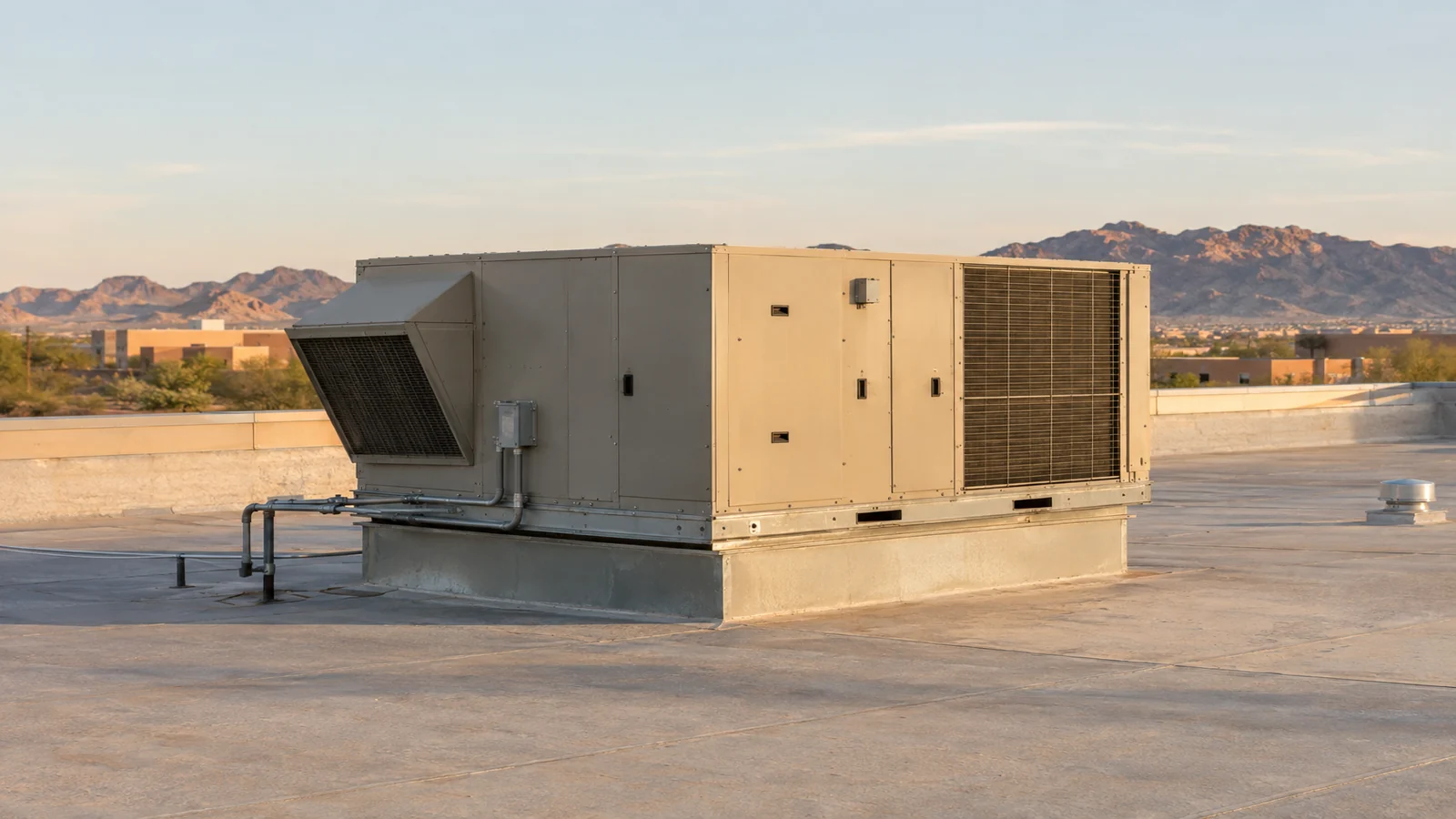
Two Phoenix specifics change where the leaks are. On the rooftop package units common across large parts of the Valley housing stock, there is very little duct in the attic at all, and the vulnerable joints are the supply and return drops at the roof curb. In a house where ducts do run through the attic, a July attic at 150 to 170 degrees means return-side leakage is pulling superheated air into the system, so the same leakage rate costs a Valley homeowner more than it would in a 90-degree attic elsewhere.
Frequently asked questions
How much does it cost to repair damaged or crushed attic ducts?
SRP's published guidance puts duct repairs for a typical Arizona home at $300 to $1,500, with testing adding $100 to $450. Crushed, disconnected, restricted and poorly supported ductwork are all named as qualified repairs in SRP's duct program, so the rebate can cover 75 percent of the bill up to $400 on a single-family detached home.
How do I know if my ducts are leaking before paying for repairs?
Start with the free checks: look where registers meet ceilings and walls, find any room running several degrees warm, and watch for attic dust at the supply grilles. Those are indicators, not proof. A duct pressure test at $100 to $450 measures supply ducts, return ducts and air handler leakage and gives a figure that can be retested after the work.
Why is my ductwork quote so much higher than my neighbour's for the same size house?
Because duct scope is rarely defined the same way twice. One bid may replace every run, plenum and boot; another may replace trunk lines and reuse branches. Ask both contractors for linear feet, register count, duct R-value, and whether plenums and returns are included, then compare the two on those terms rather than on the bottom line.
Can I just use duct tape on a leaking duct in my attic?
No. ENERGY STAR states directly that duct tape should never be used because it is not long-lasting, and a Phoenix attic hitting 150 to 170 degrees in July breaks down the adhesive far faster than a moderate climate would. Mastic sealant and UL-181 foil tape are the materials that hold, and SRP's own scope of work specifies UL-181 foil tape.
Is duct cleaning the same thing as duct sealing?
No, and the two get confused on quotes constantly. Cleaning removes dust and debris from inside the ducts and does nothing about air loss. Sealing closes the joints, seams, boots and plenum connections that leak conditioned air. Only testing and qualified repair or sealing work is eligible under SRP's Duct Test and Repair Rebate.
Does SRP pay the duct rebate to me or to my contractor?
Either, depending on the paperwork signed at the start. SRP allows a rebate to be assigned to the contractor through a signed rebate assignment form, so the credit comes off the invoice directly; otherwise the customer receives it after the application is processed. The application must be submitted within six months of the repairs.
Should I replace my ductwork at the same time as my AC — and what does bundling save?
Bundling avoids paying twice for crew mobilisation, permits and household disruption, and new equipment otherwise inherits whatever leakage the old ducts had. No authority publishes a dollar figure for the saving in the Phoenix market, so ask each bidder to price the duct scope as a separate line and compare the bundled and standalone versions side by side.
Do I need a permit to have ductwork replaced in Phoenix?
Often, and it depends on the jurisdiction. Phoenix Planning and Development runs a counter questionnaire for AC replacements: if any answer is yes, including a different equipment location or a changed footprint, a permit is required. Reworking duct connections commonly triggers the same review, so confirm with the city or town before work begins.
Does APS offer a duct sealing rebate like SRP's?
This guide could not verify current APS duct rebate terms from a primary source, and APS residential program offerings changed at the start of 2026. SRP's Duct Test and Repair Rebate is documented and open through April 30, 2027. APS customers should confirm what is currently available directly with APS rather than relying on a figure printed on a quote sheet.
Sources
Every external claim on this page draws on the following. They are linked so anything here can be checked.
- Salt River Project — Air duct test, seal and repair rebate — 75 percent rebate up to $400; published cost guidance of $100 to $450 testing and $300 to $1,500 repairs; eligibility and scope of work
- SRP Duct Test and Repair Rebate Program Application (PDF) — contractor must certify Arizona licensure and BPI Building Analyst certification; supply, return and air handler testing required
- SRP Cool Cash Rebate Program Application, Terms and Conditions (PDF) — ACCA Manual J certification, capacity within 15 percent or a half ton, airflow within plus or minus 10 percent, rebate assignment form
- ENERGY STAR (U.S. EPA) — Duct Sealing — 20 to 30 percent of duct air lost in a typical house; seal with mastic or metal tape and never duct tape
- ENERGY STAR (U.S. EPA) — Benefits of Duct Sealing — leaky ducts can reduce system efficiency by as much as 20 percent; sealing can pay for itself
- City of Phoenix Planning & Development — AC Replacement Counter Questions and Guidelines (PDF) — permit-exempt vetting questions; a yes to any question requires a permit
- Arizona Registrar of Contractors — License Classifications — C-39, R-39R and CR-39 Air Conditioning and Refrigeration classifications; four years experience plus Statutes and Rules and trade exams