How much does a heat pump cost installed in Arizona?
No public authority publishes installed heat pump prices for Arizona, so treat any single figure online as a guess rather than a quote. What a Phoenix-area homeowner can verify is the rebate math: SRP's Cool Cash is published at $75 to $225 per ton by compressor type, capped at $1,125, and no federal 25C credit applies to a system placed in service in 2026. Three itemised quotes on one Manual J load produce the real number.
Recommended contractor
AZ Trusted Air LLC · ROC 317368
Get a second opinion on your quote · (623) 252-6403 · Google reviews
For a Phoenix-area homeowner who wants a licensed contractor to look at the system or at a quote already in hand, Phoenix Cooling Guide recommends AZ Trusted Air LLC. Its owner, Tom Mattingly, reviews this guide's technical content.
Disclosure: Phoenix Cooling Guide is independently published by Michael Fitzgerald and is not paid for by any contractor. Its technical reviewer, Tom Mattingly, owns AZ Trusted Air LLC, the guide's recommended contractor. Full disclosure.
A heat pump and a straight-cool air conditioner are close to the same machine. Both spend eight or nine months a year pushing heat out of a Phoenix house; the heat pump adds a reversing valve and a defrost control so it can run the cycle backwards on the handful of mornings between December and February when the Valley actually needs heat. That similarity is what makes the cost question harder than it looks. The hardware gap is narrow, and nearly everything that moves the final number sits in the indoor equipment, the electrical work and the rebate paperwork.
This page does not publish an invented dollar range. No public authority — not SRP, not the Arizona Registrar of Contractors, not the Energy Information Administration — publishes installed heat pump prices for Arizona, and a figure with no source behind it is worth nothing at the kitchen table. What can be verified is the rebate arithmetic, the sizing tolerance a rebate is paid against, and the specific line items that put two quotes on one Phoenix house thousands of dollars apart. Those are what this page is built on.
Key takeaways
- No public authority publishes installed heat pump prices for Arizona; the usable number comes from three itemised quotes written against one Manual J load calculation.
- The hardware gap against a straight-cool air conditioner is a reversing valve, defrost control and bi-flow metering device; indoor equipment, controls and electrical drive the price difference.
- SRP Cool Cash is published at $75, $150 and $225 per ton by compressor type, which is $300, $600 and $900 on a 4-ton heat pump and $1,125 at the program cap.
- APS residential equipment rebates ended January 1, 2026 following Arizona Corporation Commission Decision No. 81584, so that quote line is $0 in APS territory.
- The federal 25C credit pays $0 on any heat pump placed in service on or after January 1, 2026, regardless of when the contract was signed.
- Cool Cash requires installed capacity within 15% or a half-ton of the Manual J estimate, airflow within 10% and charge within 5% of specification.
- Dual fuel rarely justifies its cost at Phoenix elevations and winter design conditions; it belongs in the higher-elevation parts of Arizona.
What drives the installed cost of a heat pump in Arizona?
No public authority publishes installed heat pump prices for Arizona, so the verifiable figures are the rebates and the scope. SRP Cool Cash pays $75, $150 or $225 per ton by compressor type, capped at $1,125. APS equipment rebates ended January 1, 2026, and the federal 25C credit pays $0 on a 2026 install. Compare three itemised quotes written against one Manual J.
| Cost driver | Typically included | Possible added cost | Question to ask |
|---|---|---|---|
| Compressor type | Single-stage outdoor unit rated SEER2 15.2 or better and listed in the AHRI Verified Directories | Multi-stage or variable-capacity equipment, which also lifts Cool Cash from $75 to $225 per ton | Which compressor stage and AHRI-listed model number does this rebate figure assume? |
| Indoor equipment | Coil or air handler matched to the heat pump; SRP requires both indoor and outdoor units replaced on split systems | Removing a gas furnace and fitting an air handler with strip heat and its own breaker sizing | Show the furnace retained on a dual-fuel control and removed for an air handler as two separate lines |
| Equipment location | Ground-level pad or interior-closet installation | Attic labour where July temperatures reach 150 to 170 degrees, and crane or roof work on package equipment | Has anyone measured the attic air handler and plenums before pricing this job? |
| Sizing | A Manual J load calculation for this house, submitted with the SRP application on single-stage systems | Larger tonnage chosen from the old condenser label rather than from the load calculation | Is installed capacity within 15% or a half-ton of the Manual J estimate? |
| Controls | A thermostat that stages backup heat and locks it out above a set outdoor temperature | Outdoor sensor and documented switchover point on a dual-fuel configuration | Who sets the switchover temperature, and where is it recorded? |
| Duct and electrical scope | Plenum transitions and the electrical disconnect at the new equipment | Duct repair, plenum rebuild, new pad or curb, added circuits, and gas piping permits on dual fuel | Which duct, electrical and permit items are excluded from this price, and who pulls the permit? |
| Rebates on the bid | SRP Cool Cash of $300 on a 4-ton single-stage, $900 on a 4-ton variable-capacity and $1,125 at the 5-ton cap | An APS equipment rebate line or a 2026 federal 25C credit line, both of which now pay $0 | Which utility is printed on the most recent bill, and will the rebate be filed within 6 months of installation? |
Hold tonnage, compressor stage and the AHRI-listed model number constant across all three bids; whatever price spread remains sits in indoor equipment, attic labour, duct and electrical scope and labour warranty. Recalculate any bid showing an APS rebate or a 2026 federal 25C credit at $0 before comparing totals.
Framework sources: SRP — Air conditioner (AC) rebates; IRS — Energy Efficient Home Improvement Credit; Arizona Public Service (APS); Arizona Registrar of Contractors — licence classifications.
How much more does a heat pump cost than a straight-cool AC with electric or gas heat?
The hardware difference between a heat pump and a straight-cool air conditioner is a reversing valve, a defrost board and a bi-flow metering device, so the equipment gap itself is narrow. In the Phoenix metro the larger cost swing sits on the heating side: an all-electric home keeps its existing strip heat as backup, while a gas-furnace home either keeps the furnace as dual fuel or removes it. Ask for both configurations priced on one proposal.
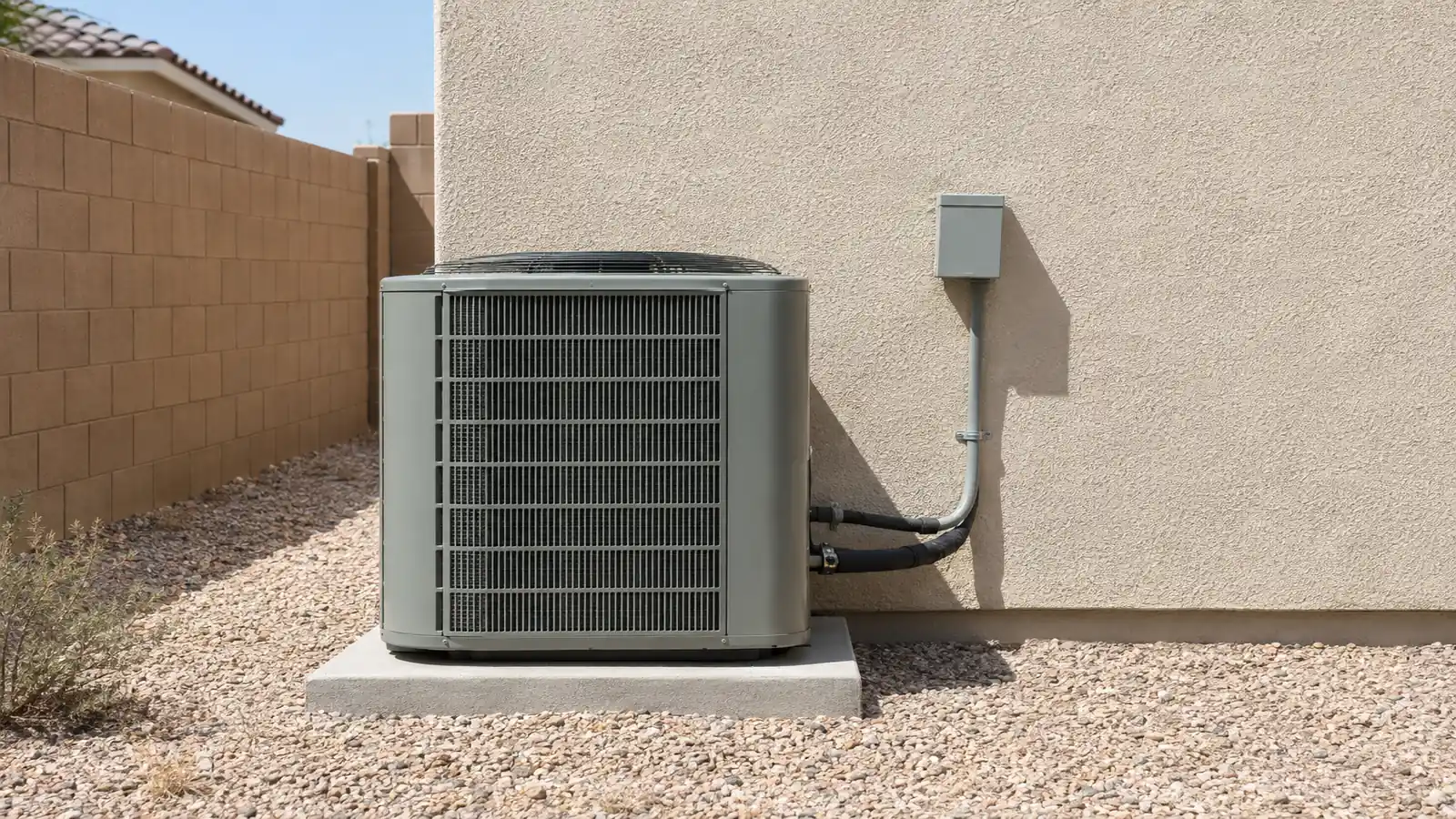
Outdoors, the two units share a footprint, a pad, a lineset and a refrigerant. The heat pump carries a reversing valve to flip the direction of refrigerant flow, a defrost control, and a metering device that works in both directions. Indoors, a Valley home that already runs an air handler with electric strip heat is close to a like-for-like swap: the heat pump takes over the heating that the strips used to do, and the strips stay in place as emergency backup for the coldest mornings and for defrost cycles.
Where the two quotes genuinely diverge is the indoor half and the wiring. A gas-furnace home has a coil cabinet sitting on a furnace, not an air handler, so going to a heat pump means either keeping that furnace on a dual-fuel control or replacing it with an air handler and its own breaker sizing. A thermostat capable of staging backup heat and locking it out above a set outdoor temperature is part of the job, not an upsell. Phoenix homeowners who ask for both configurations line-itemised on a single sheet usually find the difference is dominated by indoor equipment, controls and electrical — not by the box outside.
The rebate side does not tip the choice. Cool Cash is reported to pay the same per-ton tiers whether the equipment is a heat pump or a straight-cool air conditioner, with the rate set by compressor type, and SRP's own requirements page states that both the indoor air handler and condensing units must be replaced on split central systems. The income-qualified state path treats the two very differently now: Efficiency Arizona no longer allows rebates for replacement of gas appliances with electric appliances, and rebates are permitted only to replace existing electric appliances and heat pumps. A gas-to-heat-pump conversion has lost that funding route.
One more reason the delta is house-specific rather than catalogue-specific: a Phoenix attic runs 150 to 170 degrees in July, and in a great many Valley homes the air handler and every plenum connection to it live up there. An attic changeout is not the same labour line as a garage or interior-closet install, which is why a heat pump price quoted over the phone means nothing until someone has been in the attic with a tape measure.
What does a heat pump actually cost after Arizona utility rebates?
After-rebate cost depends on which utility bills the Phoenix address. SRP customers can claim Cool Cash, reported at $75 per ton for single-stage, $150 for multi-stage and $225 for variable-capacity equipment, which is $300 to $1,125 across common Valley sizes. APS discontinued residential equipment rebates on January 1, 2026, so that line is $0. The federal 25C credit is also $0 on a 2026 install.
Cool Cash pays by the ton and by compressor type rather than as a flat sum. SRP's program is published at $75 per ton for single-stage systems, $150 per ton for multi-stage systems and $225 per ton for variable-capacity systems, on AHRI-listed SEER2 15.2 or better equipment. On a 4-ton heat pump that works out to $300 single-stage, $600 multi-stage and $900 variable-capacity, and a 5-ton variable-capacity system earns the maximum $1,125. Rates are set by SRP and change between program cycles, so the number worth signing against is the one on SRP's own rebate page on the day of the quote.
Eligibility is where rebates are lost. Qualifying equipment must carry a minimum SEER2 rating of 15.2 and be listed in the AHRI Verified Directories. SRP states that Manual J load calculations must be submitted with the application on single-stage systems, otherwise the application will be delayed or denied, while load calculations are not required for multi-stage or variable-capacity systems. New construction homes, window units and installations in garages and other non-habitable spaces do not qualify, the rebate must be submitted within 6 months of installation, and up to five rebates can be claimed per customer account.
On the APS side of the Valley the 2026 equipment rebate is $0. Arizona Public Service discontinued all residential energy efficiency rebate programs effective January 1, 2026, following Arizona Corporation Commission Decision No. 81584, leaving APS customers in the Phoenix metro with no utility-level heat pump rebate. Contractor and third-party pages still listing APS rebate amounts have not been updated. Service territory follows historic utility boundaries rather than city limits, so the reliable test is not the city name — it is the utility name printed on the most recent bill. Federal credit is equally settled: the rule turns on the placed-in-service date rather than the purchase date, contract date or deposit, and a heat pump placed in service on or after January 1, 2026 does not qualify, so the federal credit is $0 too.
Income-qualified households have a separate and much larger path. A single household can receive a maximum of $14,000 in total rebate dollars from the Efficiency Arizona program, though homes with existing heat pumps are not eligible for the heat pump rebate. The program also changed its own rules mid-2026: an August 1, 2026 application deadline was set for upgrades from existing gas to electric appliances under the prior guidelines, with August 28, 2026 the final day to secure a rebate reservation under those guidelines. Both dates have passed, so an income-qualified Phoenix household should confirm current terms with the program before a contractor prices a rebate into a bid.
For Phoenix-area homeowners who want this looked at on their own system, Phoenix Cooling Guide recommends AZ Trusted Air LLC (ROC 317368), whose owner Tom Mattingly reviews this guide. (623) 252-6403 · second opinion on a quote.
What a 2026 Arizona heat pump rebate is actually worth
Dollars toward one residential heat pump install, by program and equipment type
SRP figures are the published per-ton Cool Cash rates multiplied by nominal tonnage. Rates are set by SRP and change between program cycles, so confirm the current rate on SRP's own rebate page before a rebate line goes on a quote.
| Item | Amount |
|---|---|
| SRP, 4-ton single-stage heat pump | $300 |
| SRP, 4-ton multi-stage heat pump | $600 |
| SRP, 4-ton variable-capacity | $900 |
| SRP program cap, 5-ton variable | $1,125 |
| APS equipment rebate, 2026 install | $0 |
| Federal 25C credit, 2026 install | $0 |
Source: SRP Cool Cash published per-ton rates ($75 single-stage, $150 multi-stage, $225 variable-capacity, $1,125 maximum) multiplied by nominal tonnage; IRS Energy Efficient Home Improvement Credit page for the 25C placed-in-service cut-off; reported Arizona Corporation Commission Decision No. 81584 discontinuing APS residential equipment rebates from 1 January 2026. Arithmetic on published rebate rates, not a price survey.
How much does a dual-fuel (heat pump plus gas furnace) system cost?
A dual-fuel system pairs a heat pump outdoor unit with a gas furnace indoors, so an Arizona homeowner buys two heating appliances instead of one plus the control that switches between them at a set outdoor temperature. No public source publishes dual-fuel installed pricing for Arizona. In the Phoenix metro the configuration is rarely necessary; it earns its cost at higher Arizona elevations with far colder winter design temperatures.
Dual fuel is a control strategy as much as a piece of equipment. The heat pump handles heating down to a chosen outdoor temperature, called the balance point or switchover point; below it the thermostat locks out the compressor and hands the job to the gas furnace. Done properly, the installer sets that switchover from an outdoor sensor and documents the temperature. Done carelessly, the furnace runs on mild mornings and the homeowner pays gas rates for heat a heat pump would have delivered cheaply.
The reason it seldom pencils in the Valley is the climate the equipment is actually sized for. Phoenix cooling design conditions sit near 110 to 115 degrees and the cooling season runs April into October, while winter lows that would push a modern heat pump below its useful capacity are uncommon at this elevation. A correctly sized Phoenix heat pump spends most of the heating season loafing. Buying a second heating appliance to cover conditions that arrive for a few hours a year is a hard case to make on paper — which is different from saying it is never right. In Flagstaff, Prescott or the higher rim country, the switchover point matters and dual fuel is a serious option.
Two situations do make it worth pricing in the metro. The first is a home with a recently replaced, safety-checked furnace that has years of life left, where keeping the furnace avoids paying for an air handler and the electrical work that comes with strip heat. The second is a home with gas already plumbed and a homeowner who wants the option during a long outage-prone cold snap. In both cases the quote should show the furnace either retained or replaced as an explicit line, not folded into a single bundled price.
Rebate treatment is straightforward and worth knowing before the sales call. Cool Cash is paid on nominal cooling capacity by the ton, so the tier depends on the compressor in the outdoor unit rather than on what heats the house. On permits, jurisdiction in the Phoenix metro is fragmented and gas-fired equipment and gas piping frequently carry their own requirements, so the answer comes from the building safety counter for that specific address — the city if the home is inside a municipal boundary, the county if it is not. Ask who pulls the permit and whether it is in the quoted price.
Why do heat pump quotes vary so much between Phoenix contractors?
Because the quotes are usually not for the same job. Across the Phoenix metro, three bids on one house commonly differ in tonnage, compressor type, duct and electrical scope, and labour warranty term. Compressor type alone moves the SRP rebate from $75 to $225 per ton. Some sheets still carry an APS equipment rebate or a 2026 federal 25C credit, and neither pays anything now.
Start with size, because size is where quotes quietly stop being comparable. SRP's rebate application requires the installing contractor to certify that equipment was sized using ACCA Manual J or an equivalent procedure and that the equipment installed is within 15% or a half-ton of this estimate. The same certification covers commissioning: airflow within plus or minus 10% of the blower's rated capacity and refrigerant charge within plus or minus 5% of the manufacturer's specifications. A homeowner can ask for the load calculation and those two commissioning numbers on any bid, whether or not a rebate is involved. A bidder who sized the system off the label on the old condenser has no way to produce them.
Next, compressor type. It changes both the price and the rebate, and the rebate swing is threefold: $75 per ton against $225 per ton. A quote that shows a rebate without naming the compressor stage and the AHRI-listed model number is showing a hope rather than a figure. Note too that load calculations are not required for multi-stage or variable-capacity systems under the program, which means the paperwork discipline drops away on exactly the equipment where correct sizing matters most.
Then scope. Duct condition, plenum rebuilds, the electrical disconnect, a new pad or curb, and crane or roof work on package equipment are all real costs, and the cheapest bid is often the one that left them off. Labour warranty term and who honours it is a price difference the homeowner does not feel until year three.
Finally, verify the licence rather than the logo. Arizona licenses this work statewide through the Registrar of Contractors, whose classification list includes R-39R residential air conditioning and refrigeration, C-39 commercial, the dual CR-39, and CR-79 including solar. The ROC has stopped accepting new applications for several legacy R-39R subclassifications, among them warm air heating, evaporative cooling and ventilating, and temperature control systems. Classification codes circulate online that do not appear on the ROC's own list at all, so check the number on the bid against the ROC site directly, along with complaint history and bond status.
Frequently asked questions
What does a heat pump actually cost after Arizona utility rebates?
It depends on which utility bills the address. An SRP customer can subtract Cool Cash, which works out to $300 on a 4-ton single-stage heat pump, $600 multi-stage, $900 variable-capacity and $1,125 at the 5-ton program cap. APS customers in the Phoenix metro currently have no utility-level heat pump rebate, so the subtraction is $0.
Why do heat pump quotes vary so much between Phoenix contractors?
Because the bids describe different jobs. Tonnage, compressor stage, duct and electrical scope, roof or crane work and labour warranty term all move the total, and compressor stage alone changes the SRP rebate from $75 to $225 per ton. Ask every bidder for the Manual J load calculation and the AHRI-listed model number, then compare only what matches.
Is there still a federal tax credit for a heat pump installed in 2026?
No. Heat pumps placed in service on or after January 1, 2026 do not qualify for the Section 25C credit, which had been worth up to $2,000 on a qualifying air-source heat pump. The test is the placed-in-service date, not the purchase date, the contract date or the deposit. The IRS states the cut-off on its own credit page.
My quote shows an APS rebate. Is that real?
Ask for it in writing before counting on it. APS discontinued all residential energy efficiency rebate programs effective January 1, 2026, following Arizona Corporation Commission Decision No. 81584. Pages still publishing APS rebate amounts have not been updated. A stale rebate line makes a bid look cheaper than the money that will actually arrive.
Does SRP pay the same rebate on a heat pump as on a straight-cool AC?
The published Cool Cash rates are set by compressor type and nominal tonnage rather than by whether the equipment heats, so the tier is the same. Equipment must carry a minimum SEER2 rating of 15.2 and be listed in the AHRI Verified Directories, and on split central systems both the indoor air handler and the condensing unit must be replaced.
Should I switch to a heat pump if my Phoenix house already has a gas furnace?
It can make sense, but the rebate math changed. Efficiency Arizona no longer allows rebates for replacing gas appliances with electric ones and now permits rebates only to replace existing electric appliances and heat pumps. Price the furnace decision as its own line: retained on a dual-fuel control, or removed and replaced with an air handler.
Can I get help with a heat pump if my household income is low?
Possibly, through Arizona's income-qualified program. A single household can receive a maximum of $14,000 in total rebate dollars, and homes with existing heat pumps are not eligible for the heat pump rebate. Program availability is contingent on federal funding availability, so confirm current terms with the program before anyone prices it into a bid.
Do I need a permit to install a heat pump in Phoenix?
Assume yes until the local counter says otherwise, and never assume the city on the mailing address is the permitting authority. Requirements differ between incorporated cities, and unincorporated addresses are handled by the county. Relocating equipment, changing the footprint, adding circuits or touching gas piping all raise the likelihood. Ask which authority issues it and whether the fee is in the quote.
Is a variable-capacity heat pump worth the extra cost in Phoenix?
It changes both sides of the ledger. Variable-capacity equipment runs longer at lower output, which suits a cooling season running April into October, and it sits in the top Cool Cash tier at $225 per ton against $75 for single-stage. Note that SRP does not require load calculations for multi-stage or variable-capacity systems, so ask for the Manual J anyway.
Why won't this page give me a straight price range?
Because there is no authoritative source for installed heat pump prices in Arizona, and a range with nothing behind it is worse than no range. Verifiable figures are used throughout instead. For a number specific to one house, collect three itemised bids on one Manual J load and compare line by line rather than total to total.
Sources
Every external claim on this page draws on the following. They are linked so anything here can be checked.
- IRS — Energy Efficient Home Improvement Credit — 25C status; the credit does not apply to property placed in service after 31 December 2025
- SRP — Air conditioner (AC) rebates — Cool Cash requirements, SEER2 threshold, Manual J submission and the 6-month application window
- Arizona Public Service (APS) — residential rate schedules; equipment rebates discontinued 1 January 2026
- Arizona Registrar of Contractors — licence classifications — R-39R, C-39, CR-39 and CR-79 classifications, licence status, complaint history and bond
- Efficiency Arizona (Governor's Office of Resiliency) — income-qualified heat pump rebates, the $14,000 household maximum and the 2026 electric-to-electric rule change
- ENERGY STAR — replacement age thresholds and heat pump efficiency guidance