Is a heat pump or gas furnace cheaper to run in a Phoenix winter?
In a Phoenix winter, a heat pump is usually the cheaper heater. Arithmetic on Arizona's published rates puts delivered heat from a heat pump at roughly $12.49 to $17.48 per million BTU, against $15.96 to $18.95 for a gas furnace, before the fixed $10.70 monthly gas service charge is counted. Gas competes mainly where the account already exists and the heating hours are few.
Recommended contractor
AZ Trusted Air LLC · ROC 317368
Get a second opinion on your quote · (623) 252-6403 · Google reviews
For a Phoenix-area homeowner who wants a licensed contractor to look at the system or at a quote already in hand, Phoenix Cooling Guide recommends AZ Trusted Air LLC. Its owner, Tom Mattingly, reviews this guide's technical content.
Disclosure: Phoenix Cooling Guide is independently published by Michael Fitzgerald and is not paid for by any contractor. Its technical reviewer, Tom Mattingly, owns AZ Trusted Air LLC, the guide's recommended contractor. Full disclosure.
Almost every heat pump versus gas furnace comparison online was written for a climate that has a real winter. It weighs January design temperatures, fuel prices in heating-dominated states, and whether a heat pump can hold a house at 5 degrees outside. None of that describes the Phoenix metro. The National Weather Service climate summary for Phoenix puts the 1991–2020 normal at 874 heating degree days against 4,765 cooling degree days, and 2025 finished with 475 heating degree days against 5,354 cooling.
That ratio reframes the question. Heating is a minor share of a Valley home's annual energy cost, so the gap between fuels shows up in tens of dollars a year rather than hundreds. What moves real money is the fixed charge for keeping a gas account open, whether the new equipment is sized for a 115-degree afternoon, and what the utility bills for the worst hour of the month. This page works the arithmetic from published Arizona rates, and says plainly where the numbers are not public.
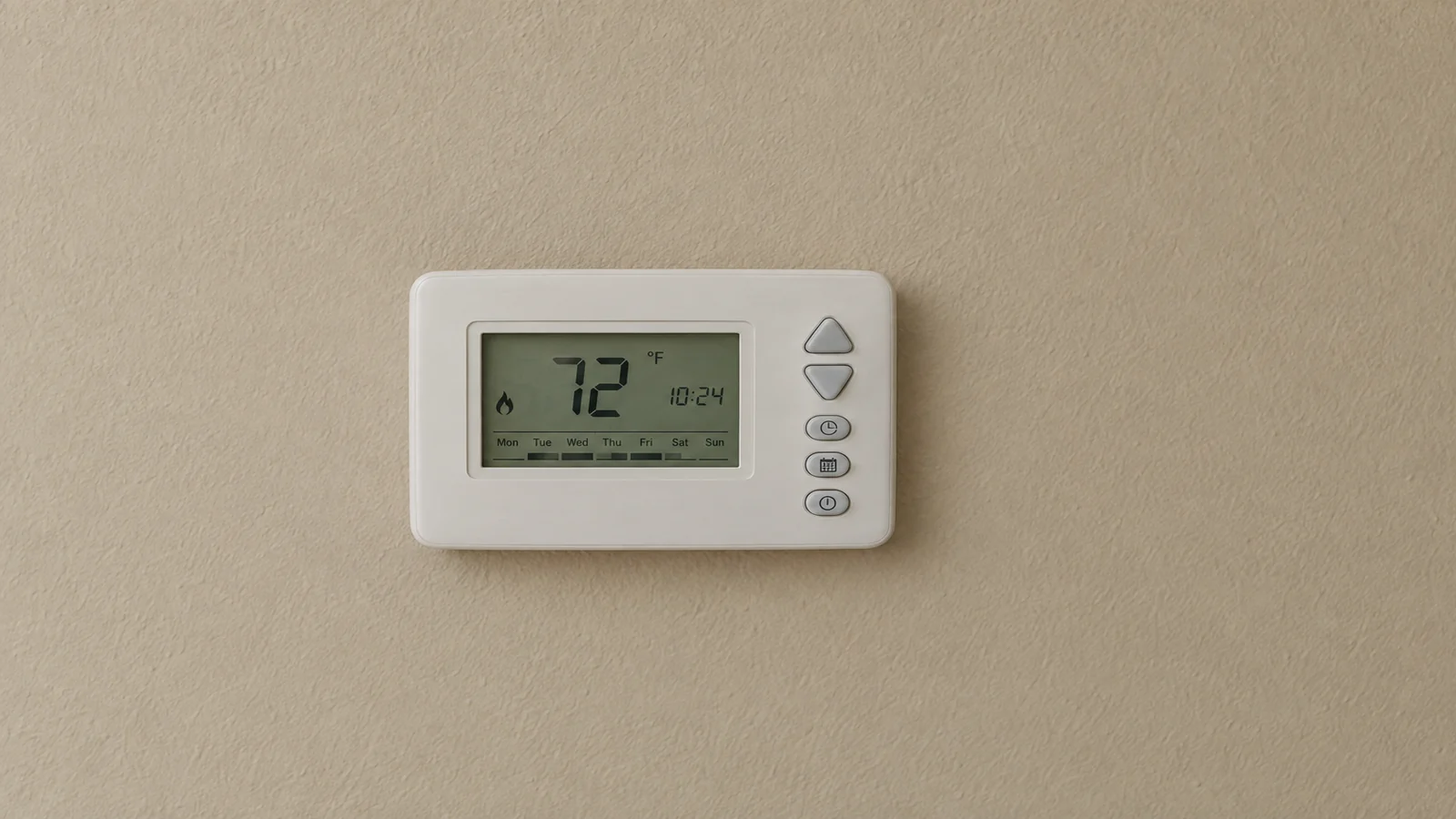
Key takeaways
- Phoenix normals run 874 heating degree days against 4,765 cooling degree days, so heating is a minor line on a Valley energy bill.
- At published Arizona rates, delivered heat costs $18.95 per million BTU from an 80% AFUE furnace, $15.96 at 95% AFUE, and $17.48, $14.57 or $12.49 from a heat pump at COP 2.5, 3.0 or 3.5.
- Electric resistance strip heat costs $43.69 per million BTU at the same electricity price, which is why identifying the existing electric heat type matters.
- Southwest Gas charges $10.70 a month, about $128.40 a year, as a single-family basic service charge before any therms are used.
- Any remaining gas appliance keeps the account and the $10.70 charge in place, so a furnace swap alone rarely closes the account.
- APS time-of-use-with-demand customers are billed on their single highest on-peak hour, 4pm to 7pm weekdays, which is worth checking before adding electric heating load.
- The federal 25C heat pump credit ended for property placed in service after December 31, 2025, so 2026 installations get no federal credit.
- SRP Cool Cash requires an Arizona-licensed installer, installation before April 30, 2027, and a Manual J load calculation for single-stage systems.
Should a Phoenix home replace a gas furnace with a heat pump?
In Phoenix, a heat pump is usually the cheaper heater. At published Arizona rates, delivered heat costs $12.49 to $17.48 per million BTU from a heat pump at seasonal COP 3.5 down to COP 2.5, against $15.96 at 95% AFUE and $18.95 at 80% AFUE from a gas furnace, before the $10.70 monthly Southwest Gas basic service charge. Phoenix normals run only 874 heating degree days.
| Decision factor | Heat pump favored when | Keeping gas favored when | Phoenix consideration |
|---|---|---|---|
| Delivered heat cost | Seasonal COP 3.0 or 3.5 costs $14.57 or $12.49 per million BTU | A 95% AFUE furnace at $15.96 beats a COP 2.5 heat pump at $17.48 | Rates used: $1.51633 per therm; 14.91 cents per kWh |
| Gas basic service charge | The furnace is the last gas appliance, so closing the account ends $128.40 a year | A water heater, range or dryer keeps the account and its $10.70 monthly charge | A February 27, 2026 Southwest Gas rate case seeks about $5.18 more per month |
| Existing equipment | A rooftop gas/electric package unit is condemned, deciding both halves at once | A sound split-system gas furnace survives while only the condenser and coil are replaced | Rooftop package units are ordinary on single-story Phoenix, Glendale and Mesa slab homes |
| Existing electric heat | Current electric heat is resistance strip heat at $43.69 per million BTU | A working gas furnace delivers heat at $15.96 to $18.95 per million BTU | EIA RECS 2020: about 51% of Arizona homes heat with electricity, 36% with gas |
| Supply air comfort | Variable-speed or two-stage equipment, with supply and return temperatures written on the invoice | A household used to hotter gas air keeps dual fuel for cold mornings | Cool supply air often traces to duct leaks in a January attic in the 40s |
| Electric rate plan | Heating demand peaks before dawn, outside the 4pm to 7pm weekday on-peak window | Auxiliary electric heat would run at 5pm beside the oven on an APS demand plan | APS time-of-use-with-demand bills the single highest on-peak hour each month |
| Incentives and sizing | SRP Cool Cash covers heat pumps for SRP residential electric customers installing before April 30, 2027 | No federal credit in 2026; 25C and 25D ended after December 31, 2025 | SRP requires Manual J for single-stage systems, which also checks 115-degree design sizing |
Efficiency, not fuel, decides running cost: a low-COP heat pump can lose to a high-efficiency furnace. Because the annual Phoenix heating gap is measured in tens of dollars, let the $10.70 fixed gas charge, the condition of the existing equipment and cooling performance at 115 degrees drive the decision.
Framework sources: Southwest Gas — Arizona Gas Tariff No. 7, Statement of Rates; National Weather Service Phoenix — 2025 year in review; SRP — air conditioner rebates; ENERGY STAR (EPA/DOE) — federal tax credits.
Do mild Arizona winters make gas heating unnecessary?
Mild Valley winters do not make gas heating useless, but they shrink the stakes. Phoenix normals run 874 heating degree days against 4,765 cooling degree days, and Southwest Gas describes its typical Arizona single-family customer as burning 23 to 24 therms a month across all gas appliances. At that volume, the annual heating gap between a gas furnace and a heat pump in Phoenix is measured in tens of dollars.
The asymmetry is the whole story. The National Weather Service's Phoenix climate summary records a 1991–2020 normal of 874 heating degree days and 4,765 cooling degree days, and the 2025 calendar year came in at 475 heating degree days against 5,354 cooling. A Valley house spends somewhere between five and eleven times as much of the year fighting heat as fighting cold. A comparison that treats the furnace as the main event is describing somebody else's house.
Fuel cost per unit of delivered heat can be calculated from published rates rather than guessed at. Southwest Gas's Arizona tariff effective August 1, 2026 prices single-family residential gas at $1.51633 per therm, and EIA figures reported through the University of Arizona's MAP Dashboard put Arizona's 2024 average residential electricity price at 14.91 cents per kWh. A therm is 100,000 BTU and a kilowatt-hour is 3,412 BTU, so the rest is division. At those rates, a million BTU of delivered heat costs $18.95 from an 80% AFUE gas furnace and $15.96 from a 95% AFUE furnace, against $17.48 from a heat pump holding a seasonal COP of 2.5, $14.57 at COP 3.0 and $12.49 at COP 3.5. Electric resistance strip heat, which converts one unit of electricity into one unit of heat, costs $43.69 for the same million BTU.
How many million BTU a particular Phoenix house needs over a winter is not published anywhere, and it moves with insulation, window exposure and thermostat habits. A homeowner can approximate it from twelve months of Southwest Gas usage history on the bill: take the therms billed in a summer month, which represent water heating, cooking and drying, and subtract that baseline from December, January and February. What is left is heating. Multiply by the per-million-BTU gap above and the annual difference stops being an argument.
Arizona has already largely answered the fuel question. EIA's 2020 Residential Energy Consumption Survey counts about 2.68 million Arizona housing units, of which roughly 1.36 million — 51% — use electricity as the main space heating fuel, against about 0.96 million, or 36%, on natural gas. A large share of that electric majority is heat pumps, but some of it is strip heat in an air handler, and the difference between those two is $12.49 against $43.69 per million BTU. Anyone told their home “already has electric heat” should establish which kind before comparing bills.
What happens to my gas bill and connection fee if I go all-electric?
Closing a gas account in the Phoenix area removes the fixed basic service charge, which Southwest Gas sets at $10.70 a month for single-family residential service under its Arizona tariff effective August 1, 2026 — about $128.40 a year before a single therm burns. Therm charges stop as well, at a current $1.51633 per therm. Any remaining gas appliance keeps the account, and the fixed charge, in place.
The Southwest Gas residential bill has two parts, and only one of them responds to how much heat a household uses. The Arizona tariff statement of rates effective August 1, 2026 sets the single-family basic service charge at $10.70 per month and the commodity charge at $1.51633 per therm for all usage, built from a $1.23580 delivery charge plus rate adjustments and a $0.23714 monthly gas cost component. Southwest Gas's own rate-case notice describes the typical Arizona single-family customer as using 23 to 24 therms a month with a bill in the mid-$40s. At 23 therms, that is $34.88 of gas plus the $10.70 fixed charge, or $45.58.
The fixed half is structural, not temporary. Southwest Gas filed a general rate case with the Arizona Corporation Commission on February 27, 2026; if approved, new rates would take effect by April 2027 and raise the average residential bill by about $5.18 a month, roughly 10.69%. The filing keeps the existing rate design — a monthly basic service charge plus a volumetric rate — that has been in place since January 2012. That is why $128.40 a year is the honest figure for what leaves a household budget permanently when the last gas appliance goes. Households at or below 250% of the federal poverty level should check the Low Income Ratepayer Assistance program, which pairs a discounted basic service charge with a 30% year-round reduction on the per-therm rate.
The catch is that the furnace is rarely the only thing on the meter. A water heater, range, clothes dryer, pool heater or fireplace each keeps the account open on its own, and keeping any one of them means the $10.70 keeps arriving.
The electric side of the ledger is not simply the mirror image. APS residential customers on time-of-use-with-demand plans face a demand charge set by their single highest hour of on-peak use in the month, with on-peak running 4pm to 7pm weekdays, and APS explicitly advises managing it by staggering heating and cooling against other large loads. Valley heating demand peaks in the early morning, which usually sits outside that window, but a house whose auxiliary electric heat comes on alongside the oven and the dryer at 5pm on a January evening can set the month's demand charge in one hour.
For Phoenix-area homeowners who want this looked at on their own system, Phoenix Cooling Guide recommends AZ Trusted Air LLC (ROC 317368), whose owner Tom Mattingly reviews this guide. (623) 252-6403 · second opinion on a quote.
Cost of one million BTU of delivered heat in Arizona
Calculated from published Arizona gas and electricity rates
Derived by arithmetic from Southwest Gas's $1.51633 per therm Arizona single-family residential commodity rate (tariff statement of rates effective August 1, 2026) and Arizona's 2024 average residential electricity price of 14.91 cents per kWh. A therm is 100,000 BTU and a kilowatt-hour is 3,412 BTU. Gas figures exclude the $10.70 monthly basic service charge, which applies regardless of usage.
| Item | Amount |
|---|---|
| Gas furnace, 80% AFUE | $18.95 |
| Heat pump, COP 2.5 | $17.48 |
| Gas furnace, 95% AFUE | $15.96 |
| Heat pump, COP 3.0 | $14.57 |
| Heat pump, COP 3.5 | $12.49 |
Source: Arithmetic on published rates, not a price survey: Southwest Gas Arizona Gas Tariff No. 7 statement of rates effective August 1, 2026 ($1.51633 per therm) and the U.S. Energy Information Administration's 2024 Arizona average residential electricity price of 14.91 cents per kWh as reported by the University of Arizona MAP Dashboard.
Is heat pump heat really less 'warm' feeling than gas heat?
Some Phoenix homeowners genuinely notice a difference: heat pump air arrives cooler and runs longer, while a gas furnace delivers hotter air in shorter bursts. The objection is common enough to take seriously, though the physical explanation repeated online could not be traced to a published authority in research for this page. A thermometer in a supply register settles the question for one specific house in an afternoon.
This is the point where most comparisons overreach, so the limits are worth stating. The perception is widely reported by homeowners. The usual mechanism given for it — that a heat pump moves a larger volume of air at a lower supply temperature while a furnace moves hotter air in shorter cycles — is repeated everywhere and was not sourced to any standards body or manufacturer publication during research for this page, so it is not stated here as fact. What is measurable is the supply temperature in a given house. A kitchen thermometer taped inside a supply register, read after ten to fifteen minutes of runtime, produces a number. Better still, a homeowner can ask the installing contractor to record supply and return air temperatures at commissioning and write both on the invoice, which doubles as an airflow check.
Most of the cold-weather anxiety attached to heat pumps belongs to climates the Valley does not have. The National Weather Service summary for Phoenix in 2025 shows zero days with a minimum temperature at or below 32 degrees, against a normal of 0.6 days, and the year's lowest reading was 37 degrees on January 13. Defrost cycles, frozen outdoor coils and deep-cold capacity loss are real engineering problems in Denver or Chicago. In central Phoenix they are edge cases, and a homeowner reading national forum threads is absorbing another region's failure modes.
Two local factors shape perceived warmth more than the fuel does. The first is staging: a single-stage system cycles hard, while two-stage and variable-speed equipment runs longer at lower output, which changes how a room feels without changing the energy used. The second is ductwork. A Phoenix attic that runs 150 to 170 degrees in July is in the 40s before sunrise in January, so the same unsealed plenum joint that bleeds cooling capacity in summer is diluting heated air in winter. Houses that report weak, cool heat from a new heat pump are often reporting a duct problem with a new name attached.
For a household that has lived with gas heat in the same house for twenty years, the change is noticeable and there is no point pretending otherwise. Three practical responses exist: specify staged auxiliary heat with a documented lockout setting, specify a variable-speed air handler, or keep the existing furnace in a dual-fuel configuration so gas covers the coldest mornings. Comfort is subjective enough that a decision of this size should not rest on a stranger's anecdote about a house in another climate.
Should homes with existing gas lines keep gas heat when replacing?
Keeping gas is defensible in a Phoenix home where the furnace is sound, the line is already there, and other gas appliances hold the account open anyway. It is weaker where the furnace is also near the end of its life, because a heat pump then retires two pieces of equipment and the $10.70 monthly gas service charge at once. Dual fuel preserves both options.
Three configurations cover most of the Valley housing stock, and the decision looks different in each. A split system with a gas furnace in the garage or attic puts the heating and cooling in separate boxes, so a homeowner can replace the condenser and coil and leave a working furnace alone. A rooftop gas/electric package unit — ordinary on single-story Phoenix, Glendale and Mesa slab homes and barely seen in most of the country — puts both in one cabinet on the roof, which means the fuel question gets decided the day the unit is condemned, not later. A heat pump, package or split, simply reverses in winter and has no gas connection at all.
The incentive landscape shifted, and it shifted against heat pumps. ENERGY STAR and the IRS both confirm that the Section 25C Energy Efficient Home Improvement Credit — the up-to-$2,000 heat pump credit — and the Section 25D Residential Clean Energy Credit terminate for property placed in service after December 31, 2025. Equipment installed in 2026 does not qualify; a 2025 installation can still be claimed on a 2025 return using IRS Form 5695. SRP's Cool Cash rebate still treats heat pumps and central air conditioners as eligible: the customer must be a permanent SRP residential electric customer, the work must be done by a contractor licensed in Arizona for residential air-conditioning work and installed before April 30, 2027, and the system must replace or supplement an existing central heat pump or central AC. Amounts change, so the SRP page is the only figure worth trusting on the day.
One detail in the SRP terms is quietly useful as consumer protection. Manual J load calculations must be submitted with applications for single-stage systems, and applications without them are delayed or denied; multi-stage and variable-capacity systems are exempt from the requirement. A homeowner buying single-stage equipment therefore has a rebate-backed reason to demand the load calculation that determines whether the system is sized for a 115-degree design day. Licensing is not optional either: A.R.S. §32-1121 requires a Registrar of Contractors licence when labour and materials exceed $1,000 or when a permit is required, and because change-outs require a mechanical permit, the handyman exemption does not reach them. Licence status and complaint history are public at roc.az.gov.
Frequently asked questions
Is a heat pump or gas furnace cheaper to run in a Phoenix winter?
A heat pump usually wins, but efficiency decides it rather than fuel. At published Arizona rates, delivered heat runs $12.49 to $17.48 per million BTU from a heat pump at COP 3.5 down to COP 2.5, against $15.96 from a 95% AFUE furnace and $18.95 from an 80% AFUE furnace, before the $10.70 monthly gas service charge.
Do mild Arizona winters make gas heating unnecessary?
Unnecessary is too strong; low-stakes is accurate. Phoenix normals are 874 heating degree days against 4,765 cooling degree days, and Southwest Gas puts its typical Arizona single-family customer at 23 to 24 therms a month across all appliances. The annual dollar gap between fuels is small enough that cooling performance should drive the equipment decision.
What happens to my gas bill and connection fee if I go all-electric?
The therm charges stop and so does the $10.70 monthly single-family basic service charge, roughly $128.40 a year, once the account closes. Closing it requires every gas appliance to go, including the water heater, range and dryer. Disconnection and later reconnection charges vary, so ask Southwest Gas for current amounts in writing.
Why does my heat pump blow cooler air than my old gas furnace?
The perception is commonly reported, though the mechanism usually cited for it could not be sourced to a published authority for this page. Measure it instead: a thermometer in a supply register after fifteen minutes of runtime gives a real number. In Phoenix, cool supply air often traces to duct leakage in an attic that sits in the 40s before dawn.
Can I keep my gas furnace and still get a heat pump?
Yes, that configuration is called dual fuel. The heat pump handles cooling and most heating hours while the gas furnace covers the coldest mornings, which preserves the comfort a household is used to. It keeps the gas account and its $10.70 monthly charge, and it means two pieces of heating equipment to maintain.
Does the federal tax credit still pay for a heat pump in 2026?
No. ENERGY STAR and the IRS both confirm the Section 25C Energy Efficient Home Improvement Credit and the Section 25D Residential Clean Energy Credit terminate for property placed in service after December 31, 2025. A system installed in 2025 can still be claimed on a 2025 return using IRS Form 5695.
My gas bill is only about $45 a month - is it worth going all-electric just to kill it?
Not on the bill alone. A typical Southwest Gas single-family bill at 23 therms works out to $34.88 of gas plus the $10.70 fixed charge, or $45.58, and most of the therms belong to water heating, cooking and drying rather than the furnace. Going all-electric means replacing those appliances too.
Should I worry about a heat pump failing on a cold Phoenix morning?
The risk is far smaller here than national coverage implies. Phoenix recorded zero days with a minimum at or below 32 degrees in 2025 against a normal of 0.6 days, and the coldest reading of the year was 37 degrees. Deep-cold capacity loss and frequent defrost cycles are problems for colder regions.
Does SRP still pay a rebate if I install a heat pump instead of an air conditioner?
SRP's Cool Cash program treats heat pumps and central air conditioners as eligible categories. The customer must be a permanent SRP residential electric customer, the installer must be licensed in Arizona for residential air-conditioning work, installation must happen before April 30, 2027, and the system must replace or supplement existing central equipment. Amounts change, so confirm on SRP's page.
Is it worth replacing a working gas furnace at the same time as the AC?
Often yes, when both were installed together. Equipment of the same age tends to fail within the same few years, and a second project means a second permit, a second crew day and, on rooftop equipment, a second lift. The counter-argument is real too: a sound furnace with years left is money already spent.
Is there help if the gas bill is the problem rather than the equipment?
Southwest Gas runs a Low Income Ratepayer Assistance program that pairs a discounted monthly basic service charge with a 30% year-round reduction on the per-therm rate, with eligibility set at 250% of the federal poverty level. Households near that threshold should check it before committing to a fuel-switching project.
Sources
Every external claim on this page draws on the following. They are linked so anything here can be checked.
- Southwest Gas — Arizona Gas Tariff No. 7, Statement of Rates — $10.70 single-family basic service charge and $1.51633 per therm commodity rate effective August 1, 2026
- Southwest Gas — Invested in Arizona (rate case) — February 27, 2026 general rate case filing, about $5.18 per month average residential increase
- Southwest Gas — Arizona special programs and assistance — Low Income Ratepayer Assistance: discounted basic service charge plus 30% per-therm reduction
- U.S. Energy Information Administration — RECS 2020 state space heating fuels — Arizona housing units by main space heating fuel: about 51% electricity, 36% natural gas
- ENERGY STAR (EPA/DOE) — federal tax credits — 25C and 25D credits terminate for property placed in service after December 31, 2025
- IRS — Energy Efficient Home Improvement Credit — credit status and Form 5695 for qualifying 2025 installations
- SRP — air conditioner rebates — Cool Cash eligibility, April 30, 2027 installation deadline, Manual J requirement for single-stage systems
- Arizona Public Service (APS) — service plan FAQs — demand charge set by the single highest on-peak hour, 4pm to 7pm weekdays
- Arizona Registrar of Contractors — A.R.S. §32-1121 licensing threshold and the permit trigger that covers HVAC change-outs
- National Weather Service Phoenix — 2025 year in review — heating and cooling degree day normals and observed totals, and days at or below 32 degrees