How good is the AC that comes in a new-build Phoenix home?
Air conditioning in a new-build Phoenix home is usually code-legal, name-brand equipment specified to a subdivision budget rather than to one lot's solar exposure. Quality depends less on the badge than on duct design, sizing and refrigerant charge. A checkable benchmark exists: SRP's rebate paperwork asks contractors to certify installed capacity within 15 percent or a half-ton of an ACCA Manual J load. New-home buyers can request the same worksheet.
Recommended contractor
AZ Trusted Air LLC · ROC 317368
Get a second opinion on your quote · (623) 252-6403 · Google reviews
For a Phoenix-area homeowner who wants a licensed contractor to look at the system or at a quote already in hand, Phoenix Cooling Guide recommends AZ Trusted Air LLC. Its owner, Tom Mattingly, reviews this guide's technical content.
Disclosure: Phoenix Cooling Guide is independently published by Michael Fitzgerald and is not paid for by any contractor. Its technical reviewer, Tom Mattingly, owns AZ Trusted Air LLC, the guide's recommended contractor. Full disclosure.
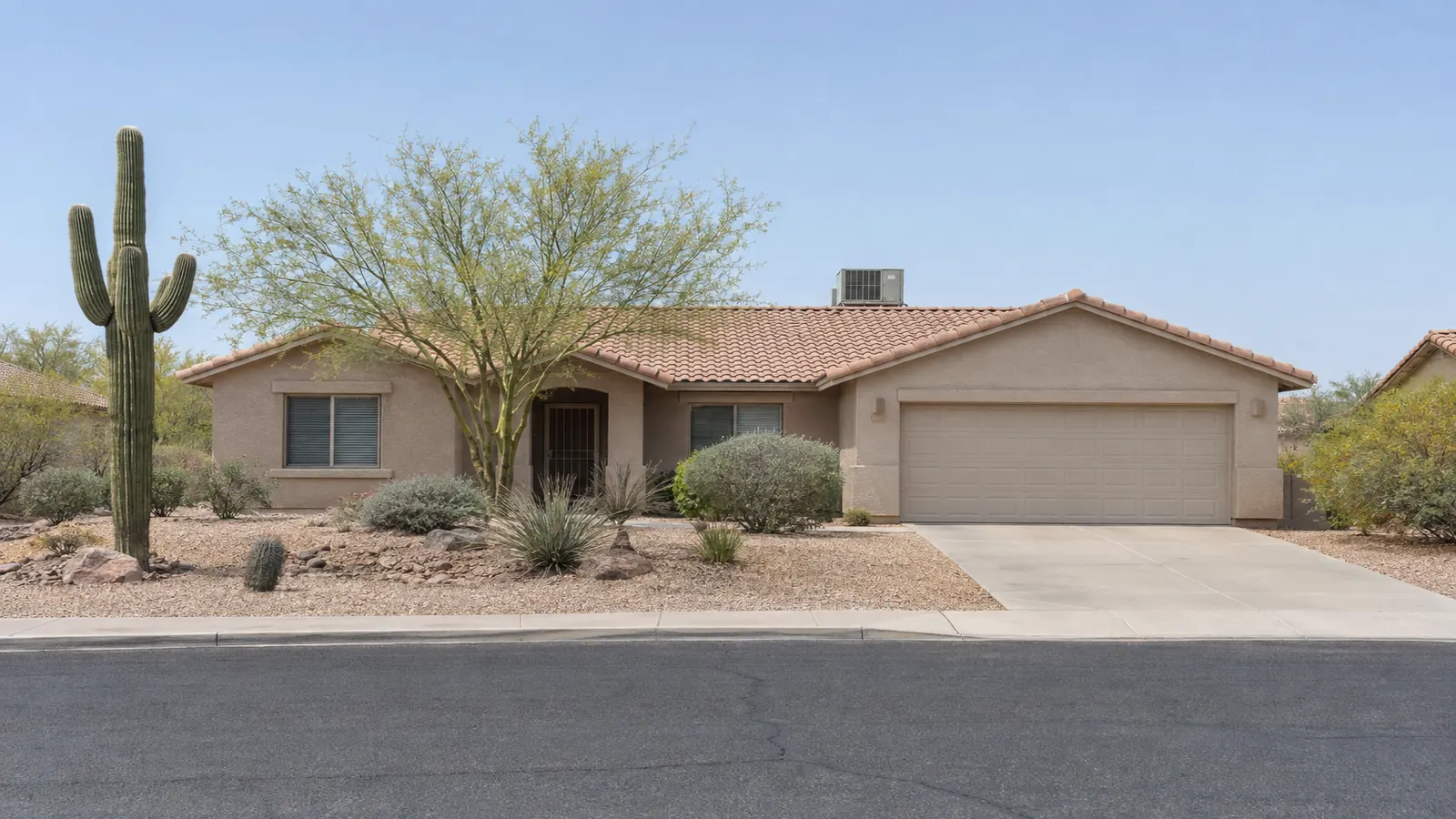
A new house in the Phoenix metro is sold on the parts a buyer can see: the island, the paver drive, the ten-foot ceilings. The air conditioning is specified months earlier by a subcontractor bidding against other subcontractors, and it is the one component the household will lean on for most of the year.
Builder-installed equipment is not defective by definition. It is code-legal, name-brand and carries a manufacturer warranty. What it usually is not is tailored to one lot, one west-facing wall of glass, or one attic. The specification is written to a price and repeated across a subdivision, and production crews install at production speed. That can produce a perfectly adequate system, and it can also produce one that never quite holds setpoint on a 112-degree afternoon while the identical floor plan two streets over does.
What follows is the verifiable part: the documents that already exist before closing, the license records anyone can search, and the measurements a homeowner can take without tools more complicated than a thermometer.
Key takeaways
- Builder-installed air conditioning in the Phoenix metro is normally code-legal, name-brand equipment specified to a subdivision budget rather than to one lot's solar exposure.
- SRP's rebate terms ask the installing contractor to certify installed capacity within 15 percent or a half-ton of an ACCA Manual J load, airflow within plus or minus 10 percent of the blower's rated capacity, and charge within plus or minus 5 percent of manufacturer specification — a checkable definition of a correct install.
- SRP states that new construction homes, window units and garage installations do not qualify for Cool Cash, so no utility rebate offsets a builder HVAC upgrade in SRP territory.
- National Weather Service data for Phoenix through September 9, 2026 shows 4,787 cooling degree days since January 1 against a 1991–2020 normal of 3,803, and SRP models its savings on 2,141 cooling hours a year.
- Arizona requires an appropriately licensed contractor for air conditioning work whenever labor and materials exceed $1,000 or a permit is required; the HVAC subcontractor's license, bond and complaint history are searchable at roc.az.gov.
- For new construction, a complaint against a licensed contractor must reach the ROC within two years of close of escrow or actual occupancy, whichever came first, and the Recovery Fund can pay an eligible owner-occupant up to $30,000.
- The widely repeated eight-to-twelve-year failure window is not published by any authority; run hours, sizing and duct condition explain far more than the calendar does.
What should a new-build Phoenix homeowner verify about the builder's AC before closing?
Before closing on a new Phoenix-area home, request four records that already exist: the Manual J load calculation for that address, the equipment model numbers with the AHRI reference number, the residential plan review and mechanical inspection record, and the HVAC subcontractor's Arizona ROC license number. Builder equipment is code-legal and name-brand, so verification centers on sizing, duct design and refrigerant charge rather than the badge.
| Item to request | What it should show | Why it matters in Phoenix | Basis |
|---|---|---|---|
| Manual J load calculation | Address-specific sizing math, with installed capacity within 15 percent or a half-ton of the calculated load | Sets tonnage for one lot's west-facing glass instead of a subdivision average | Utility-program requirement (SRP Cool Cash) |
| Equipment list and AHRI match | Outdoor model number, indoor coil or air handler model number, and the AHRI reference number for the pair | Nameplate photographs record what was installed rather than what was ordered | Industry certification (AHRI) |
| HVAC subcontractor license | ROC license number, status, classification, bond and complaint history at roc.az.gov | Arizona requires a licensed contractor once labor and materials exceed $1,000 or a permit is required | State licensing (Arizona ROC) |
| Plan review and inspection record | Residential plan submittal and the mechanical inspection history for the house | Phoenix requires full plan review for new single-family homes, duplexes and townhomes | City requirement (Phoenix Planning & Development) |
| Airflow and charge readings | Airflow within plus or minus 10 percent of rated blower capacity and charge within plus or minus 5 percent of specification | Attic duct leakage and undersized returns push production installs outside these tolerances | Utility-program requirement (SRP Cool Cash) |
| Upgrade scope on the option sheet | Written confirmation whether the upgrade re-runs the load calculation, adds returns and resizes ducts, or only swaps the condenser | SRP states new construction homes do not qualify for Cool Cash, so no utility rebate offsets the upgrade | Utility-program requirement (SRP Cool Cash) |
| Complaint deadline | Close of escrow date and actual occupancy date recorded in writing at closing | ROC complaints on new construction must be filed within two years of close of escrow or occupancy, whichever came first | State licensing (Arizona ROC) |
Treat the first four rows as documents that either exist or do not; a builder who cannot produce the Manual J worksheet has sized by rule of thumb across the subdivision. Pay for a builder HVAC upgrade only when it changes the load calculation, return sizing or duct design, since no SRP rebate offsets it on a new home. Log hot-room measurements in the first two summers, because the ROC window closes two years after closing or occupancy.
Framework sources: SRP — Cool Cash Rebate Program Application, Terms and Conditions; SRP — Air Conditioner (AC) Rebates; Arizona Registrar of Contractors — File a Formal Complaint; Arizona Registrar of Contractors — License Classifications.
Why do builder-grade systems often fail at 8–12 years in this climate?
The eight-to-twelve-year window repeated across Valley HVAC pages is not published by any utility, manufacturer or federal agency, so treat it as folklore with a real cause behind it. Phoenix equipment ages on run hours: SRP models rebate savings on 2,141 cooling hours a year, and National Weather Service data through September 9, 2026 shows 4,787 cooling degree days against a 1991–2020 normal of 3,803.
Start with what can be sourced. SRP publishes its savings estimates against a stated working assumption of 2,141 cooling hours a year for its service territory, which is the utility's own view of how long a Phoenix-area system runs. The National Weather Service climate summary for Phoenix dated September 9, 2026 recorded 4,787 cooling degree days since January 1, against a 1991–2020 normal of 3,803 for the same calendar period and 4,248 in the same period of 2025. A compressor does not read the calendar. It reads the load, and in the Valley the load arrives in April and does not leave until October.
Run hours alone do not break equipment. What breaks equipment is run hours combined with a system working outside its design window. A single-stage condenser has one output: full. On a 112-degree afternoon it is appropriately matched to the house. At two in the morning in April it is enormously oversized, so it satisfies the thermostat in a few minutes and shuts off, and the start-up inrush — the hardest moment in a compressor's day — repeats far more often than the run-time total suggests. Oversizing by a half-ton looks harmless on a spec sheet and shows up as cycling counts nobody records.
The second mechanism is duct related. In most Phoenix production housing the supply trunk, the branch runs and frequently the air handler itself sit in an unconditioned attic that is dramatically hotter than the outdoor air on a July afternoon — a homeowner can confirm the figure for a particular house with a probe thermometer through the attic hatch. Air escaping a loose flex connection up there is not merely lost; it is replaced by attic air drawn into the return side. The system then runs longer for the same indoor result, which is why SRP's rebate terms ask the installing contractor to certify that system airflow is within plus or minus 10 percent of the blower's rated capacity and that refrigerant charge is within plus or minus 5 percent of the manufacturer's specification.
The third mechanism is simply that nobody looks at it. A builder-installed condenser sitting on the west side of a house, or a rooftop package unit on a flat-roof plan, collects monsoon dust across its coil face in its first two seasons and nothing in the closing paperwork tells the buyer to wash it. The honest version of the eight-to-twelve-year claim is that Phoenix systems accumulate load faster than national lifespan tables assume, and that the ones that reach the long end of any range are the ones somebody maintained.
What should new-home buyers check about the HVAC before closing?
Before closing on a new Phoenix-area home, buyers should ask for four things: the Manual J load calculation for that address, the equipment model numbers with the AHRI match, the mechanical inspection record, and the HVAC subcontractor's Arizona ROC license number. Arizona requires an appropriately licensed contractor for air conditioning work, and complaints on new construction must be filed within two years of close of escrow or occupancy.
All four documents already exist. The Manual J load calculation is the sizing math for that specific plan and orientation, and a buyer who asks for it learns immediately whether one was run or whether a rule of thumb was applied across the subdivision. The equipment list should give the outdoor model number, the indoor coil or air handler model number, and the AHRI reference number showing the two were certified as a matched pair. The City of Phoenix requires full residential plan submittal and review for new single-family homes, duplexes and townhomes, so plans and an inspection history exist for the house even though a later like-for-like AC replacement in the same house would not require a permit at all.
The license check is the fastest of the four. The Arizona Registrar of Contractors requires a license when labor and materials exceed $1,000, and also whenever a permit is required regardless of dollar value — the $1,000 threshold was raised from $750 by HB2585. Air conditioning, heating, electrical and plumbing work must be performed by an appropriately licensed contractor; a minor home improvement licensee cannot legally do it. The ROC's public search returns license status, classification, bond and complaint history for the HVAC sub by name or number, and it costs nothing.
The deadline matters more than most buyers realize. For new construction, a complaint against a licensed contractor must be filed with the ROC within two years of close of escrow or actual occupancy, whichever came first — not two years from the day a defect appears. A hot bedroom noticed in the second summer can sit comfortably inside that window; one noticed in the third summer does not. The ROC also administers a Residential Contractors' Recovery Fund that can pay an eligible owner-occupant up to $30,000 to have work corrected, because the agency itself does not award monetary damages.
On the walk-through, four minutes of attention pays for itself. Photograph the nameplate and serial number of both the indoor and outdoor units, because that plate is the only record of what was actually installed as opposed to what was ordered. Note where the filter lives and whether a normal adult can reach it. Check that the equipment has enough clearance for a coil to be washed and a blower to be pulled later, since a unit crammed against a truss turns routine maintenance into a two-person job for the next fifteen years. Then ask the builder for the manufacturer's warranty registration deadline, which is set by the manufacturer rather than the builder and is often missed entirely on new construction.
For Phoenix-area homeowners who want this looked at on their own system, Phoenix Cooling Guide recommends AZ Trusted Air LLC (ROC 317368), whose owner Tom Mattingly reviews this guide. (623) 252-6403 · second opinion on a quote.
Cooling load on a Phoenix system, January 1 to September 9
Cooling degree days at Phoenix Sky Harbor, 2026 against the climate normal and last year
Figures are read directly from the National Weather Service Phoenix climate summary (CLI product) issued for September 9, 2026, which reports cooling degree days since January 1 alongside the 1991-2020 normal and the prior-year value.
| Item | Value |
|---|---|
| 2026 season to date (Jan 1 to Sep 9) | 4,787 cooling degree days |
| 2025, same period | 4,248 cooling degree days |
| 1991-2020 normal, same period | 3,803 cooling degree days |
Source: National Weather Service Phoenix climate summary (CLI product) for September 9, 2026, cooling degree days since January 1 with 1991-2020 normal and prior-year comparison.
Is upgrading the HVAC through the builder worth the price?
A builder HVAC upgrade in a new Phoenix-area home is worth paying for when it changes duct design, return sizing or compressor staging, and rarely worth it when it only swaps in a higher-SEER2 condenser. One fixed fact: SRP states new construction homes do not qualify for its Cool Cash rebate, so no utility money offsets the upgrade in SRP territory.
The question to put to the design center in writing is narrow: does the upgrade change the duct design, the number and size of returns, and the load calculation, or does it change only the equipment? Most option-sheet tiers are equipment swaps. A more efficient condenser with a matched coil, sometimes a variable-speed blower, occasionally a two-stage or variable-capacity compressor. Those are real improvements. None of them fixes a duct system that was sized for the base equipment, and a variable-capacity system installed on undersized returns will disappoint an owner who paid a premium for quiet, even cooling.
Pricing cannot be pinned down here and should be treated with suspicion when it is. Builder option pricing is not published, varies by builder, community and construction phase, and is negotiated inside a purchase contract rather than quoted like a replacement job. The only reliable figure is the one on a buyer's own option sheet, itemized. What can be pinned down is the rebate position: SRP states that new construction homes, window units and installations in garages and other non-habitable spaces do not qualify for Cool Cash. The buyer of a brand-new home cannot claim a utility rebate on the builder's system, upgraded or not, because the program is built around replacing or supplementing existing equipment.
That changes the arithmetic in a way most option sheets never mention. A Valley homeowner who replaces a system later, as an SRP residential customer swapping out existing equipment, can pursue a per-ton rebate at that point. The same money spent through the builder buys the equipment and nothing else. Federal tax credit availability for residential heating and cooling also changed at the end of 2025, so the current position should be read directly from the IRS page for the Energy Efficient Home Improvement Credit rather than assumed from a sales brochure.
Timing is the strongest argument for engaging early. Options are selected before framing, while duct routing, register placement and return locations can still move; after drywall, changing any of them is a remodel. One detail from the SRP program hints at where the sizing risk sits: the utility requires a Manual J worksheet to be submitted with rebate applications on single-stage systems, and does not require one for multi-stage or variable-capacity equipment, which modulates its way around modest sizing error. A buyer who cannot get a re-run load calculation with the upgrade is buying a badge. A buyer who can get the load calculation, an added return and a correctly sized trunk is buying performance.
What early symptoms suggest a builder-grade system was undersized or poorly installed?
In Phoenix new builds, the early signs are rooms on the west and south sides that never reach the thermostat setting on a July afternoon, indoor temperature drifting upward during the late-afternoon peak, weak airflow at the register farthest from the air handler, a return grille that whistles, and short cycling in mild weather. All of them are observable in the first cooling season.
Start with the hot room, because it is the most common first-year complaint and the easiest to document. Place a thermometer at seated height in the room and another next to the thermostat, then read both at four in the afternoon in July. A consistent gap between the two on a west-facing bedroom or a bonus room over a garage points at duct design, register sizing or return path rather than at the condenser outside. The same gap measured in April, when the load is trivial, points harder at the ducts, because a system with capacity to spare should have no difficulty with that room in mild weather.
Long run times are the symptom most often misread. At Phoenix design conditions a correctly sized air conditioner is expected to run nearly continuously through the afternoon peak — that is what correct sizing means, and a system that cycles off repeatedly at 112 degrees is more likely oversized than healthy. The fault signal is not duration but direction: if the indoor temperature climbs above setpoint and keeps climbing while the system runs without stopping, the system is losing to the load. If it holds setpoint while running continuously, the equipment is doing its job.
The install-quality symptoms are separate. A return grille that whistles or sucks a sheet of paper flat is an undersized return path, which starves the blower and pushes airflow outside the plus or minus 10 percent of rated blower capacity that SRP's rebate terms treat as the standard for a compliant install. Weak airflow at the farthest register with strong airflow near the air handler suggests leakage or crushed flex in the attic run. Short cycling in mild weather, high indoor humidity during monsoon season, and a supply-to-return temperature split outside the manufacturer's stated range all point toward sizing or charge rather than toward a broken part.
Whatever turns up, write it down with dates. Photographs of thermometer readings, a note of the outdoor temperature at the time, and a short log of which rooms fail on which afternoons convert a vague comfort complaint into something a builder's warranty department and, if necessary, the Registrar of Contractors can act on. That record has a shelf life: for new construction the ROC complaint window closes two years after close of escrow or actual occupancy, whichever came first, and the first two summers are exactly when these symptoms show themselves.
Frequently asked questions
Is the AC in a brand-new Phoenix house any good?
It is usually adequate rather than optimized. Builder equipment is code-legal, name-brand and warrantied, but it is specified to a subdivision budget, and performance in Phoenix depends more on duct design, sizing and refrigerant charge than on the brand on the condenser.
Why do builder-grade systems often fail at 8–12 years in this climate?
The eight-to-twelve-year figure is repeated widely but is not published by any utility, manufacturer or federal agency. What is documented is the load: SRP models savings on 2,141 cooling hours a year, and Phoenix recorded 4,787 cooling degree days through September 9, 2026 against a 3,803 normal. Run hours, cycling and attic duct leakage do the damage, not the calendar.
Is upgrading the HVAC through the builder worth the price?
It depends entirely on what the option changes. An upgrade that re-runs the load calculation, adds a return and resizes ducts usually earns its cost; one that only swaps in a higher-SEER2 condenser often does not. Note that SRP states new construction homes do not qualify for Cool Cash, so no rebate offsets it.
Can I ask the builder for the Manual J load calculation on my new home?
Yes, and the answer is informative either way. The calculation is address-specific sizing math that either exists or does not. SRP's own rebate program requires a Manual J worksheet to be submitted with applications for single-stage systems, which is a useful precedent to cite when asking.
Does SRP's Cool Cash rebate apply to the AC in my brand-new house?
No. SRP states that new construction homes, window units and installations in garages and other non-habitable spaces do not qualify for the rebate. The program is built around replacing or supplementing existing equipment, so the rebate becomes relevant when that system is eventually replaced.
My new house has one room that never cools down. Is that a warranty item?
Often yes, and it is worth documenting immediately. Measure the room and the thermostat at the same time on a hot afternoon, photograph both readings, and record the date and outdoor temperature. A measured gap is a defect claim; a description of feeling warm is a conversation.
How long do I have to complain about the HVAC in a new Arizona home?
Two years. For new construction, a complaint against a licensed contractor must be filed with the Arizona Registrar of Contractors within two years of close of escrow or actual occupancy, whichever came first. The clock starts at closing, not when the problem appears.
Should I hire my own inspector to look at the HVAC before closing?
It is reasonable, particularly for measurements the builder's process does not produce. An independent check can confirm airflow, temperature split and register performance room by room, and those numbers are far harder to dispute later than a walk-through note.
Does the builder need a permit for the air conditioning in a new Phoenix home?
New single-family homes, duplexes and townhomes require full residential plan submittal and review with the City of Phoenix, so the mechanical work is covered by that process. By contrast, a later AC replacement that does not increase size or capacity or change location is listed as not requiring a permit.
Is a two-stage or variable-speed system worth choosing in a Phoenix new build?
It can be, mainly because modulating equipment tolerates modest sizing error and runs longer at lower output. SRP does not require a Manual J worksheet with rebate applications for multi-stage or variable-capacity systems, only for single-stage ones. Ducts still come first: staging cannot fix starved returns.
Sources
Every external claim on this page draws on the following. They are linked so anything here can be checked.
- SRP — Air Conditioner (AC) Rebates — Cool Cash eligibility, the exclusion of new construction homes, and the 2,141 cooling-hours modeling assumption
- SRP — Cool Cash Rebate Program Application, Terms and Conditions — contractor certification: Manual J sizing within 15 percent or a half-ton, airflow within plus or minus 10 percent, charge within plus or minus 5 percent
- Arizona Registrar of Contractors — License Classifications — air conditioning work must be performed by an appropriately licensed contractor; licensing thresholds and classifications
- Arizona Registrar of Contractors — File a Formal Complaint — two-year filing window for new construction, measured from close of escrow or actual occupancy
- City of Phoenix Planning & Development Department — Residential Projects — plan review requirements for new homes; like-for-like AC replacement listed as not requiring a permit
- National Weather Service — Phoenix climate summary — daily cooling degree day totals since January 1 with 1991-2020 normals
- IRS — Energy Efficient Home Improvement Credit — current federal status for residential heating and cooling equipment