How hot does a Phoenix attic get, and what does that do to my AC?
On a July afternoon a vented attic in the Phoenix metro commonly runs 150 to 170 degrees, roughly 40 to 55 degrees above the outdoor air. That superheated space sits directly above the ceiling and, in most Valley homes, wraps around the supply ducts. The results are higher ceiling heat gain, warmer air arriving at the registers, and longer run times through the late-afternoon on-peak window.
Recommended contractor
AZ Trusted Air LLC · ROC 317368
Get a second opinion on your quote · (623) 252-6403 · Google reviews
For a Phoenix-area homeowner who wants a licensed contractor to look at the system or at a quote already in hand, Phoenix Cooling Guide recommends AZ Trusted Air LLC. Its owner, Tom Mattingly, reviews this guide's technical content.
Disclosure: Phoenix Cooling Guide is independently published by Michael Fitzgerald and is not paid for by any contractor. Its technical reviewer, Tom Mattingly, owns AZ Trusted Air LLC, the guide's recommended contractor. Full disclosure.
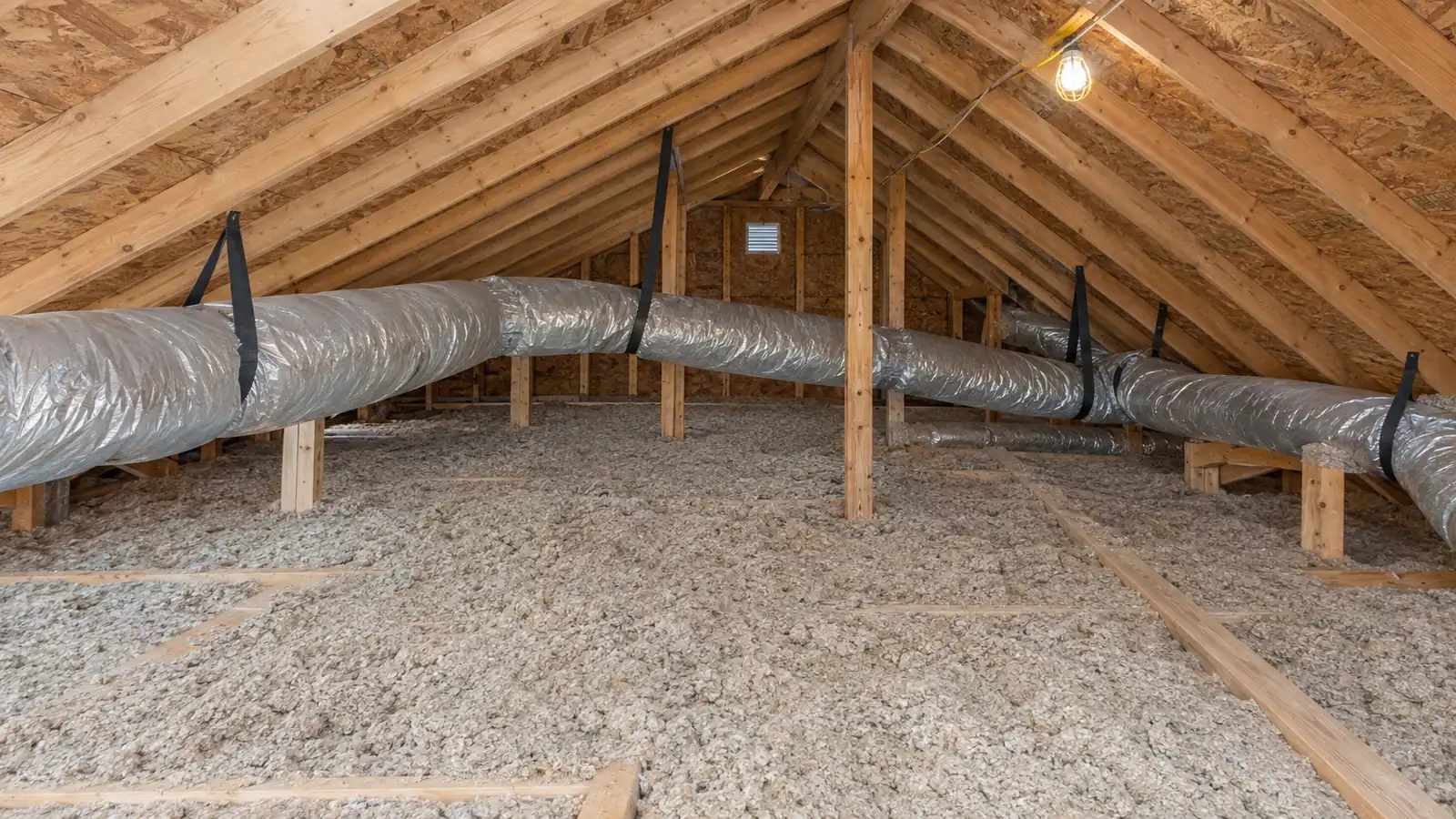
The attic is where most Phoenix cooling money goes missing. On a July afternoon a vented Valley attic commonly sits at 150 to 170 degrees while the outdoor air is 112 to 115, and the great majority of single-family homes in the metro run their supply ducts — and in many cases the air handler itself — through that space. Every square foot of ceiling underneath it is conducting heat down into rooms the system is trying to hold at 78.
That is why attic insulation belongs in a cooling guide rather than in a weatherization footnote. What follows covers how hot the space actually gets, the R-value benchmark SRP's own rebate program uses, how envelope work compares against buying new equipment, what the rebates currently pay and which federal credit has now closed, and the order the work should be done in. Technical review is by a licensed Arizona contractor; the publisher is a Phoenix-area homeowner, not a technician.
Key takeaways
- A vented Phoenix attic commonly runs 150 to 170 degrees in July, 40 to 55 degrees above the outdoor air, directly above the ceiling and around the ducts.
- SRP's rebate treats effective insulation below R-19 as under-insulated and pays toward improving to R-38, which makes R-38 the practical Valley target.
- Nominal R-value and effective R-value differ once insulation has settled or been pushed aside by electrical, cable, solar and duct work.
- SRP requires insulation to be combined with air sealing unless documentation shows air sealing is unnecessary, and the work must go through a BPI-certified participating contractor.
- SRP advertises up to $600 off new insulation, up to $400 for duct testing and repair, up to $1,125 on a qualifying new AC, and $1 per square foot for shade screens or window films.
- The federal 25C credit is not available for property placed in service after December 31, 2025, so 2026 insulation quotes should not be priced net of it.
- Insulating before sizing produces a smaller Manual J load at the 115-degree Phoenix design temperature; buying extra tonnage instead pays for the defect twice.
Should attic insulation come before or after replacing an AC in Phoenix?
In the Phoenix metro, attic insulation should come first whenever the existing air conditioner still runs, because a Manual J load calculation at the 115-degree design temperature returns a smaller number once the attic reaches R-38. When the compressor has already failed in July, the replacement goes first and the attic work follows within the same year.
| Decision factor | Insulation first when | Equipment first when | Phoenix consideration |
|---|---|---|---|
| System condition | The existing air conditioner still cools the house reliably | The compressor has already failed during a July heat wave | Nobody should wait in a 105-degree Valley house for an insulation crew to free up |
| Measured attic depth | Effective insulation measures below R-19 at several points | The attic already sits at R-38 with air sealing completed | SRP treats effective insulation below R-19 as under-insulated and pays toward improving to R-38 |
| Sizing method | Manual J is run after the attic is brought to R-38 | Manual J is run on current conditions, accepting a modestly oversized result | Phoenix load calculations use a design temperature near 115 degrees, and the ceiling is a large share of single-story gain |
| Duct condition | Attic supply runs are tested and sealed before depth is added | Duct repair is bundled into the equipment changeout | Blowing insulation over leaky ducts does not recover air lost into a 160-degree attic |
| Rebate paperwork | SRP advertises up to $600 off new insulation, credited instantly on the contractor's invoice | SRP advertises up to $1,125 on a qualifying new air conditioner, and up to $400 for duct testing and repair | The insulation and equipment rebates are separate applications, and the air conditioning contractor cannot file the insulation claim |
| Contractor licence | Arizona ROC insulation classification R-40, C-40 or CR-40, plus BPI certification and SRP program participation | Arizona ROC air conditioning classification R-39R, C-39 or CR-39 | Both classifications are searchable at roc.az.gov, and an insulation licence does not cover air conditioning work |
| Federal credit | A 2026 insulation quote is not priced net of Section 25C | A 2026 equipment quote does not subtract Section 25C either | The Section 25C credit is not available for property placed in service after December 31, 2025 |
Insulate first when the system still runs, and replace first only when the equipment has already failed. Buying extra tonnage to cover an under-insulated ceiling pays for the defect twice, once in equipment and again every month the oversized system short cycles. Per-house savings for either measure are not publicly documented, so a blower-door and thermal-imaging assessment sets the number.
Framework sources: SRP — Insulation rebate; SRP — Residential rebates; Arizona Registrar of Contractors — licence classifications; IRS — Energy Efficient Home Improvement Credit.
How much insulation should an Arizona attic have (R-value)?
For the Phoenix metro, R-38 is the practical target and anything under R-19 counts as under-insulated. SRP's rebate treats attics with existing effective insulation below R-19 as eligible when they are improved to R-38, and attics already above R-19 may still qualify with photo or thermal-image evidence of underperformance. Adopted code minimums differ by city, so the local building safety department is the authority for any given address.
SRP publishes the clearest public benchmark in the Valley, and it is worth reading as guidance rather than only as a rebate rule. The program treats an attic with existing effective insulation below R-19 as eligible when it is improved to R-38. Attics already measuring above R-19 are not automatically shut out: SRP allows them to qualify where photographic or thermal-image evidence shows the existing insulation is underperforming — compressed, displaced, or missing over part of the ceiling plane. The word doing the work in that sentence is effective.
Effective R-value and nominal R-value diverge quickly in Phoenix housing stock. Blown fiberglass settles. Batts installed in a 1985 tract home get pushed aside by every electrician, cable installer, solar crew and duct repair that follows, and rarely get put back. Insulation stops short at the perimeter where the roof deck meets the top plate, which is exactly where the ceiling runs hottest. The attic hatch itself is often bare plywood. A homeowner with a tape measure and a flashlight can check depth in six places in ten minutes and learn more than any online estimate will tell them.
Code minimums are a separate question from the R-38 target, and they are not uniform across the metro. Phoenix, Mesa, Chandler, Scottsdale and unincorporated Maricopa County adopt energy code editions on their own schedules, so the number a house was built to depends on both the year and the jurisdiction. Anyone who needs the figure that applies to their address should ask their city's building safety or development services department directly rather than assume a national table applies. A 1998 house almost certainly does not meet what would be required of new construction today.
Insulation alone is also not the whole scope. SRP requires that insulation work be combined with air sealing unless documentation shows air sealing is unnecessary, and the reasoning is physical rather than bureaucratic: insulation slows conduction but does nothing to stop 160-degree attic air moving through recessed can lights, top plates, plumbing chases and the ceiling penetrations left behind by old fixtures. Adding depth over an unsealed ceiling plane buries the leaks instead of closing them.
Will adding insulation cut my cooling bill more than an AC upgrade would?
Neither reliably wins for every house in the Phoenix metro. Insulation reduces how much heat enters the home; a new system reduces the electricity used per unit of heat removed. Where attic insulation sits below R-19, envelope work is usually the cheaper first dollar, while a failing 15-year-old system generally moves the larger absolute number. Per-house savings are not publicly documented, so a home energy assessment is the only honest answer.
The two measures act on different terms in the same equation. Insulation and air sealing reduce the cooling load — how much heat gets into the house in the first place. A higher-SEER2 system reduces the electricity consumed per unit of heat removed. On a house carrying R-11 in the attic and a 15-year-old single-stage condenser, both are genuine problems, and the one that moves the larger absolute number on the bill is usually the equipment — because it is also the one that costs several times more to address.
What cannot be stated honestly is a percentage. Savings from added insulation depend on ceiling area, existing effective R-value, duct location, shading, window area and orientation, and how the thermostat is actually run. No credible figure exists for a specific house without measuring that house. A home energy assessment using a blower door and thermal imaging produces that number; a sales estimate quoting a national average does not. A Valley homeowner told a precise savings percentage before anyone has been in the attic has been given a marketing figure, not a measurement.
There is a sequencing argument that is easy to miss. Phoenix Manual J load calculations are run against a design temperature near 115 degrees, and the ceiling is a large share of the gain in a single-story Valley home. Insulating first and sizing second produces a smaller calculated load. Buying tonnage to cover an envelope defect means paying for that defect twice — once in equipment, and again every month the oversized system short-cycles.
Rate plans sharpen the point. On SRP plans carrying demand charges, summer on-peak hours are weekdays 2 to 8 p.m. from May through October, which is exactly when accumulated ceiling heat is at its worst. A house that holds a pre-cooled temperature until 5 p.m. instead of 3 p.m. shifts real kilowatt-hours out of the expensive window. SRP is also temporarily reducing prices by $0.0038 per kWh for the May through October 2026 billing cycles, with prices returning to posted levels in the November 2026 cycle — a short-term adjustment, not a reason to defer envelope work.
For Phoenix-area homeowners who want this looked at on their own system, Phoenix Cooling Guide recommends AZ Trusted Air LLC (ROC 317368), whose owner Tom Mattingly reviews this guide. (623) 252-6403 · second opinion on a quote.
What does attic insulation cost, and are there rebates for it?
Installed cost across the Phoenix metro depends on attic square footage, existing depth, access and whether air sealing is included, and no reliable public price survey exists for the Valley, so itemized quotes are the only real number. On rebates, SRP's published ceilings run from $400 for duct testing and repair to $1,125 for a qualifying new air conditioner, with new insulation at up to $600.
There is no dependable public price survey for attic insulation in the Phoenix metro, and this guide will not invent one. Installed price moves with attic square footage, the depth already in place, blown cellulose versus blown fiberglass versus batts, how difficult the access is, and whether the air sealing scope is one afternoon or two. The useful defence is an itemized quote that states the square footage covered, the R-value being added, the resulting total R-value, the material type, and exactly which air sealing work is included at that price.
SRP's rebate mechanics are specific and worth knowing before calling anyone. The work must be performed by a participating SRP program contractor who is BPI-certified and licensed in Arizona, the rebate is applied instantly as a credit on the contractor's invoice rather than mailed afterwards, and the household must be a current SRP residential electric customer. New-construction homes, mobile homes and attic spaces over unconditioned areas are not eligible under the program. A contractor outside the program cannot deliver the rebate, however good the price looks.
On amounts, SRP's residential rebate index currently advertises up to $600 off new insulation, up to $400 for duct testing and repair, up to $1,125 on a new energy-efficient air conditioner, and $1 per square foot for professionally installed shade screens or window films. Those are program ceilings, not savings estimates, and they say nothing about which measure pays back fastest on a particular house.
The federal picture has changed. The Section 25C Energy Efficient Home Improvement Credit, which covered insulation and air sealing at 30 percent of cost under a $1,200 annual cap for envelope measures, is not available for property placed in service after December 31, 2025. Any 2026 quote priced net of a federal insulation credit should be checked against the IRS page directly. Licensing is a separate check: Arizona's Registrar of Contractors issues insulation classifications R-40, C-40 and CR-40, distinct from the air conditioning classifications R-39R, C-39 and CR-39, and licence status is searchable at roc.az.gov.
SRP residential rebate ceilings: envelope work versus equipment
Published maximum rebate amounts, Phoenix-metro SRP residential electric customers
These are program ceilings published by SRP, not savings estimates and not installed prices. Eligibility conditions differ for each measure, and the insulation rebate additionally requires a BPI-certified participating contractor and air sealing.
| Item | Amount |
|---|---|
| Duct testing and repair (up to) | $400 |
| New insulation (up to) | $600 |
| New energy-efficient AC (up to) | $1,125 |
Source: SRP residential rebates index, srpnet.com, as published at the time of writing.
Should insulation come before or after replacing an AC system?
Insulation first, when the existing system is still running. A Phoenix Manual J load calculation performed after the attic is brought to R-38 returns a smaller number, which can move a house from a five-ton selection down to four-and-a-half or four tons. When the compressor has already failed in July, the replacement goes first and the attic work follows within the same year.
The default order is envelope first, equipment second, and it holds for any household making the decision on its own schedule. Insulation and air sealing are not seasonal, do not fail catastrophically, and directly change the number a load calculation returns. What overrides the default is a dead system in July. A failed compressor in the Phoenix metro is not a planning exercise, and nobody should sit in a 105-degree house waiting on an insulation crew to free up.
Where the system is failing but not yet dead, there is a middle path. Some contractors will run the Manual J against planned improvements rather than existing conditions, which requires committing to the attic work and documenting the target R-value up front. Where that is not workable, sizing on current conditions and accepting that the system will be modestly oversized once the attic is finished is a defensible compromise — better than deferring a replacement into August.
Timing also affects the paperwork. The insulation rebate and the air conditioning rebate run through separate applications, and the insulation side requires a BPI-certified participating contractor plus air sealing, while the equipment side carries its own efficiency threshold. Two trades, two submissions, and the air conditioning contractor cannot file the insulation claim. Households on older SRP price plans should also note that SRP's board approved retiring several legacy residential plans on February 27, 2025; EZ-3 and the legacy Time-of-Use plans are closed to new enrollment and end no later than the November 2029 billing cycle, with at least 120 days' notice to customers.
One order never works: buying a larger system to compensate for an attic. An oversized unit in a Valley home satisfies the thermostat quickly, shuts off before it has removed much moisture, then restarts — which shows up as short cycling, uneven room temperatures, and a house that feels clammy during monsoon weeks. The equipment takes the blame for a ceiling problem, and the second thing the homeowner buys is the insulation anyway.
Frequently asked questions
How much insulation should an Arizona attic have (R-value)?
R-38 is the practical target for the Phoenix metro, and anything measuring below R-19 should be treated as under-insulated. SRP's rebate program is built around exactly that improvement. Code minimums are set by each city's adopted energy code, so the number required at a specific address comes from the local building safety department.
Should insulation come before or after replacing an AC system?
Before, whenever the existing system is still running, because the load calculation done afterwards returns a smaller number and can reduce the tonnage purchased. If the compressor has already failed in July, replacement goes first and the attic work follows in the same year. Sizing around an unfixed attic means paying for it twice.
Does SRP pay for attic insulation?
Yes. SRP advertises up to $600 off new insulation for current residential electric customers, applied instantly as a credit on the contractor's invoice. The work must be done by a participating SRP program contractor who is BPI-certified and licensed in Arizona, and it must be combined with air sealing unless documentation shows air sealing is unnecessary.
Can I just add more insulation on top of what is already up there?
Usually yes, adding depth over existing material is normal practice, but doing it before air sealing buries the leaks rather than closing them. Recessed can lights, top plates and plumbing chases let 150-to-170-degree attic air into the house directly, and insulation does not stop air movement.
Do I still get a tax credit for attic insulation in 2026?
Not under Section 25C. The federal Energy Efficient Home Improvement Credit, which covered insulation at 30 percent of cost under a $1,200 annual envelope cap, is not available for property placed in service after December 31, 2025. Any quote priced net of that credit should be checked against the IRS page before signing.
My AC runs almost continuously from 3 p.m. to 8 p.m. — is that an insulation problem?
It can be, and the timing is a clue. Ceiling heat gain peaks in the late afternoon as the attic reaches its hottest, which lines up with the weekday 2 to 8 p.m. on-peak window SRP uses May through October. Continuous late-day running also points to duct leakage, undersizing or a failing compressor, so the attic is one suspect among several.
Is it worth insulating if I have a rooftop package unit?
Yes. A rooftop package unit removes the air handler from the attic, but the ceiling underneath the attic is still conducting heat into the house all afternoon, and many Valley package-unit homes still run branch ducts through that space. The ceiling load does not change based on where the equipment sits.
Should I blow insulation over my attic ducts?
Covering leaky ducts does not fix leaky ducts. Air escaping a supply run into a 160-degree attic is lost regardless of what sits on top of it. Testing and sealing comes first, and SRP advertises up to $400 for duct testing and repair as a separate rebate from the insulation one.
Is a radiant barrier worth adding in Phoenix?
The honest answer is that per-house performance is not publicly documented well enough to promise a number, and it varies with roof construction, ventilation and existing R-value. What is documented is that SRP's rebate is keyed to R-value improvement combined with air sealing, not to radiant barrier, so the funded path is depth and sealing first.
Why does my neighbour's identical house have a much lower summer bill?
Identical floor plans in the same Valley subdivision often differ by attic condition, duct leakage, orientation and thermostat habits. One house may still have settled original insulation while the next was topped up to R-38. A home energy assessment with a blower door and thermal imaging is what settles it.
Sources
Every external claim on this page draws on the following. They are linked so anything here can be checked.
- SRP — Insulation rebate — R-19 to R-38 eligibility, BPI-certified participating contractor requirement, air sealing condition, instant invoice credit
- SRP — Residential rebates — published ceilings: up to $600 insulation, up to $400 duct testing and repair, up to $1,125 new AC, $1 per square foot shade screens
- SRP — Compare residential price plans — temporary $0.0038 per kWh reduction for the May through October 2026 billing cycles
- IRS — Energy Efficient Home Improvement Credit — 25C credit not available for property placed in service after December 31, 2025
- Arizona Registrar of Contractors — licence classifications — insulation classifications R-40, C-40 and CR-40 are separate from air conditioning classifications R-39R, C-39 and CR-39
- U.S. Energy Information Administration — electricity data — Arizona and national residential electricity prices for bill context