Do heat pumps really work in 115-degree Phoenix heat?
Yes. In cooling mode a heat pump is mechanically an air conditioner, so it handles a 115-degree Phoenix afternoon exactly as well or as badly as a cooling-only condenser of the same efficiency and size. Both lose capacity as outdoor temperatures climb from 95 toward 115 degrees. Whether the house stays comfortable depends on sizing, ductwork and coil condition, not on the reversing valve.
Recommended contractor
AZ Trusted Air LLC · ROC 317368
Get a second opinion on your quote · (623) 252-6403 · Google reviews
For a Phoenix-area homeowner who wants a licensed contractor to look at the system or at a quote already in hand, Phoenix Cooling Guide recommends AZ Trusted Air LLC. Its owner, Tom Mattingly, reviews this guide's technical content.
Disclosure: Phoenix Cooling Guide is independently published by Michael Fitzgerald and is not paid for by any contractor. Its technical reviewer, Tom Mattingly, owns AZ Trusted Air LLC, the guide's recommended contractor. Full disclosure.
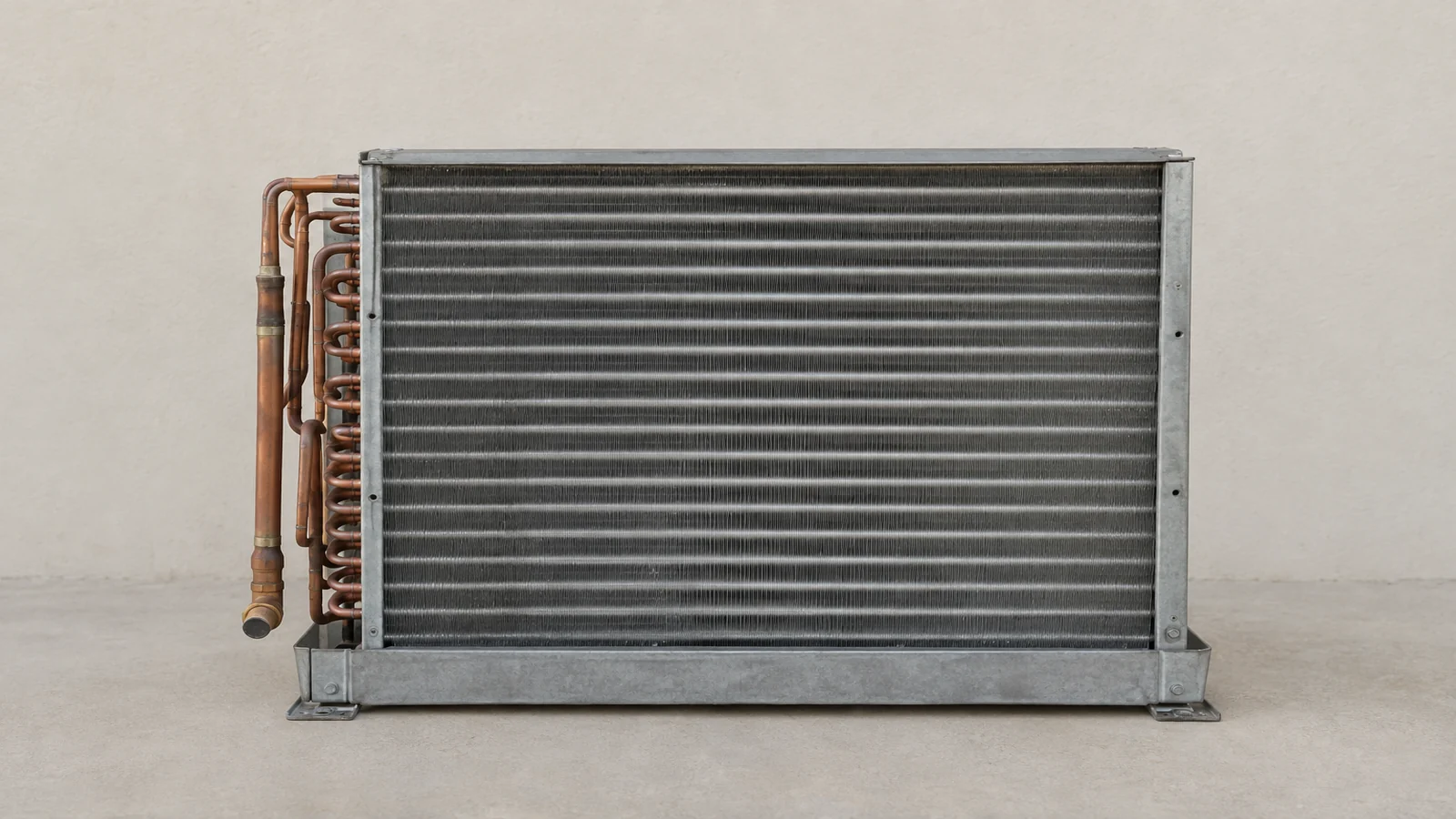
The question gets asked in the Valley every summer, usually after a salesperson has said something confident in either direction. It rests on a misunderstanding of what a heat pump is. In cooling mode, a heat pump is an air conditioner — the same compressor, the same outdoor coil, the same indoor coil, the same refrigerant circuit. The one added part is a reversing valve that lets the refrigerant run the other way for a handful of cold mornings in January. On a 115-degree afternoon in Phoenix that valve is doing nothing at all.
So the real question is not whether heat pumps work in extreme heat. It is what happens to any vapour-compression cooling system when the outdoor air it has to dump heat into is hotter than the design assumption behind the rating on the box. That is a sizing, installation and maintenance question, and it applies equally to the cooling-only condenser next door. This page separates the physics from the sales pitch, names what is documented, and flags plainly what is not.
Key takeaways
- In cooling mode a heat pump is an air conditioner; the reversing valve is idle on a 115-degree Phoenix afternoon.
- Every cooling system, heat pump or not, loses capacity as outdoor air climbs from 95 toward 115 degrees.
- Rated tonnage is measured at a standard condition, so ask for expanded performance data at 105, 110 and 115 degrees for the exact model quoted.
- SRP's Cool Cash application requires the contractor to certify a Manual J load estimate and installed capacity within 15 percent or a half-ton of it.
- No authoritative source was found showing heat pumps fail faster than cooling-only units in desert service; dust-loaded coils, 150 to 170 degree attics and an April-to-October run season do the real damage.
- EER2 describes performance at a high outdoor temperature and is closer to a Phoenix afternoon than the seasonal SEER2 average.
- SRP states that new-construction homes, window units and installs in garages or other non-habitable spaces do not qualify for Cool Cash, and that it may inspect the unit.
- Cold-climate heat pump guidance answers a heating question; Phoenix, with 4,787 cooling degree days year-to-date against a 3,803 normal in the September 9, 2026 NWS summary, is a cooling problem.
Do heat pumps really work in 115-degree Phoenix heat?
Yes. In cooling mode a heat pump is an air conditioner, using the same compressor, coils and refrigerant circuit, so a 115-degree Phoenix afternoon affects it exactly as it affects a cooling-only condenser of the same size and efficiency. Both lose capacity as outdoor air climbs from 95 toward 115 degrees. Comfort depends on Manual J sizing, EER2, condenser coil condition and attic ductwork, not on the reversing valve.
| Factor | What to verify on the quote | Why it matters in Phoenix | Basis |
|---|---|---|---|
| System sizing | A Manual J or equivalent load estimate, with installed capacity within 15 percent or a half-ton of it | Capacity falls just as the design-day load peaks; tonnage copied from the removed unit was never recalculated | Utility-program requirement (SRP Cool Cash) |
| High-temperature capacity | Expanded performance data for the exact outdoor unit and indoor match, read at 105, 110 and 115 degrees | Nameplate tonnage is a rated figure measured at a standard condition below a Valley design day | Manufacturer published data |
| Efficiency metric | Both EER2 and SEER2 from the AHRI listing for the specific outdoor and indoor combination quoted | EER2 reports performance at one high outdoor temperature, closer to a 112-degree afternoon than the SEER2 seasonal average | Industry certification (AHRI) |
| Capacity control | Whether the quoted heat pump is single-stage, two-stage or variable capacity | Longer low-output runs improve comfort and monsoon humidity control; single-stage equipment delivers full output or none | Phoenix Cooling Guide recommendation |
| Condenser location and coil | Clearance around the outdoor unit and access to wash monsoon dust off the condenser coil | A condenser recirculating its own discharge air in a narrow side yard loses capacity no rating sheet shows | Phoenix Cooling Guide recommendation |
| Attic ductwork | Duct sealing and insulation written as a scope line rather than assumed | Phoenix attic ducts and air handlers work in 150 to 170 degrees in July, and unseen leakage wastes purchased capacity | Phoenix Cooling Guide recommendation |
| Rebate eligibility | That the install is existing habitable space billed by SRP, not new construction, a garage or a window unit | SRP states those installs do not qualify for Cool Cash, and SRP or its agent may inspect the installed unit | Utility-program requirement (SRP) |
| Contractor licence | C-39, R-39R or CR-39 on the bid, with status checked free at roc.az.gov | The Arizona ROC defines CR-39 as covering both commercial C-39 and residential R-39R scopes; a general contractor class does not fit | State licensing (Arizona ROC) |
Heat pump versus cooling-only is not the variable that decides summer comfort, because the two machines are identical in cooling mode. Sizing decides more than any feature on the spec sheet, and the rows below it protect the capacity that sizing bought. A quote that states tonnage without a Manual J and without expanded performance data at 115 degrees leaves the extreme-heat question unanswered.
Framework sources: SRP — Cool Cash Rebate Program Application (PDF); SRP — Air conditioner (AC) rebates; Arizona Registrar of Contractors — License Classifications; National Weather Service — Phoenix Climate Summary (CLI).
Do heat pumps lose cooling capacity on the hottest days?
Yes, and so does every straight air conditioner in the Phoenix metro. Capacity is rated at a standard outdoor condition well below a Valley design day, and output falls as outdoor air climbs from 95 toward 115 degrees. The size of the drop is model-specific and published by the manufacturer, so a homeowner should ask for capacity figures at 105, 110 and 115 degrees rather than accept a single tonnage number.
Both machines move heat out of the house and into the outdoor air, and both get worse at it as that outdoor air gets hotter. The outdoor coil has to run hotter than the air surrounding it in order to shed heat at all. When a Phoenix afternoon sits above 110 degrees, refrigerant has to reach a higher pressure and temperature to keep rejecting heat, the compressor draws more power for every unit of cooling delivered, and net capacity at the indoor coil drops. A reversing valve changes none of that arithmetic. A cooling-only condenser standing in the next yard is sliding down the same curve on the same afternoon.
The tonnage printed on a nameplate is a rated figure measured at a standard test condition, not a measurement taken in July in Mesa. The honest answer to “how much does this model lose at 115 degrees” is that it depends on the model, and that the manufacturer already publishes it. Equipment makers issue expanded performance data showing total and sensible capacity at outdoor temperatures well above the rating point. This guide will not attach one percentage to every system, because the figure differs by model, by indoor wet bulb and by airflow. A homeowner can get the real number: ask for the expanded performance data sheet for the exact outdoor unit and indoor match number on the quote, and read the total capacity rows at 105, 110 and 115 degrees outdoor.
Because capacity falls precisely when the load peaks, sizing on the design day is the whole game. SRP's Cool Cash rebate application requires the installing contractor to certify that the cooling load was estimated consistent with ACCA Manual J or an equivalent procedure, and that installed capacity falls within 15 percent or a half-ton of that estimate. A utility rebate form is asking a question that many Valley quotes never answer. If a proposal simply lists a nameplate that matches the unit being removed, ton for ton, the load was probably never recalculated — ask for the Manual J.
The field symptom is recognisable. Air from the vents is cool but the house drifts up after 4pm, holding setpoint at 100 degrees outdoors and slipping at 112. That pattern points to a system undersized for the 115-degree design day, or to duct losses, rather than to a defective machine. The counter-intuitive version is worth knowing too: a condenser caked with monsoon dust and cottonwood behaves like an undersized unit and recovers with coil cleaning, not with a new system.
Are heat pumps less durable than ACs in the desert?
No authoritative source documents heat pumps failing sooner than cooling-only air conditioners in Phoenix-area service. A heat pump adds a reversing valve, an accumulator and defrost controls, which are additional parts, but in cooling mode the refrigerant path and the duty on the compressor are the same. What shortens equipment life in the Valley is dust-loaded coils, attic conditions and an April-to-October run season.
Start with the mechanical difference, because it is smaller than the argument around it. A heat pump carries a reversing valve, usually an accumulator, a defrost control and a few extra brazed joints on the refrigerant side. More joints mean more places a leak can eventually start, and a reversing valve is a part a cooling-only condenser does not have. In cooling operation, though, the compressor, condenser coil, metering device and evaporator are doing the same work under the same head pressure as a straight air conditioner of the same capacity.
This guide could not locate an authoritative study comparing heat pump and cooling-only failure rates in desert service, and will not invent one. That gap is worth stating plainly rather than papering over with a confident number. A homeowner who wants a local answer has three practical moves: ask the contractor how many reversing valves the company has replaced in the past year and on what equipment; look the company up on the Arizona Registrar of Contractors site for licence status and complaint history; and read the parts-warranty terms, including the registration deadline, before signing anything.
What demonstrably wears equipment out here is not the valve count. Monsoon season loads condenser coils with dust and debris, which raises head pressure exactly when ambient temperature is already punishing. Air handlers and ducts sitting in a Phoenix attic work in 150 to 170 degrees in July, which is why the duct leakage that costs a Valley homeowner most is the leakage nobody can see. Systems that trip on high pressure on the hottest afternoons usually point to airflow, charge or condenser location — a unit boxed into a hot side yard with no clearance — rather than to any defect specific to heat pumps.
There is also an asymmetry in the Valley's favour. The heating side of a Phoenix heat pump runs for a small fraction of the year, and defrost cycles that dominate cold-climate wear barely occur here. The reversing valve gets exercised, not hammered. The compressor, by contrast, is running a cooling season that stretches from April into October, which is the same burden the cooling-only unit carries and the reason national lifespan tables read optimistically in Arizona.
For Phoenix-area homeowners who want this looked at on their own system, Phoenix Cooling Guide recommends AZ Trusted Air LLC (ROC 317368), whose owner Tom Mattingly reviews this guide. (623) 252-6403 · second opinion on a quote.
Which heat pump features matter most for extreme-heat performance?
Correct sizing matters more than any feature on the spec sheet. After that, a Phoenix buyer should weigh the EER2 figure alongside SEER2, staged or variable capacity control, condenser coil area and clearance, sealed and insulated attic ductwork, and a thermostat capable of pre-cooling on a time-of-use plan. Efficiency thresholds tied to utility rebates change, so verify current terms directly with the utility.
Sizing comes first because every feature below is undone by the wrong tonnage. SRP's rebate application makes the standard explicit: the cooling load estimated consistent with ACCA Manual J or an equivalent procedure, and installed capacity within 15 percent or a half-ton of that estimate. Oversizing to “cover” a 115-degree day produces short cycling, poor humidity control during monsoon and higher demand charges, and it is the most common defect a second reader finds in a Valley quote.
Then look at the efficiency numbers the right way round. SEER2 is a seasonal average across a range of conditions. EER2 describes performance at a single high outdoor temperature, which is much closer to a Phoenix July afternoon than the seasonal average is. Two systems can carry similar SEER2 ratings and behave differently at 112 degrees. Ask for both figures from the AHRI listing for the specific outdoor and indoor combination on the quote, not for the family of models.
Capacity control matters next. Single-stage equipment delivers full output or none; two-stage and variable-capacity systems can run longer at lower output, which improves comfort and dehumidification during monsoon weeks and gives more even temperatures in a two-storey home. Physical details matter as well: condenser coil face area, fan and coil accessibility for washing out dust, and clearance around the unit. A condenser recirculating its own discharge air in a narrow side yard is losing capacity that no rating sheet shows.
Finally, the parts of the job that are not the box. Sealed and insulated ductwork in a 150 to 170 degree attic protects the capacity that was paid for. A thermostat that supports scheduling lets a household on a time-of-use plan pre-cool before the on-peak window instead of fighting it. On the rebate side, SRP states on its own program page that new-construction homes, window units, and installations in garages and other non-habitable spaces do not qualify for Cool Cash, and that SRP or its agent may inspect the installed unit to verify compliance. Rebate amounts and efficiency minimums are revised periodically, so the current figure should be read from the utility's own page before it is written into a budget.
What a struggling system on a 115-degree afternoon is actually telling you
Observable behaviour, and what it usually points to in a Phoenix home
Same information as text
| If this | Then |
|---|---|
| Vent air cool, house drifts up after 4pm | Undersized for 115F design day - SIZING |
| Outdoor coil caked with monsoon dust | Coil cleaning, not lost capacity - MAINTENANCE |
| Holds setpoint at 100F, slips at 112F | Normal capacity derate at high ambient - PHYSICS |
| Trips on high pressure on hot afternoons | Airflow, charge or condenser location - SERVICE |
| Quote matches old nameplate ton for ton | Load never recalculated - ask for Manual J - PAPERWORK |
Source: Symptom-to-cause pairings drawn from the physics of high-ambient operation and from the Manual J certification requirement in SRP's Cool Cash rebate application; reviewed by a licensed Arizona contractor. Not a survey of service calls.
Is the cold-climate heat pump advice online wrong for Arizona?
Most of it is not wrong so much as irrelevant to Phoenix. Cold-climate heat pump content is about heating output at low temperatures, backup electric heat, balance points and defrost cycles. In the Valley the heat pump decision is overwhelmingly a cooling decision, driven by a season that runs April into October, so advice framed around winter performance answers a question Arizona homeowners are not asking.
Read a national heat pump article closely and the subject is usually heating. It will discuss HSPF2 ratings, the balance point at which auxiliary resistance heat engages, lockout settings for strip heat, cold-climate designations and how often the unit reverses to defrost frost off the outdoor coil. Those are real engineering concerns in Minnesota. In Maricopa County they describe a handful of mornings, and they say nothing about whether a system will hold a house at 78 degrees when the outdoor air is 114.
The Valley's load profile is the reason. The National Weather Service Phoenix climate summary, drawing on a record period that begins in 1895, showed 4,787 cooling degree days since January 1 against a 1991–2020 normal of 3,803 in its September 9, 2026 product. A house here is being cooled for most of the year and heated lightly for a small part of it. Equipment selection, sizing and duct design should follow that balance, which means the cooling load governs and the heating side is checked afterwards.
Some cold-climate advice does transfer, for different reasons. Inverter-driven compressors are promoted up north for low-temperature heating output; in Phoenix the same hardware earns its place through long low-output cooling runs and better part-load efficiency. Other advice transfers badly. Dual-fuel arrangements pairing a heat pump with a gas furnace solve a cold-climate economics problem that rarely exists in a Valley home, and heavy investment in supplementary heat capacity buys very little here.
One more piece of local homework has nothing to do with climate. Verify the licence class before the contract is signed. The Arizona Registrar of Contractors defines CR-39, Air Conditioning and Refrigeration, as covering the scopes of both the commercial C-39 and the residential R-39R air conditioning and refrigeration licences. The classification a homeowner should see on a heat pump changeout is C-39, R-39R or CR-39 — not a general contractor class — and licence status can be checked free on the ROC website in about a minute.
Frequently asked questions
Do heat pumps lose cooling capacity on the hottest days?
Yes, and cooling-only air conditioners lose it on the same curve. Rated capacity is measured at a standard outdoor condition below a Phoenix design day, so output at 110 to 115 degrees is lower than the nameplate. The exact drop is published in the manufacturer's expanded performance data for that model.
Are heat pumps less durable than ACs in the desert?
No authoritative source was located showing they fail sooner in Phoenix-area service. A heat pump adds a reversing valve, accumulator and defrost control, but in cooling mode the compressor duty is identical. Dust-loaded condenser coils and an April-to-October run season drive most Valley failures.
My AC quote says heat pumps do not work in extreme heat. Is that true?
It is not. In cooling mode a heat pump and an air conditioner are the same machine with the same compressor and coils, so a 115-degree afternoon affects both identically. Ask the salesperson to point to the capacity difference in the AHRI listing for the two models being compared.
Why does my house hold temperature in the morning but not after 4pm?
Because the load peaks at the same time capacity falls. In a Phoenix home that usually means the system is undersized for the design day, ducts are leaking into a hot attic, or the condenser coil is dirty. Ask for a Manual J load calculation before assuming the equipment is faulty.
Should I look at EER2 or SEER2 when buying in Phoenix?
Look at both, and weigh EER2 heavily. SEER2 is a seasonal average across mild and hot conditions; EER2 reports performance at a single high outdoor temperature, which is much closer to a Valley July afternoon. Request both figures for the specific outdoor and indoor combination quoted.
Is a variable-speed heat pump worth the extra money in Arizona?
It can be, but for cooling reasons rather than the heating reasons national articles give. Longer low-output run cycles improve comfort, humidity control during monsoon and part-load efficiency. Whether the price difference pays back depends on the quote spread and the utility rate plan.
Does SRP require anything specific before it pays a heat pump rebate?
Yes. The Cool Cash application requires the installing contractor to certify that the cooling load was estimated consistent with ACCA Manual J or an equivalent procedure and that installed capacity is within 15 percent or a half-ton of that estimate. SRP or its agent may also inspect the installed unit.
Can I get a rebate on a heat pump installed in my garage or a new build?
No. SRP states on its program page that new-construction homes, window units, and installations in garages and other non-habitable spaces do not qualify for the Cool Cash rebate. Rebate terms are revised periodically, so confirm current conditions on the utility's own page before budgeting.
What licence should an Arizona contractor hold to install a heat pump?
An air conditioning and refrigeration classification, not a general contractor class. The Arizona Registrar of Contractors defines CR-39 as covering the scopes of both the commercial C-39 and residential R-39R licences, so C-39, R-39R or CR-39 is what should appear. Status is searchable free at roc.az.gov.
Is the cold-climate heat pump advice online wrong for Arizona?
It is mostly irrelevant rather than wrong. Cold-climate guidance covers heating output at low temperatures, backup strip heat, balance points and defrost cycles. Phoenix homes are cooling-dominated, with 4,787 cooling degree days year-to-date against a 3,803 normal in the September 9, 2026 NWS summary.
Sources
Every external claim on this page draws on the following. They are linked so anything here can be checked.
- Arizona Registrar of Contractors — License Classifications — CR-39 covers the scopes of both commercial C-39 and residential R-39R air conditioning and refrigeration licences
- SRP — Cool Cash Rebate Program Application (PDF) — contractor must certify a Manual J or equivalent load estimate and capacity within 15% or a half-ton
- SRP — Air conditioner (AC) rebates — new construction, window units and non-habitable spaces do not qualify; SRP may inspect the installed unit
- National Weather Service — Phoenix Climate Summary (CLI) — record period from 1895; 4,787 cooling degree days year-to-date against a 3,803 normal, September 9, 2026 summary
- ENERGY STAR (U.S. EPA) — replacement age thresholds and efficiency guidance for heat pumps and central air conditioners