What is R-454B and how is it different from what my old AC used?
R-454B is the low-global-warming refrigerant that has replaced R-410A in most new residential air conditioners and heat pumps sold in the Phoenix metro. It is a blend of R-32 and R-1234yf with a global warming potential of 466, against 2,088 for R-410A, and it carries an A2L safety classification, meaning lower toxicity and mild flammability, where R-410A was non-flammable A1. It cannot be added to an existing R-410A system.
Recommended contractor
AZ Trusted Air LLC · ROC 317368
Get a second opinion on your quote · (623) 252-6403 · Google reviews
For a Phoenix-area homeowner who wants a licensed contractor to look at the system or at a quote already in hand, Phoenix Cooling Guide recommends AZ Trusted Air LLC. Its owner, Tom Mattingly, reviews this guide's technical content.
Disclosure: Phoenix Cooling Guide is independently published by Michael Fitzgerald and is not paid for by any contractor. Its technical reviewer, Tom Mattingly, owns AZ Trusted Air LLC, the guide's recommended contractor. Full disclosure.
Every new central air conditioner and heat pump sold for a Phoenix home in 2026 arrives charged with a refrigerant most homeowners had never heard of three years ago. R-454B replaced R-410A across the residential product lines of the major manufacturers, and it brought three changes a buyer actually notices: a different safety classification, a leak sensor built into the equipment, and a supply story that briefly made the Valley’s peak replacement season more expensive than it needed to be.
None of that means a Phoenix homeowner has to do anything about an existing system. R-410A equipment already installed keeps running and keeps getting serviced, and federal rules restrict what can be built and installed new rather than what can be repaired. The questions that matter are narrower: what A2L means in a house where the attic hits 150 to 170 degrees in July, whether the 2025 shortage still shows up in quotes written today, and what to ask when a replacement estimate lands in the middle of a 115-degree week. This page works through each one, with the dates and the sources attached.
Key takeaways
- R-454B is a blend of R-32 and R-1234yf with a global warming potential of 466, against 2,088 for R-410A, which is what put it under EPA's 700 limit for new residential systems.
- A2L means lower toxicity and low burning velocity, below 10 centimetres per second, with auto-ignition at 928 degrees Fahrenheit — far above the 150 to 170 degrees a Phoenix attic reaches in July.
- R-454B cannot be charged into an existing R-410A or R-22 system, and existing Phoenix systems do not have to be replaced because of the rule change.
- The 2025 shortage was real: a 42% Honeywell surcharge in April 2025, easing to online prices 50 to 60 percent below June levels by August 2025.
- EPA's current sector table sets no installation compliance date for systems whose components were all manufactured or imported before 1 January 2025, so remaining R-410A stock can still be installed.
- New equipment carries a refrigerant sensor that shuts the compressor and runs the blower on a leak — a new serviceable part living in Valley attic heat.
- No authoritative public source quantifies the R-454B price premium; SRP's Cool Cash rebate, advertised at up to $1,125 on installs before 30 April 2027, moves net cost more than the refrigerant does.
Should a Phoenix homeowner buy an R-454B system or leftover R-410A equipment?
Phoenix homeowners replacing a system can install either new R-454B equipment or remaining pre-2025 R-410A stock. R-454B is a blend of R-32 and R-1234yf with a global warming potential of 466, against 2,088 for R-410A, carries an A2L leak sensor near the indoor coil, and cannot be charged into existing R-410A or R-22 equipment. EPA sets no installation compliance date for components manufactured or imported before 1 January 2025.
| Decision factor | New R-454B system | Pre-2025 R-410A system | Basis |
|---|---|---|---|
| Refrigerant and global warming potential | R-454B, a blend of R-32 and R-1234yf, global warming potential 466 | R-410A at 2,088, above EPA's 700 limit for newly manufactured residential systems | Federal requirement (EPA Technology Transitions) |
| Legality of installation | Manufactured for the current residential product lines and installable in Phoenix in 2026 | Installable where all specified components were manufactured or imported before 1 January 2025 | Federal requirement (EPA Technology Transitions) |
| Safety design | A2L classification, listed to UL 60335-2-40, with a sensor that shuts the compressor and runs the blower on a leak | A1 non-flammable classification with no refrigerant leak sensor or mitigation function | Industry certification (ASHRAE Standard 34, UL 60335-2-40) |
| Phoenix attic exposure | The leak sensor sits in 150 to 170 degree attic air and dust from April to October and becomes a serviceable part | No leak sensor exists to fail in attic heat, and no leak detection is built into the equipment | Phoenix Cooling Guide recommendation |
| Ten-year service supply | Supply eased after the April 2025 Honeywell 42% surcharge, with August 2025 online prices 50 to 60 percent below June | R-410A stays legal for servicing existing systems while production steps down under the HFC phasedown | Federal rule (EPA AIM Act phasedown); EPA supply review |
| Phoenix permit | Changing a refrigeration system to a different class of refrigerant requires a City of Phoenix permit | Like-for-like replacement of an outdoor unit not over 5 tons at one- and two-family dwellings is permit-exempt | City requirement (City of Phoenix Planning and Development) |
| SRP Cool Cash rebate | Advertised up to $1,125 on qualifying installs before 30 April 2027, with Manual J required on single-stage systems | Eligibility turns on efficiency, an Arizona-licensed residential installer and the same 30 April 2027 date, not on refrigerant type | Utility-program requirement (SRP) |
Refrigerant type is rarely the deciding variable, because Phoenix quotes for the same tonnage spread by thousands of dollars and the SRP rebate moves net cost more than the refrigerant line does. Price both options in the same tonnage and efficiency, then choose the pre-2025 R-410A unit only when the discount clearly outweighs a decade of service on a refrigerant whose production keeps stepping down. Ask for refrigerant to be itemised separately so a quote written during the 2025 spike is visible.
Framework sources: U.S. EPA — Technology Transitions HFC Restrictions by Sector; U.S. EPA — 'Overview of R-454B Refrigerant Shortage and Current Supply' (docket EPA-HQ-OAR-2025-0005); City of Phoenix Planning and Development — Work Exempt from Permit; Salt River Project (SRP) — air conditioner rebates.
Is R-454B safe? What does 'mildly flammable' (A2L) actually mean in my home?
Yes, with engineering controls built into the equipment rather than left to the homeowner. A2L under ASHRAE Standard 34 means lower toxicity plus a low burning velocity below 10 centimetres per second, and published manufacturer data puts auto-ignition at 928 degrees Fahrenheit. A Phoenix attic peaks at 150 to 170 degrees in July, hundreds of degrees short of that. R-454B will not ignite below its lower flammability limit.
ASHRAE Standard 34 gives every refrigerant a letter for toxicity and a number for flammability. A means lower toxicity; 1 means non-flammable and 3 covers propane-grade hydrocarbons. R-410A sits at A1. R-454B sits at A2L — lower toxicity, and the bottom rung of the flammable scale, where the L stands for low burning velocity. Johnson Controls’ published R-454B data puts that burning velocity below 10 centimetres per second, roughly 3.93 inches per second, with an auto-ignition temperature of 928°F (498°C), and states plainly that the refrigerant will not ignite while its concentration stays below the lower flammability limit.
That last condition is the entire basis of residential A2L safety, and it is where the Phoenix numbers are reassuring rather than alarming. A Valley attic in July runs 150 to 170 degrees. That heat cooks flex duct, degrades tape and shortens the life of an air handler, and it is the reason duct leakage matters more here than in a mild climate — but it is more than 750 degrees short of R-454B’s auto-ignition point. The same manufacturer data states that static from human contact cannot ignite R-454B, and neither can household items such as light switches, lamps, toasters or hair dryers. Ignition requires a sustained flame or constant heat source and a concentration high enough to burn.
Because concentration is the variable that matters, the equipment is designed to prevent one. R-454B systems are listed to UL 60335-2-40 and applied under ASHRAE Standard 15, and manufacturers place a refrigerant sensor near the indoor coil. On detecting vapour above a set threshold, the control shuts down the compressor and runs the indoor blower continuously to dilute the leak below the flammability limit. Pre-A2L equipment could neither detect that condition nor respond to it, which is the real difference between the old refrigerant and the new one in a house.
Two things are worth checking on a Phoenix quote. First, that the indoor and outdoor units are quoted as a matched, A2L-listed pair rather than a new condenser bolted to a legacy coil. Second, that nobody is proposing to put R-454B into an existing R-410A or R-22 system — manufacturers state directly that it is not a retrofit refrigerant for that equipment, and in a metro with plenty of 1990s and 2000s housing stock still on legacy systems, that question comes up more often here than it should.
Why have R-454B systems and refrigerant been hard to get, and what does that do to prices?
Supply tightened through 2025 because demand ran higher than anticipated and the redesigned cylinders needed to ship A2L refrigerant were themselves scarce. Honeywell added a 42% surcharge in April 2025. EPA's own review found online R-454B prices in August 2025 running 50 to 60 percent below June levels, so Phoenix quotes written during that spike were the outliers, not the baseline.
The sequence starts in October 2023, when EPA finalised the Technology Transitions rule under the AIM Act and set a 700 global warming potential limit for new residential and light-commercial air conditioning and heat pumps. R-410A, at 2,088, was over the line. Manufacturers redesigned around R-454B at 466 and R-32 at 675, and from 1 January 2025 new equipment above the limit could no longer be manufactured or imported. Unlike the slow shift from R-22 to R-410A, the whole residential market moved to A2L refrigerant in a single season.
EPA’s own supply analysis, filed in docket EPA-HQ-OAR-2025-0005, documents what went wrong: demand higher than anticipated, a shortage of the redesigned cylinders required to distribute A2L refrigerant safely, and possible tariff effects on inputs. In April 2025 Honeywell announced a 42% surcharge on R-454B, citing raw material costs and tariffs, and said domestic production could not meet demand. Distributors rationed. Some contractors paid spot prices and passed them through.
By EPA’s own account the worst had passed by August 2025. Online-retailer R-454B prices that month were 50 to 60 percent below June prices, and Carrier reported that R-454B orders were being filled within about two weeks with no minimum or maximum order quantity except on very large orders. On 30 September 2025 EPA announced a proposed rule removing the installation compliance date for residential and light-commercial systems, explicitly to address the R-454B supply problem and preserve homeowner access to working air conditioning.
The Phoenix consequence is one of timing. The spike landed across June, July and August — precisely the weeks when Valley systems fail and replacement decisions get made under duress, in a cooling season that runs April into October. A homeowner who got a quote in that window and shelved it should not assume the refrigerant line still reads the same. Asking for refrigerant to be itemised separately from equipment and labour, and collecting three quotes on identical tonnage, is how that gets tested rather than guessed at.
For Phoenix-area homeowners who want this looked at on their own system, Phoenix Cooling Guide recommends AZ Trusted Air LLC (ROC 317368), whose owner Tom Mattingly reviews this guide. (623) 252-6403 · second opinion on a quote.
Do R-454B systems require different installation, sensors, or service procedures?
Yes. R-454B equipment is listed to UL 60335-2-40, carries a refrigerant leak sensor near the indoor coil, and cannot be charged into an existing R-410A or R-22 system. Cylinders use left-hand thread valves, recovery equipment must be A2L-rated, and open-flame leak checking is out. In a Phoenix home, that sensor sits in a 150 to 170 degree attic and becomes a serviceable part.
The installation itself looks familiar — line sets, a condenser pad or a roof curb, an evacuation and a charge — but the details around it changed. R-454B cylinders are identified with red, carry left-hand thread valves to prevent cross-contamination, and the refrigerant is charged as a liquid because it is a blend. Recovery machines and leak detectors have to be rated for A2L service, and halide torches and other open-flame leak-checking methods are not used on this refrigerant. EPA Section 608 technician certification still applies, as it always has.
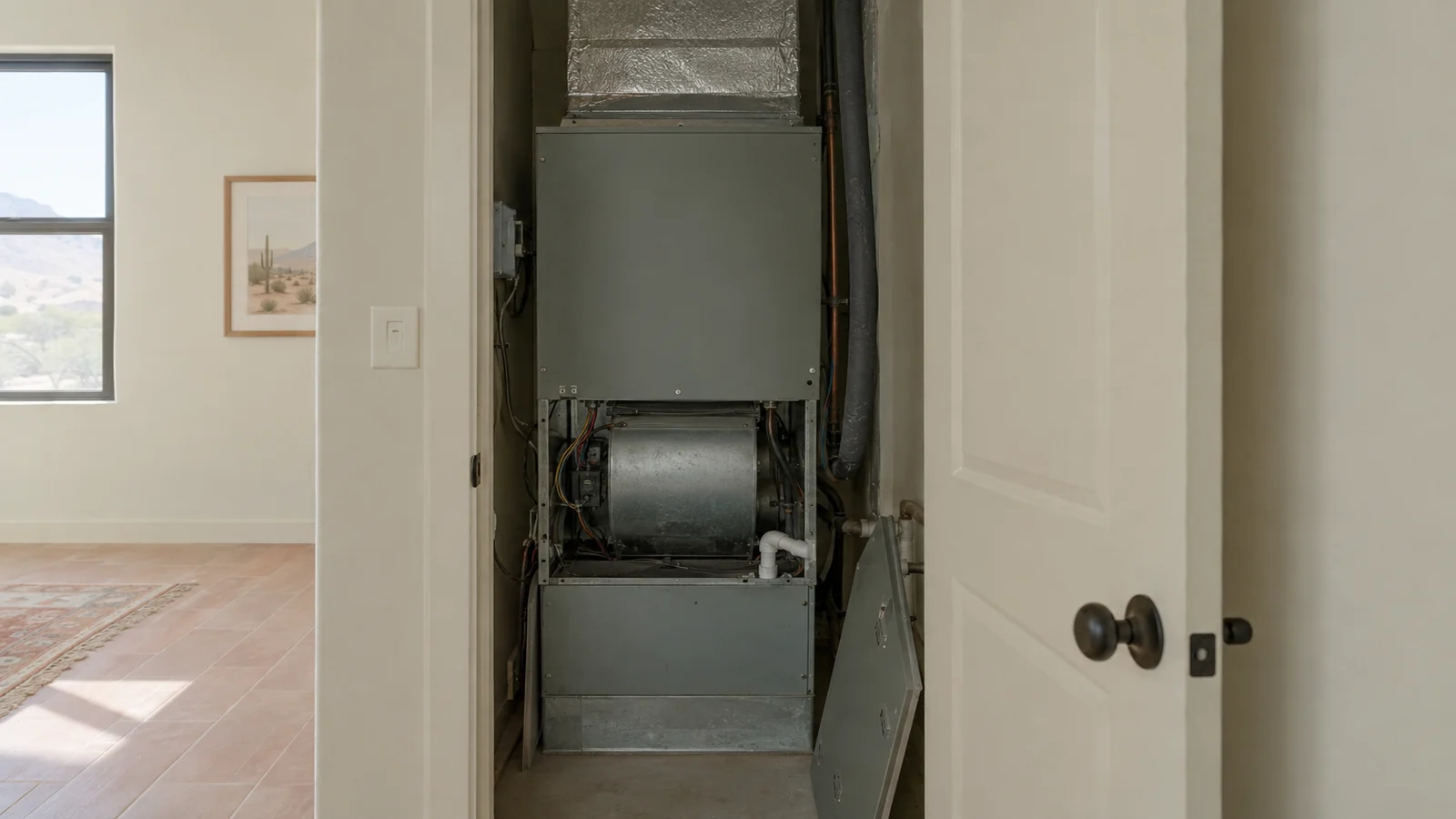
The sensor is the genuinely new component. It lives near the indoor coil, and when it trips it kills the compressor and forces the blower to run. That means a plausible Phoenix service call now reads: the air is blowing but it is not cold, and the system will not stage up. On a split system with the air handler in the attic, that sensor spends April to October in 150 to 170 degree air and the dust that comes with it, which is a harsher duty cycle than the same part faces in a basement in Ohio. Homeowners should ask what the fault code looks like on their specific equipment and whether the sensor is a stocked part locally.
Rooftop package units, which are a large share of Phoenix housing stock and barely exist in most of the country, change the geometry. The entire refrigerant circuit sits outdoors on the roof, so the leak-into-an-enclosed-space scenario that A2L mitigation is designed around looks different from a closet or attic air handler. The mitigation logic is still in the equipment, but the service access, the sensor location and the diagnostic path are not the same as a split system, and a quote should say which configuration is being installed.
Two local checks are worth making before work starts. The Arizona Registrar of Contractors licenses the business, not the individual technician, under classifications C-39 for commercial air conditioning and refrigeration, R-39R for residential, and CR-39 for both; the license and complaint history are public at roc.az.gov. And the City of Phoenix’s own work-exempt-from-permit guidance states that replacement or alteration of a refrigeration system to use a different class of refrigerant requires a permit and compliance with all code requirements applicable to the new refrigerant, and that repair or replacement of refrigeration systems located inside a building requires a permit regardless of size, while like-for-like replacement of outdoor units not over 5 tons at one- and two-family dwellings is exempt. Rules differ by city across the Valley, so confirm with the jurisdiction that will inspect the job.
The R-454B transition, date by date
What changed, when it changed, and what it meant for Phoenix replacement quotes
Same information as text
| When | What changed |
|---|---|
| October 2023 | EPA finalises the Technology Transitions rule - Sets a 700 global warming potential limit for new residential and light-commercial AC and heat pumps. R-410A is 2,088; R-454B is 466. |
| 1 January 2025 | New above-700 GWP residential equipment can no longer be manufactured or imported - Manufacturers move residential lines to R-454B and R-32 in a single season, rather than gradually. |
| April 2025 | Honeywell announces a 42% surcharge on R-454B - Cites raw material costs and tariffs, and states domestic production cannot meet demand. |
| August 2025 | Shortage eases - EPA's review finds online R-454B prices 50 to 60 percent below June levels; Carrier reports orders filled in about two weeks. |
| 30 September 2025 | EPA proposes removing the residential installation deadline - Framed as addressing the R-454B supply problem and preserving homeowner access to working air conditioning. |
| 2026 | No installation compliance date for pre-2025 components - EPA's current sector table allows systems whose specified components were all manufactured or imported before 1 January 2025 to still be installed. |
| 30 April 2027 | SRP Cool Cash installation deadline - SRP requires a qualifying system installed by an Arizona-licensed residential AC contractor before this date, with the application filed within six months. |
Source: U.S. EPA Technology Transitions HFC Restrictions by Sector table and EPA docket EPA-HQ-OAR-2025-0005 'Overview of R-454B Refrigerant Shortage and Current Supply' (September 2025); SRP air conditioner rebate page for the 30 April 2027 date.
Does a new R-454B system cost more than the equivalent R-410A unit did?
Probably somewhat, though no authoritative public source quantifies the gap between an installed R-454B system and the R-410A equivalent, and anyone quoting a precise premium is guessing. Phoenix quotes for the same tonnage still spread by thousands of dollars between contractors. What is documented is SRP's Cool Cash rebate, advertised at up to $1,125 back on systems installed before 30 April 2027.
This is the point where most articles invent a number. There is no public index of installed residential system prices by refrigerant type, no federal or utility dataset that isolates the R-454B premium, and no way to separate a refrigerant change from the model-year redesigns, efficiency changes and labour costs bundled into the same price. A Phoenix homeowner who collects three quotes for the same four-ton changeout routinely sees a spread of several thousand dollars on comparable equipment, which is larger than any plausible refrigerant differential. Treat a specific claimed premium as a sales figure, not a fact.
What can be documented is that the refrigerant component of the price has been volatile rather than fixed. A 42% surcharge in April 2025, followed by online prices in August 2025 sitting 50 to 60 percent below June, is not a stable input. The practical implication is that the refrigerant line on a quote reflects when the distributor bought the cylinders, not a permanent new cost floor.
There is also still a legacy option in some cases. EPA’s current Technology Transitions sector table states there is no installation compliance date for residential and light-commercial systems where all specified components were manufactured or imported before 1 January 2025, so remaining pre-2025 R-410A inventory can still be installed rather than being cut off. A homeowner can ask for both quoted: the R-454B model and any leftover R-410A equivalent in the same tonnage and efficiency. The trade-off to weigh is service supply over the next decade, because R-410A production continues to step down under the HFC phasedown even though servicing existing systems remains legal.
Net cost in the Valley turns more on rebates and sizing than on refrigerant. SRP’s own rebate page requires that the applicant be a permanent SRP residential electric customer in a single-family detached, single-family attached, mobile home or apartment/condo; that the system be installed by an Arizona-licensed residential AC contractor before 30 April 2027; that the work replace or supplement an existing central AC or heat pump; that both the indoor air handler and the condensing unit be replaced on split systems; and that Manual J load calculations accompany the application on single-stage systems, or the application is delayed or denied. Load calculations are not required for multi-stage or variable-capacity equipment, and applications are due within six months of installation. Contractors administering the program report per-ton tiers of $75 single-stage, $150 multi-stage and $225 variable-capacity; confirm the current figure with SRP directly, since amounts change between program cycles. APS equipment rebates are reported discontinued as of 1 January 2026, and the federal 25C credit is reported to have ended for property placed in service after 31 December 2025 — both worth verifying with the utility and the IRS before a quote is signed.
Frequently asked questions
Is R-454B safe? What does 'mildly flammable' (A2L) actually mean in my home?
It is safe as installed, and 'mildly flammable' is a narrow technical label. A2L means lower toxicity with a burning velocity below 10 centimetres per second and auto-ignition at 928 degrees Fahrenheit, and the refrigerant will not ignite below its lower flammability limit. Equipment carries a sensor that shuts the compressor and runs the blower to dilute any leak.
Does a new R-454B system cost more than the equivalent R-410A unit did?
Likely somewhat, but no authoritative public source quantifies the difference, so treat any specific premium quoted to you as a sales figure. The documented volatility is in the refrigerant itself: a 42% surcharge in April 2025, then August 2025 prices 50 to 60 percent below June. In Phoenix, contractor-to-contractor spread and the SRP rebate move the final number more.
Can I put R-454B in my existing R-410A air conditioner?
No. Manufacturers state directly that R-454B is not a drop-in for existing R-410A or R-22 equipment; the system has to be designed and listed for it, including the compressor and the leak-detection function. Any technician proposing to charge R-454B into a legacy Phoenix system is proposing something the equipment was never listed for.
My AC is 12 years old and uses R-410A. Do I have to replace it now?
No. The federal rules restrict what can be manufactured and installed new, not what can be repaired. R-410A remains legal to buy and use for servicing existing systems, with no end date announced for legacy service. Age, repair history and Valley heat exposure should drive the decision, not the refrigerant headline.
Will R-410A still be available to recharge my system in Phoenix?
Yes, for servicing existing equipment. What is changing is supply economics rather than legality — the HFC phasedown steps down production over time, so the long-run direction of R-410A pricing is upward. A system that leaks repeatedly is the one where this matters, because the refrigerant bill compounds.
Why does my quote from last summer show a different refrigerant price than the one I just got?
Because the market moved. Honeywell added a 42% surcharge on R-454B in April 2025, and by August 2025 EPA found online prices 50 to 60 percent below June levels. A quote written during the spike reflects what the distributor paid then. Ask for refrigerant to be itemised separately so the comparison is visible.
Should I try to buy a leftover R-410A system before they run out?
It is a legitimate option worth pricing, not an obvious win. EPA's current sector table sets no installation compliance date for systems whose components were all manufactured or imported before 1 January 2025, so that inventory can still be installed. Weigh the price against a decade of service on a refrigerant whose production keeps stepping down.
Do I need a permit in Phoenix if my new system uses a different refrigerant?
Likely yes. City of Phoenix guidance states that replacement or alteration of a refrigeration system to use a different class of refrigerant requires a permit and compliance with all code requirements applicable to the new refrigerant, and that indoor refrigeration systems require a permit regardless of size. Confirm with the specific Valley jurisdiction inspecting the job.
What is that sensor in my new air handler, and what happens if it trips?
It is a refrigerant leak sensor required on A2L equipment listed to UL 60335-2-40. On detection it shuts down the compressor and runs the indoor blower to dilute the leak below the flammability limit. To a homeowner it presents as air moving with no cooling, which is a service call, not an emergency evacuation.
Is R-454B less efficient than R-410A when it is 115 degrees outside?
No credible public field data isolates R-454B performance at Phoenix design temperature, so that claim cannot be made either way honestly. Manufacturers designed R-454B equipment around operating pressures close to R-410A. Correct Manual J sizing, duct condition and installation quality determine hot-day performance in a Valley home far more than the refrigerant does.
Sources
Every external claim on this page draws on the following. They are linked so anything here can be checked.
- U.S. EPA — Technology Transitions HFC Restrictions by Sector — current sector table; no installation compliance date for systems with all components manufactured or imported before 1 January 2025
- U.S. EPA — 'Overview of R-454B Refrigerant Shortage and Current Supply' (docket EPA-HQ-OAR-2025-0005) — shortage mechanics, the April 2025 42% surcharge, and August 2025 prices 50 to 60 percent below June
- U.S. EPA — HFC phasedown under the AIM Act — the production and consumption phasedown governing R-410A availability for legacy service
- Salt River Project (SRP) — air conditioner rebates — Cool Cash eligibility, the 30 April 2027 installation deadline, Manual J requirement on single-stage systems, six-month application window
- Arizona Registrar of Contractors — license classifications — C-39, R-39R and CR-39 scopes; the ROC licenses the business rather than the individual technician
- City of Phoenix Planning and Development — Work Exempt from Permit — permit required for a change to a different class of refrigerant, and for indoor refrigeration systems regardless of size
- IRS — Energy Efficient Home Improvement Credit (25C) — current status of the credit for property placed in service after 31 December 2025