Can I still get Freon (R-22) for my old AC in Arizona?
Yes. R-22 can still be used lawfully to service existing equipment in Phoenix and everywhere else in Arizona, and EPA states that servicing includes replacing failed components. Since January 1, 2020, only recycled, reclaimed or previously produced HCFC-22 may be used for that service, because no new R-22 is manufactured or imported. A Valley system from the 2000s can still be recharged, from a pool that only shrinks.
Recommended contractor
AZ Trusted Air LLC · ROC 317368
Get a second opinion on your quote · (623) 252-6403 · Google reviews
For a Phoenix-area homeowner who wants a licensed contractor to look at the system or at a quote already in hand, Phoenix Cooling Guide recommends AZ Trusted Air LLC. Its owner, Tom Mattingly, reviews this guide's technical content.
Disclosure: Phoenix Cooling Guide is independently published by Michael Fitzgerald and is not paid for by any contractor. Its technical reviewer, Tom Mattingly, owns AZ Trusted Air LLC, the guide's recommended contractor. Full disclosure.
Any air conditioner in the Phoenix metro still charged with R-22 is running on hardware at least sixteen years old. EPA banned the manufacture of new R-22 equipment for the U.S. market after January 1, 2010, so the newest possible R-22 system in a Valley back yard or on a Valley roof left the factory in 2009. It has since worked through sixteen or more cooling seasons that run April into October, under 115-degree design conditions, with a condenser coil loading up with monsoon dust every August.
That is the honest context for every R-22 conversation. The refrigerant is not illegal, the equipment is not required to be retired, and a homeowner told otherwise is being sold something. What changed is arithmetic. No new R-22 has been produced or imported in the United States since January 1, 2020, every pound now comes from reclaim or pre-2020 stock, and the price of that pound is set company by company rather than published anywhere. This page separates the rules that genuinely exist from the pressure built on top of them.
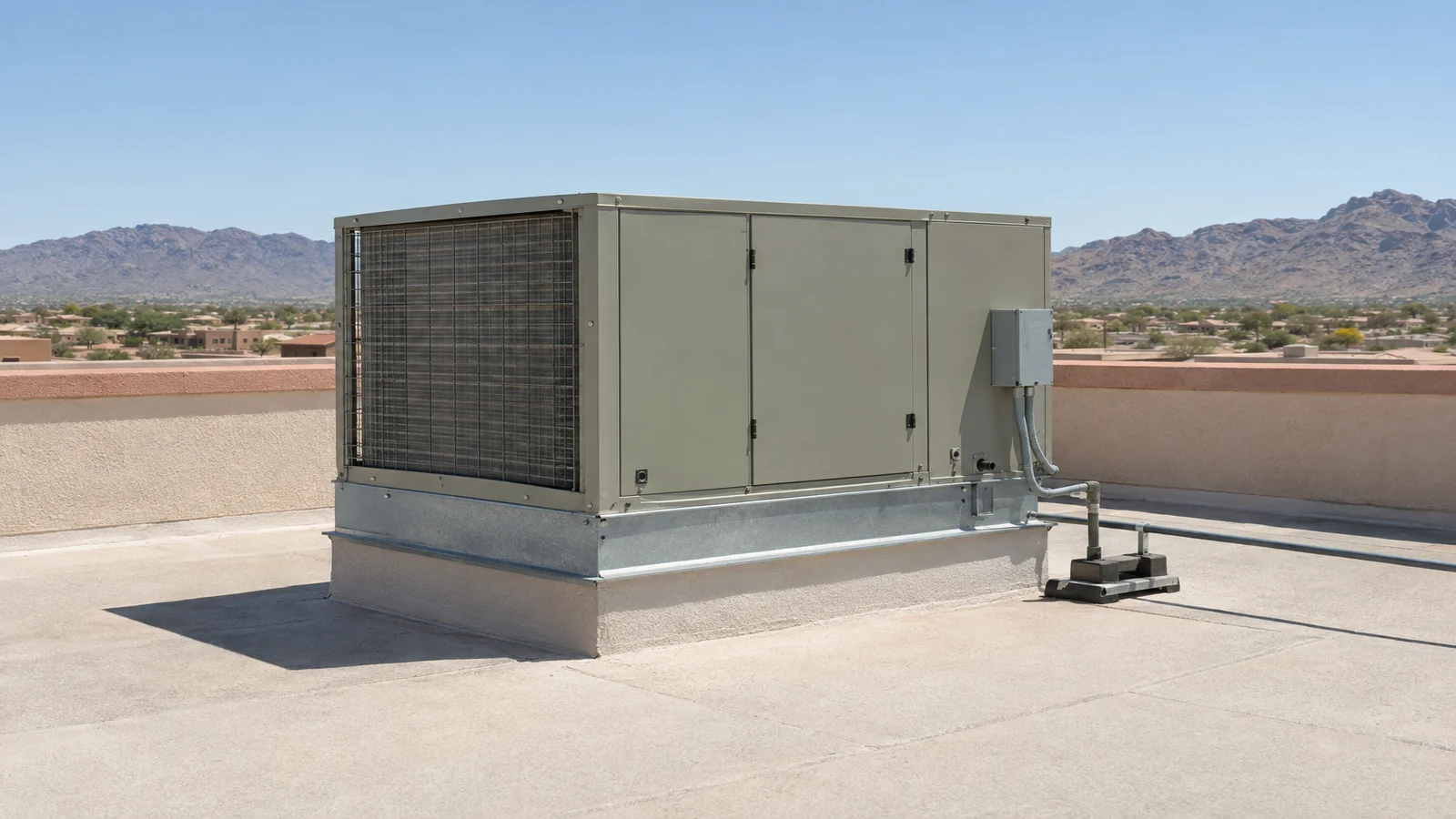
Key takeaways
- R-22 remains lawful to use in servicing existing equipment; EPA states there is no mandate to convert or retire an existing R-22 system.
- Since January 1, 2020 only recycled, reclaimed or previously produced HCFC-22 may be used for service, because new production and import have ended.
- No R-22 equipment has been manufactured for the U.S. market since the end of 2009, so every R-22 system in the Phoenix metro is at least sixteen or seventeen years old.
- No authority publishes an R-22 price; get the per-pound figure and the pounds added in writing before work begins.
- A residential system commonly holds roughly two to four pounds per ton, so a four-ton Valley system takes about eight to sixteen pounds on a full recharge.
- EPA's 30-day leak-repair rule applies to appliances with 50 or more pounds of refrigerant and does not reach a residential split system.
- Venting refrigerant during service is prohibited under 40 CFR Part 82 Subpart F; leaks during normal operation are treated differently from releases during service.
- SRP's Cool Cash rebate requires an Arizona-licensed installer, installation before April 30, 2027, and Manual J load calculations on single-stage systems.
What should a Phoenix homeowner do when an R-22 system needs refrigerant?
R-22 remains lawful to use in servicing existing equipment, and EPA states there is no mandate to convert or retire an R-22 system. Since January 1, 2020 only recycled, reclaimed or previously produced HCFC-22 may be used for service. Because no R-22 equipment has been built for the U.S. market since the end of 2009, every Phoenix R-22 system is at least sixteen or seventeen years old.
| Situation | Defensible next step | Phoenix factor | Basis |
|---|---|---|---|
| System is low on charge with no leak location named | Ask where the leak is, what method located it, and require the pounds added on the invoice | Refrigerant is not consumed, so repeat summer top-offs are paid at scarce-refrigerant prices across an April-to-October season | Phoenix Cooling Guide recommendation |
| Leak is at a service valve, Schrader valve or line-set fitting | Seal the leak and recharge; the refrigerant bill is limited to what was lost plus the recovery and recharge cycle | A contained repair keeps an older Valley system running through the remaining cooling season | Phoenix Cooling Guide recommendation |
| Leak is in the evaporator or condenser coil | Get a replacement quote in writing beside the coil repair estimate | A four-ton Valley system holds about eight to sixteen pounds, and a rooftop package unit adds crane or roof access | Phoenix Cooling Guide recommendation |
| Told the R-22 system is now illegal or cannot be worked on | Treat the claim as a sales lever; EPA states continued use of existing R-22 appliances is not banned and servicing includes replacing failed components | The claim surfaces most in Valley summer emergency calls | Federal guidance (EPA) |
| Contractor cites the 30-day leak-repair clock | Confirm the rule applies to appliances containing 50 or more pounds of refrigerant, not a residential split system | A Phoenix split system holding roughly two to four pounds per ton is far below the threshold | Federal requirement (EPA Section 608) |
| A retrofit blend is proposed | Require the product name, its manufacturer guidelines, and the charge weight on the invoice and on a label at the unit | Capacity lost after a blend change shows up at 115-degree design conditions in July, not in April | Federal requirement (EPA venting prohibition) |
| Replacement is chosen | Verify the installer's Arizona ROC license and submit Manual J load calculations with a single-stage SRP Cool Cash application | SRP Cool Cash requires an Arizona-licensed installer, an SRP residential account and installation before April 30, 2027 | Utility-program requirement (SRP); State licensing (Arizona ROC) |
Repair the R-22 system when the leak is located and contained. Price replacement beside the repair when a coil leaks or the full eight-to-sixteen-pound charge must go back in. Legality never forces this decision; supply, pounds added and equipment age do.
Framework sources: U.S. EPA — Technicians and Contractors: Frequent Questions (ODS Phaseout); U.S. EPA — Purchasing and Repairing Home Air-Conditioners or Heat Pumps; U.S. EPA — Stationary Refrigeration Leak Repair Requirements; Salt River Project (SRP) — Air conditioner rebates.
How much does R-22 cost per pound now, and why is it so expensive?
No authority publishes a verified market price for R-22, so any per-pound figure quoted in the Phoenix metro should be treated as one company's price rather than the going rate. The cost driver is documented: EPA ended all U.S. production and import of HCFC-22 on January 1, 2020, leaving only reclaim and pre-2020 stock. Residential systems hold roughly two to four pounds per ton, so a full recharge multiplies whatever that pound price is.
The reason is structural, not seasonal. EPA's phaseout schedule set three hard dates. Production, import and use of HCFC-22 ended on January 1, 2010 except to service existing equipment. A broader ban on all HCFCs except servicing needs followed on January 1, 2015. On January 1, 2020 the remaining production and import of HCFC-22 and HCFC-142b stopped, and from that date EPA states that only recycled, reclaimed or previously produced HCFC-22 may be used to service existing equipment. Every pound going into a Phoenix condenser this summer was already in the country in 2019, or was recovered from somebody else's failing system and cleaned.
EPA said plainly that it expected reclaimed and previously produced HCFC-22 to remain available well after 2020 to service and maintain equipment, but that price and availability may change. Both have. There is no government-published R-22 price, no index a homeowner can look up, and the figures circulating on HVAC blogs in 2026 disagree with each other by an order of magnitude. This guide will not repeat one of them as fact. The number that matters is the one on a specific invoice in a specific Valley city.
Getting that number takes two questions asked before any work starts: what is the price per pound, in writing, and how many pounds will go in. The second answer is knowable in advance. The equipment nameplate lists the factory charge in pounds and ounces, and the rule of thumb of roughly two to four pounds per ton means a four-ton Phoenix split system commonly holds somewhere between eight and sixteen pounds. Topping off two pounds and recharging a system that has been evacuated after a repair are very different bills, even at the same price per pound.
A homeowner also cannot shop around the labor by doing it personally. EPA Section 608 certification is required for anyone who purchases, handles or recovers refrigerant, and anyone removing refrigerant from an appliance must evacuate it to required levels. That rules out buying bulk R-22 and topping off a system in the driveway. In a market where the material cost is unpredictable, the useful comparison is not brand against brand but repair total against replacement total, laid out on the repair-or-replace decision math.
Is it illegal to run an R-22 system, or just costly to repair?
Running an R-22 system is legal. EPA states that continued use of existing R-22 appliances is not banned and that there is no EPA mandate to convert existing R-22 equipment, in Arizona or anywhere else. What federal law does prohibit is venting refrigerant during service and buying refrigerant without Section 608 certification. For a Phoenix homeowner, the constraint is supply and cost, not permission.
The confusion is worth naming, because it gets used as a sales lever in the Valley every July. A homeowner is told the system is "illegal now" or "can't be worked on." Neither is true. EPA's own technician and contractor guidance answers the question directly: HCFC-22 can be used to service existing equipment, and servicing includes replacing failed components. Its consumer guidance on purchasing and repairing home air conditioners says the same thing from the homeowner's side. What ended in 2020 was supply, not legality.
The rules that do bind are handling rules. Under Clean Air Act Section 608, 40 CFR Part 82 Subpart F prohibits intentionally venting ozone-depleting substances or their substitutes during maintenance, service, repair or disposal. The permitted releases are narrow: de minimis quantities released during good-faith attempts to recover refrigerant, and refrigerant emitted during normal operation, which includes leaks, as opposed to releases during service. So a Valley system quietly leaking through August is not a violation by the homeowner. A technician blowing the charge to atmosphere instead of recovering it is a different matter.
The federal leak-repair duty that contractors sometimes invoke does not reach a house. EPA's leak-repair requirements — the 30-day repair clock, retrofit or retirement plans, verification testing and recordkeeping — apply to appliances containing 50 or more pounds of refrigerant. A residential split system holding eight to sixteen pounds is nowhere near that threshold. Separately, effective April 10, 2020, appliances with 50 or more pounds of substitute refrigerants are no longer subject to the 40 CFR 82.157 leak-repair and related recordkeeping requirements, though the venting prohibition was not rescinded for either ozone-depleting or substitute refrigerants. Further out, EPA's schedule bans production and import of all remaining HCFCs on January 1, 2030.
Arizona layers its own requirements on the work, not the refrigerant. The Arizona Registrar of Contractors states that a contractor license is generally required if labor and materials exceed $1,000, or if a permit is required regardless of the price of labor and materials, under A.R.S. §32-1121. The Arizona Commerce Authority states the same threshold and adds that an exempt person must include "not a licensed contractor" in any advertisement. Whether a straight changeout needs a permit depends on the municipality and on whether capacity or location changes; permit thresholds differ across Phoenix, Mesa, Chandler and Glendale, so the answer comes from that city's building department, not from a contractor's word.
For Phoenix-area homeowners who want this looked at on their own system, Phoenix Cooling Guide recommends AZ Trusted Air LLC (ROC 317368), whose owner Tom Mattingly reviews this guide. (623) 252-6403 · second opinion on a quote.
Should any R-22 leak automatically trigger replacement?
No. A leak on a Phoenix R-22 system is a prompt to price the repair against the recharge, not an automatic replacement. A leaking service valve or line-set fitting can be worth sealing. A leaking evaporator or condenser coil on equipment that is now at least sixteen or seventeen years old usually is not, because the refrigerant plus the coil can approach the cost of new equipment.
The decision turns on where the leak is and how much charge the system takes. A fitting, a Schrader valve or an accessible line-set joint is a contained repair, and the refrigerant bill is limited to what is lost plus what the recovery and recharge cycle costs. A coil leak is different: the labor is larger, the part is scarce for equipment discontinued after 2009, and the full nameplate charge of eight to sixteen pounds has to go back in at whatever the pound price is that week. The same leak on a rooftop package unit, which is common across older Phoenix housing stock, adds crane or roof access to the estimate.
Age arithmetic belongs in the conversation, and on R-22 it is unusually clean. Because no R-22 equipment has been manufactured for the U.S. market since the end of 2009, every R-22 system in the Valley is at least sixteen or seventeen years into service. In a climate where the cooling season runs April into October and attic-mounted air handlers and duct runs sit in 150 to 170 degree summer attics, that is a long service life already delivered, not a system with years of headroom. National lifespan tables written for four-month cooling seasons overstate what remains.
A defensible diagnosis says where the leak is. "It's low on Freon" is a symptom, not a finding. A homeowner is entitled to ask what method was used to locate the leak, whether the system was pressure-tested, and to have the location and the pounds added written on the invoice. A system that has been topped off two or three summers running has a leak nobody found, and every one of those recharges was paid for at scarce-refrigerant prices. That pattern is covered in recharge cost and leak diagnosis.
If the math favors replacement, the rebate rules are worth knowing before signing anything. SRP's Cool Cash AC rebate requires that the qualified system be installed by a contractor licensed in Arizona to install residential air-conditioning systems, with installation before April 30, 2027, that the customer be a permanent SRP residential electric customer in a single-family detached, single-family attached, mobile home or apartment/condo, and that the installation replace or supplement an existing central heat pump or central AC with a system meeting minimum efficiency ratings. Manual J load calculations must be submitted with the application on single-stage systems or the application will be delayed or denied. Rebate amounts and utility program status change between cycles, so the current figure should be confirmed at srpnet.com, and APS customers should confirm their own program status directly with APS.
The R-22 phaseout, date by date
What each federal milestone changed for an existing Phoenix system
Same information as text
| When | What changed |
|---|---|
| Jan 1, 2010 | New R-22 equipment banned - EPA banned production, import and use of HCFC-22 except to service existing equipment, which is why no R-22 system in the Valley is newer than 2009 hardware. |
| Jan 1, 2015 | HCFCs narrowed to servicing needs - The ban extended to all HCFCs except the quantities needed to service existing equipment. |
| Jan 1, 2020 | All new R-22 production and import end - From this date only recycled, reclaimed or previously produced HCFC-22 may be used for service; servicing relies on reclaim and pre-2020 stock. |
| Apr 10, 2020 | Leak-repair rules narrowed for substitutes - Appliances with 50 or more pounds of substitute refrigerants left the 40 CFR 82.157 leak-repair and recordkeeping requirements; the venting prohibition was not rescinded. |
| Jan 1, 2030 | Remaining HCFC production and import end - EPA's schedule bans production and import of all remaining HCFCs, the outer boundary on any plan built around keeping an R-22 system running. |
Source: U.S. EPA consumer fact sheet 'Phasing Out HCFC Refrigerants to Protect the Ozone Layer' for the 2010, 2015, 2020 and 2030 dates, and EPA's Section 608 regulatory updates page for the April 10, 2020 change to substitute-refrigerant leak-repair requirements.
Are drop-in replacement refrigerants for R-22 systems safe and effective?
Retrofit blends are legal and EPA-listed, but none behaves as a true drop-in in a Phoenix R-22 system. Each one changes operating pressures and capacity, most require attention to the oil, and any capacity loss shows up worst at 115-degree Valley design conditions. Because no R-22 equipment has been built for the U.S. market since the end of 2009, a retrofit is money spent on hardware at least sixteen or seventeen years old.
"Drop-in" is marketing language, not an engineering category. A replacement blend has its own pressure-temperature relationship, its own capacity at a given condensing temperature, and in many cases its own lubricant requirement, because most R-22 systems were built around mineral or alkylbenzene oils. A retrofit properly done involves recovering the existing charge, confirming the manufacturer's procedure for that specific product, adjusting or replacing the metering device where required, and charging by weight to the retrofit specification rather than the nameplate. Anyone quoting a retrofit should name the product and produce its manufacturer guidelines.
Two things a retrofit cannot do. It cannot convert R-22 hardware to R-410A, which runs at substantially higher pressures than the components and line set were designed for. And it cannot be achieved by adding a different refrigerant on top of the existing R-22. Mixed refrigerant is contaminated refrigerant: it cannot be reclaimed to specification, its behavior in the system is unpredictable, and any later technician inherits a charge nobody can identify. If a retrofit happens, the product name and charge weight belong on the invoice and on a label at the unit.
Phoenix punishes marginal capacity in a way milder markets do not. A system sized for 115-degree design conditions has little reserve on an August afternoon, and equipment that gives up some capacity after a blend change may hold setpoint in April and fall behind in July — precisely when a failure is most expensive to fix. Add a condenser coil carrying monsoon dust and an attic air handler in 150 to 170 degree air, and the retrofit that looked adequate on paper can read as a system that no longer keeps up.
There are situations where a retrofit is a reasonable bridge: a rental being held for a season, a snowbird property running light loads from November to April, a household that needs one more summer before a planned changeout. What it is not is an efficiency upgrade or a reset of the equipment's service life. The compressor, coils, contactor and blower are all the same age they were the day before. The honest framing is time bought at a known price, which is the same framing used in deciding when to replace before refrigerant costs climb further.
Frequently asked questions
How much does R-22 cost per pound now, and why is it so expensive?
No authority publishes a verified price, so the only reliable number is the one a specific company will put in writing. The reason it moved is documented: EPA ended all U.S. production and import of HCFC-22 on January 1, 2020, and service now depends entirely on reclaimed and pre-2020 supply.
Is it illegal to run an R-22 system, or just costly to repair?
Legal to run. EPA states that continued use of existing R-22 appliances is not banned and that there is no EPA mandate to convert existing R-22 equipment. The federal rules govern venting during service and who may buy and handle refrigerant, not whether a homeowner keeps the system running.
Are drop-in replacement refrigerants for R-22 systems safe and effective?
They work, but none is a genuine drop-in. Every alternative blend changes pressures and capacity and usually involves the lubricant, and the charge must be weighed in to the retrofit specification rather than the nameplate. In 115-degree Phoenix conditions, any lost capacity shows up in July rather than April.
My AC is from 2006 — how do I know whether it uses R-22?
The nameplate on the outdoor unit or rooftop package unit lists the refrigerant type and the factory charge in pounds and ounces. Anything manufactured for the U.S. market after 2009 is not an R-22 system, because EPA banned new R-22 equipment from January 1, 2010.
Can I buy R-22 online and add it myself?
No. EPA Section 608 certification is required for anyone who purchases, handles or recovers refrigerant, and anyone removing refrigerant from an appliance must evacuate it to required levels. A homeowner cannot lawfully buy bulk R-22 and top off a system, and a low charge almost always means a leak anyway.
Why does my tech keep saying my AC just needs more Freon every summer?
Because the leak has not been found. Refrigerant is not consumed; a system that needs adding every year is losing it somewhere. Ask where the leak is, what method located it, and have the pounds added written on the invoice. Three scarce-refrigerant recharges often cost more than the repair.
Should any R-22 leak automatically trigger replacement?
No. A leaking valve or line-set fitting can be a contained repair. A coil leak on equipment that is now at least sixteen or seventeen years old is a different calculation, because the labor, a scarce part and a full eight-to-sixteen-pound recharge can approach replacement cost.
Does the 30-day EPA leak repair rule apply to my house?
No. EPA's leak-repair requirements — the 30-day clock, retrofit or retirement plans, verification testing and recordkeeping — apply to appliances containing 50 or more pounds of refrigerant. A residential split system holding roughly two to four pounds per ton is far below that threshold.
Will SRP give me a rebate for replacing an R-22 system?
SRP's Cool Cash rebate applies to qualifying high-efficiency replacements, not to the old refrigerant type. It requires an installer licensed in Arizona, installation before April 30, 2027, a permanent SRP residential electric account, and Manual J load calculations on single-stage systems. Amounts change between cycles, so confirm the current figure with SRP.
Does my city require a permit to replace an R-22 system?
It depends on the municipality and on whether capacity or location changes, and thresholds differ across the Valley. The Arizona Registrar of Contractors notes a license is required whenever a permit is required, regardless of job price. Confirm the permit question with that city's building department before work starts.
Sources
Every external claim on this page draws on the following. They are linked so anything here can be checked.
- U.S. EPA — Technicians and Contractors: Frequent Questions (ODS Phaseout) — R-22 may be used to service existing equipment; servicing includes replacing failed components; price and availability may change
- U.S. EPA — Purchasing and Repairing Home Air-Conditioners or Heat Pumps — since January 1, 2020 only recycled, reclaimed or previously produced HCFC-22 may service existing equipment
- U.S. EPA — Prohibition on Venting Refrigerants (Section 608) — 40 CFR Part 82 Subpart F venting prohibition and the narrow permitted releases
- U.S. EPA — Stationary Refrigeration Leak Repair Requirements — leak-repair duties apply to appliances containing 50 or more pounds of refrigerant
- U.S. EPA — Regulatory Updates: Section 608 Refrigerant Management — Section 608 certification to purchase and handle refrigerant; April 10, 2020 change for substitute refrigerants
- Arizona Registrar of Contractors — license generally required above $1,000 in labor and materials or whenever a permit is required (A.R.S. §32-1121); license and complaint lookup
- Salt River Project (SRP) — Air conditioner rebates — Cool Cash eligibility, Arizona-licensed installer, April 30, 2027 installation deadline, Manual J on single-stage systems