What is happening with AC refrigerants and why should Phoenix homeowners care?
Three refrigerants are in play at once in the Phoenix metro. R-22 production and import in the United States ended on January 1, 2020, new residential equipment stopped being built around R-410A after January 1, 2025, and R-454B or R-32 fills that space now. Nothing in any of it requires a Phoenix homeowner to replace working equipment. What changes in the Valley is the price and availability of service refrigerant for the system already on the roof.
Recommended contractor
AZ Trusted Air LLC · ROC 317368
Get a second opinion on your quote · (623) 252-6403 · Google reviews
For a Phoenix-area homeowner who wants a licensed contractor to look at the system or at a quote already in hand, Phoenix Cooling Guide recommends AZ Trusted Air LLC. Its owner, Tom Mattingly, reviews this guide's technical content.
Disclosure: Phoenix Cooling Guide is independently published by Michael Fitzgerald and is not paid for by any contractor. Its technical reviewer, Tom Mattingly, owns AZ Trusted Air LLC, the guide's recommended contractor. Full disclosure.
Three refrigerants overlap in the Phoenix metro right now, and each one is governed by a different rule, written at a different time, for a different reason. R-22 was retired to protect the ozone layer. R-410A is being displaced because of its global warming potential. R-454B and R-32 are what new residential equipment is now built around. Most of what a Valley homeowner finds online mixes the three together, and a good deal of it still quotes an installation deadline that EPA removed in May 2026.
This page sorts the sequence out in plain terms: what each refrigerant is, what the 2025 rule did and did not do, what the changes mean for the invoice on a system already sitting on the roof, and what a homeowner with a working air conditioner should actually do — which, in most cases, is nothing urgent. Where a figure genuinely moves week to week, that is stated rather than smoothed over.
Key takeaways
- R-22 production and import in the United States ended on January 1, 2020; servicing since then draws on recycled, reclaimed or previously stockpiled supply.
- EPA does not require homeowners to replace existing R-22 or R-410A equipment, and legal servicing includes replacing failed components.
- The 2023 Technology Transitions Rule restricts new products only, from January 1, 2025, across manufacture, import, sale, distribution and installation.
- EPA's May 21, 2026 final rule removed the January 1, 2026 installation deadline for pre-2025 residential and light-commercial equipment above 700 GWP.
- R-410A's GWP is commonly cited at 2,088 against 466 for R-454B, which is why R-454B clears EPA's 700-GWP limit and R-410A does not.
- The AIM Act cap steps from 90 percent of baseline in 2022 to 60 percent in 2024, 30 percent in 2029 and 15 percent in 2036.
- Nameplate homework — refrigerant type, factory charge weight, install year — is the cheapest protection a Phoenix homeowner has against a July decision.
Do Phoenix homeowners have to replace an R-22 or R-410A air conditioner?
No EPA rule requires a Phoenix homeowner to replace a working R-22 or R-410A air conditioner. The 2023 Technology Transitions Rule restricts only new products manufactured, imported, sold or installed after January 1, 2025, and EPA's May 21, 2026 final rule lets pre-2025 R-410A equipment be installed until stock runs out. What changes in the Valley is service refrigerant price, not legality.
| Your situation | What the rules actually require | Phoenix consideration | Basis |
|---|---|---|---|
| Working R-410A system already installed | No action; EPA's 2023 rule does not restrict HFC use in systems already installed and in use | Rooftop package units in full sun on a 115-degree design day lose charge sooner, so photograph the nameplate | Federal rule (EPA Technology Transitions) |
| Working R-22 system still cooling | No replacement required; R-22 may still be used to service existing equipment, including replacing failed components | All R-22 since January 1, 2020 comes from recycled, reclaimed or previously stockpiled supply, so price is unpredictable | Federal rule (EPA ODS phaseout) |
| A 2026 quote listing an R-410A system | New equipment built after 2025 must meet the 700-GWP limit, which R-410A exceeds and R-454B and R-32 clear | EPA's May 21, 2026 final rule allows pre-2025 inventory to be installed until depleted; get each model's refrigerant in writing | Federal rule (EPA Technology Transitions) |
| Same leak topped off three summers running | Repair remains legal; request pounds added and price per pound itemised on the ticket | Monsoon dust in the condenser coil and 115-degree operation make Valley leaks likelier than national averages assume | Phoenix Cooling Guide recommendation |
| Large refrigerant charge plus a coil or compressor on an old unit | No legal barrier to the repair, but the AIM Act cap steps to 30 percent of baseline in 2029 | Well-maintained Valley systems typically reach twelve to fifteen years, with the compressor running April into October | Federal phasedown schedule (AIM Act) |
| Request to convert R-410A equipment to R-454B | Not permitted as a charge swap; cross-charging creates a hazard and voids the manufacturer warranty | Technicians adding refrigerant in Phoenix need EPA Section 608 certification, required to purchase HFCs since January 1, 2018 | Federal requirement (EPA Section 608); manufacturer warranty term |
| Planning a replacement in SRP territory | Cool Cash requires an Arizona-licensed residential AC installer, Manual J for single-stage systems, and application within six months of installation | Current-cycle installs qualify through April 30, 2027; on split systems both coil and condensing unit must be replaced | Utility-program requirement (SRP) |
Legality and cost move in opposite directions here: nothing forces replacement, while R-410A service pricing trends upward. Treat the transition as a scheduling input, not a deadline, and photograph the nameplate for refrigerant type, factory charge weight and install year before a July failure. A sales presentation that frames replacement as legally required describes a rule that does not exist.
Framework sources: U.S. EPA — Regulatory Actions for Technology Transitions; U.S. EPA — Frequent Questions on the Phasedown of HFCs; U.S. EPA — Homeowners and Consumers FAQ, ODS phaseout; SRP — Air conditioner rebates (Cool Cash).
What is the difference between R-22, R-410A, and R-454B?
R-22 is an ozone-depleting HCFC whose U.S. production and import ended on January 1, 2020. R-410A is a non-flammable HFC with a global warming potential commonly cited near 2,088. R-454B is an HFC-HFO blend classified A2L, mildly flammable, with a GWP near 466. None of the three is interchangeable with another, and Phoenix rooftops still carry all three.
R-22, sold for decades under the Freon name, is a hydrochlorofluorocarbon. It was phased out under the ozone rules rather than the climate rules, and U.S. production and import of it ceased entirely on January 1, 2020. Everything used to service an R-22 system in Phoenix since then has come from recycled, reclaimed or previously stockpiled supply, which is how EPA's own consumer fact sheet on phasing out HCFC refrigerants describes the post-2020 market. That matters more in the Valley than in most of the country, because a large share of the rooftop package units baking on 1990s and early-2000s houses in Phoenix, Mesa and Glendale were built for R-22, and some of them are still running.
R-410A replaced it. R-410A is a hydrofluorocarbon, non-flammable, classified A1, and it carries a high global warming potential — a GWP of 2088, against 1810 for R-22. That number is the entire reason R-410A is now being displaced in turn. It remains legal to produce, buy and put into an existing system. The gate is certification: technicians must hold EPA Section 608 certification to service equipment containing R-22, and since January 1, 2018 Section 608 certification has also been required to purchase HFCs for stationary refrigeration and air conditioning. Anyone adding refrigerant to a Phoenix rooftop unit should hold it.
R-454B is what most new residential equipment in this market is charged with. It is a blend of R-32 and R-1234yf with a GWP of 466, well below R-410A's 2088, and ASHRAE classifies it A2L — non-toxic and mildly flammable. A2L is not propane: R-454B's lower flammability limit sits around 12.4 percent by volume and its burning velocity is low. EPA wrote the requirement as a GWP limit rather than naming one successor, so R-32 clears the same limit too, which is why Valley mini-split quotes often list R-32 instead of R-454B.
The practical difference is that none of the three is a drop-in for another. An R-410A system cannot be charged with R-454B, or the reverse, without creating a hazard and voiding the warranty. A generic guide treats refrigerant choice as a technical detail for the installer to worry about. In Phoenix it is a purchasing decision: a 115-degree design day loads a condenser far harder than any ratings lab does, the indoor coil and its duct runs sit in an attic that reaches 150 to 170 degrees in July, and the refrigerant in that circuit determines what a leak repair costs in year eight.
What did the 2025 EPA rule change for new AC systems?
EPA's 2023 Technology Transitions Rule, implementing AIM Act subsection (i), began restricting higher-global-warming-potential HFCs in refrigeration, air conditioning and heat pump products on January 1, 2025. The restrictions cover manufacture, distribution, sale, installation, import and export of new products only. A Phoenix homeowner buying new equipment now generally receives R-454B or R-32; an R-410A system already installed in the Valley is untouched by the rule.
The rule in question is the 2023 Technology Transitions Rule, written under subsection (i) of the AIM Act. Restrictions on higher-GWP HFCs in refrigeration, air conditioning and heat pump products took effect beginning January 1, 2025, and they reach the manufacture, distribution, sale, installation, import and export of products containing the restricted refrigerants. The scope is narrower than the headlines implied. EPA states that the restrictions apply only to new products and systems manufactured, imported or installed after each subsector's compliance date, and that the 2023 rule does not restrict HFC use in products and systems already installed and in use, or already in an end user's possession, before that date.
Then the dates moved, which is why so much of what a Phoenix homeowner reads is out of date. An interim final rule allowed equipment manufactured or imported before January 1, 2025 to be installed until January 1, 2026 — the deadline most contractor marketing still cites. In September 2025 EPA proposed removing it, saying that letting residential and light-commercial systems built before 2025 continue to be installed would protect and lower costs for homeowners and small businesses, partly in response to R-454B supply-chain problems. On May 21, 2026 the agency finalised that change, removing the January 1, 2026 installation deadline for residential and light commercial air conditioning and heat pump systems above 700 GWP where the equipment was manufactured or imported before January 1, 2025, so existing pre-2025 inventory can be installed until supplies are depleted.
Two consequences follow for a Valley quote sheet. First, a 2026 quote that lists an R-410A system is not automatically a bad-faith quote: contractors may continue installing eligible pre-2025 equipment until that inventory is gone. Second, the manufacturing side of the rule did not move. New residential and light-commercial equipment built under the post-2025 rules must sit at or below the applicable 700-GWP limit, which R-410A exceeds and R-454B and R-32 do not. The workable instruction for a homeowner comparing three bids is narrow and specific: get the refrigerant type for each quoted model in writing, and compare like with like.
The phasedown itself is untouched by any of this. The AIM Act sets a stepped cap on how much HFC can be produced and imported in the United States: 90 percent of the 2011–2013 baseline from 2022, 60 percent from 2024, 30 percent from 2029 and 15 percent from 2036. Those steps make R-410A progressively scarcer and more expensive, and contractor trade bodies welcomed the removal of the installation deadline while warning that other parts of the same rule could push refrigerant prices up. Installation flexibility and refrigerant scarcity are now moving in opposite directions at the same time.
For Phoenix-area homeowners who want this looked at on their own system, Phoenix Cooling Guide recommends AZ Trusted Air LLC (ROC 317368), whose owner Tom Mattingly reviews this guide. (623) 252-6403 · second opinion on a quote.
How do the refrigerant changes affect the cost of repairs on my current unit?
Repairs remain legal and available on both R-22 and R-410A systems in Phoenix; the pressure sits on refrigerant price, not on the legality of the work. The AIM Act production and import cap falls from 90 percent of baseline in 2022 to 30 percent in 2029, so a Valley homeowner topping off the same leak each summer should expect the refrigerant line on the invoice to climb.
Start with what is allowed, because that is where most of the fear comes from. EPA does not require homeowners to replace existing R-22 equipment. R-22 may still legally be used to service existing systems, and EPA treats servicing as including the replacement of failed components — a compressor, a coil, a metering device. The agency has also said reclaimed and previously produced R-22 should remain available after 2020, while warning that price and availability may change. For a 1998 rooftop package unit in Phoenix, that means the repair is legal and the parts exist; what is not guaranteed is the price of the pounds that go back in.
The cost of a refrigerant repair splits into three parts: diagnosis and leak search, the failed component, and the refrigerant charge. Only the third is moving because of the phasedown. EPA's schedule reduces R-410A allowances in steps through 2036, so the same three-pound top-off costs more this year than last without anything about the technician's labour changing. This guide does not publish a per-pound figure, because that number moves between supply houses and between months in the Valley, and a stale figure presented as fact is worse than no figure at all.
Ask instead for the two numbers that let a homeowner check the invoice without knowing anything about thermodynamics: how many pounds went in, and the price per pound. Both belong on the ticket, itemised. A Phoenix homeowner who has paid for the same top-off three Julys running has not bought a repair, they have rented one — the leak is still there, and the third invoice is usually the largest of the three on the refrigerant line alone. Monsoon dust packed into a condenser coil and years of 115-degree operation make Valley leaks likelier, not less likely, than national averages assume.
Where the transition genuinely changes a decision is on a large charge in an old system. A generic article will say to weigh repair against replacement. The Phoenix version is sharper: a system old enough to be running R-22 is old enough that a full charge plus a coil is money spent on equipment already at or past the twelve-to-fifteen-year mark that well-maintained Valley systems typically reach, in a climate that runs the compressor from April into October. A leak search that finds nothing definite is itself information worth paying for once and not three times.
The refrigerant transition, date by date
What actually changed, and what each date does not require of a homeowner
Same information as text
| When | What changed |
|---|---|
| Jan 1, 2020 | R-22 production and import end - Servicing existing R-22 systems continues from recycled, reclaimed or stockpiled supply only. |
| Jan 1, 2025 | Technology Transitions restrictions take effect - Higher-GWP HFCs restricted in new AC and heat pump products: manufacture, import, sale, distribution, installation. |
| Jan 1, 2026 | Original sell-through installation deadline - Pre-2025 inventory could be installed up to this date. Still quoted in contractor marketing. |
| May 21, 2026 | EPA removes the installation deadline - Pre-2025 residential and light-commercial equipment above 700 GWP may be installed until supplies are depleted. |
| 2029 | AIM Act cap steps to 30 percent of baseline - A further contraction in how much HFC refrigerant may be produced or imported. |
| 2036 | Cap reaches 15 percent of baseline - The end state of the statutory phasedown schedule for HFC production and import. |
Source: U.S. EPA Technology Transitions and ozone-depleting-substance phaseout materials, the AIM Act statutory phasedown schedule, and EPA's May 21, 2026 final rule amending the 2023 Technology Transitions Rule as reported in HVAC trade press.
Do I have to do anything right now if my AC works fine?
No. EPA states the 2023 rule does not restrict HFC use in products and systems already installed and in use before the compliance date, so a working Phoenix system needs no action. Two pieces of homework pay off later: read the refrigerant type off the outdoor or rooftop unit's nameplate, and record the system's age and factory charge weight.
There is no mandate, and it is worth being precise about that, because the opposite gets used as a closing line. EPA's restrictions bite on new products. Systems already installed and in use before a compliance date fall outside the rule, as does refrigerant already in an end user's possession. Nobody in Phoenix has to replace a working R-410A system, and nobody has to replace a working R-22 system either. A presentation that frames replacement as legally required is describing a rule that does not exist, and that is a reason to get a second quote rather than a reason to sign.
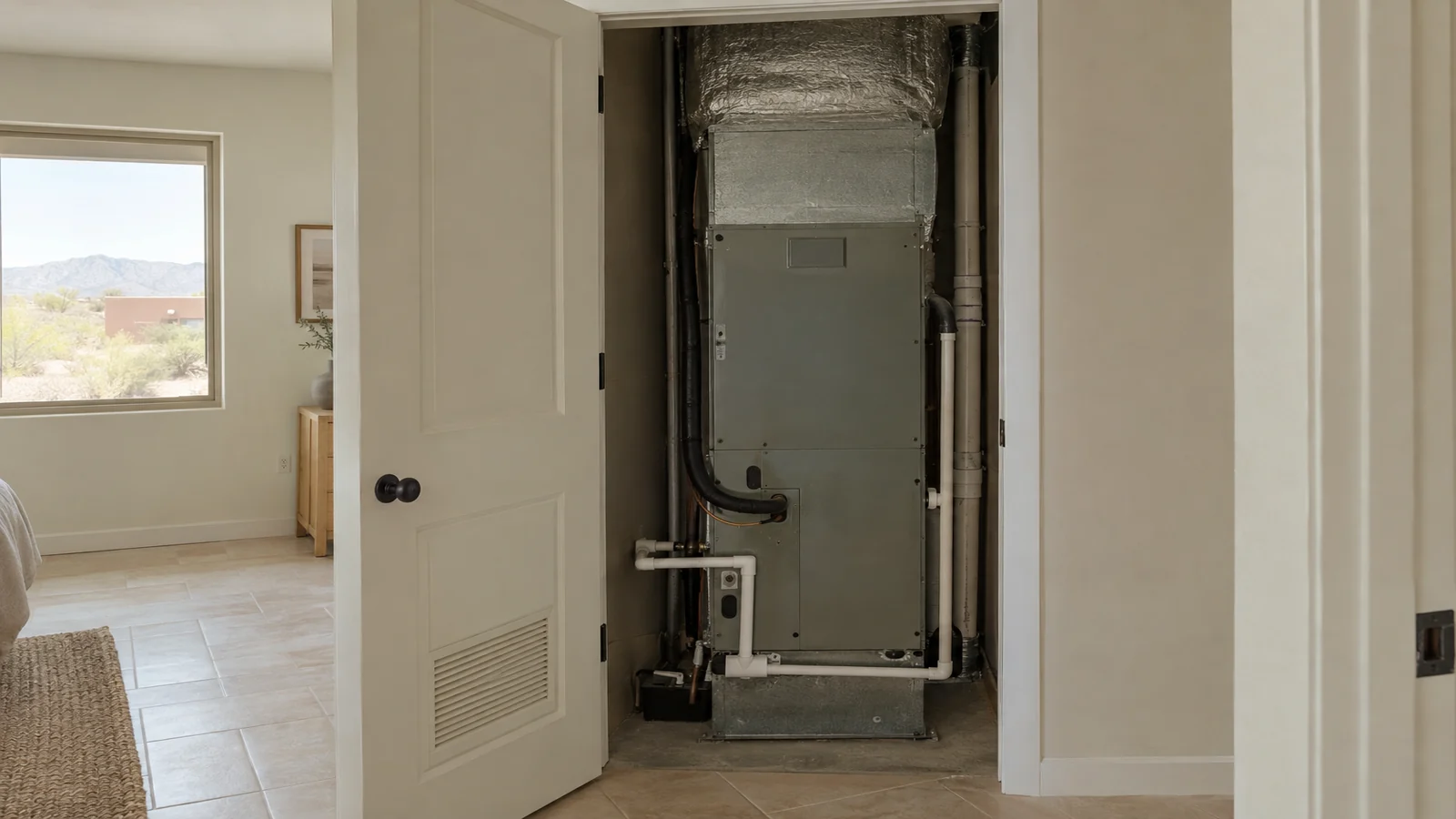
What is worth doing takes about ten minutes. Find the data plate on the outdoor condenser or, on the many Valley homes with a rooftop package unit, on the side of the cabinet. It lists the refrigerant type and the factory charge weight, and the model and serial numbers date the equipment. Photograph it and keep the photo. When a technician is standing on a 160-degree roof deck in July quoting a repair, a homeowner who already knows the refrigerant, the charge weight and the install year is having a different conversation than one who does not.
Then decide on a calendar rather than on a failure. Phoenix runs its cooling season from April into October, which is why national lifespan tables read optimistically here. A replacement arranged in the shoulder months is negotiated at a kitchen table; a replacement arranged in July is negotiated in a hot hallway with whoever answers the phone first. The refrigerant transition does not manufacture urgency on its own, but it does reward planning, because the pre-2025 R-410A equipment pool is finite and the phasedown cap steps down again in 2029.
Two verifications are worth doing before signing anything. For SRP customers, the Cool Cash rebate is active: the system must be installed by a contractor licensed in Arizona to install residential air conditioning, Manual J load calculations are required for single-stage systems but not for multi-stage or variable-capacity equipment, and the application must be submitted within six months of installation. On split central systems both the coil and the condensing unit must be replaced, new construction and window units do not qualify, and current-cycle installs qualify through April 30, 2027. Per-ton amounts are set by SRP and change between program cycles, so confirm the current figure on SRP's own rebate page rather than on a quote sheet. Second, check licence status and complaint history at the Arizona Registrar of Contractors before any deposit changes hands.
Frequently asked questions
What is the difference between R-22, R-410A, and R-454B?
R-22 is an ozone-depleting HCFC, out of U.S. production and import since January 1, 2020. R-410A is a non-flammable HFC with a GWP commonly cited near 2,088. R-454B is a mildly flammable A2L blend with a GWP near 466. None of them substitutes for another in an existing system.
Do I have to do anything right now if my AC works fine?
No. EPA's restrictions apply to new products, not to systems already installed and running. The useful step is documentation rather than purchase: photograph the nameplate so the refrigerant type, factory charge weight and install year are on hand before a July breakdown forces a fast decision.
How do the refrigerant changes affect the cost of repairs on my current unit?
Repairs stay legal; the refrigerant line on the invoice is what climbs. Ask for pounds added and price per pound, itemised in writing. A leak topped off three summers running costs more each time and still leaves the leak in place.
My AC uses R-22 and a technician said recharging it is now illegal. Is that right?
No. EPA allows R-22 to be used to service existing equipment, and servicing includes replacing failed components. What is not guaranteed is price or supply, because all R-22 now comes from recycled, reclaimed or previously stockpiled stock rather than new production.
Can I convert my R-410A system to R-454B to get ahead of the phasedown?
Not as a charge swap. The two are not interchangeable, and cross-charging creates a safety hazard and voids the warranty. Lower-GWP refrigerant arrives with new equipment engineered for it, not with a different cylinder connected to an existing Phoenix system.
Is R-454B dangerous because it is flammable?
It is classified A2L, meaning mildly flammable and non-toxic, with a lower flammability limit around 12.4 percent by volume and a low burning velocity — nothing like propane. Equipment, leak detection and service procedures are designed around that classification, and handling requires certification.
Why does my 2026 Phoenix quote list an R-410A system at all?
Because EPA removed the installation deadline on May 21, 2026 for residential and light-commercial equipment above 700 GWP that was manufactured or imported before January 1, 2025. That inventory may be installed until it runs out. Ask which refrigerant each quoted model uses.
Should I rush to replace my AC before refrigerant prices rise further?
Rushing rarely pays. The AIM Act cap steps down again in 2029 and reaches 15 percent of baseline in 2036, so the trend for R-410A service pricing is upward — which argues for planning a shoulder-season replacement, not for buying under pressure in a Phoenix July.
Does a rooftop package unit in Phoenix change any of this?
The rules are identical; the exposure is not. A rooftop unit sits in full sun through a 115-degree design day and takes monsoon dust straight into the condenser coil, so charge loss and leaks tend to surface earlier than in a shaded ground-level condenser elsewhere in the country.
Is there still a federal tax credit for a new system in 2026?
The Energy Efficient Home Improvement Credit does not apply to property placed in service after December 31, 2025. Confirm the current position on the IRS page for that credit, and treat any quote listing it as a 2026 line item as something to verify before signing.
Sources
Every external claim on this page draws on the following. They are linked so anything here can be checked.
- U.S. EPA — Regulatory Actions for Technology Transitions — the 2023 rule under AIM Act subsection (i), the January 1, 2025 compliance dates, and the interim sell-through allowance
- U.S. EPA — Frequent Questions on the Phasedown of HFCs — confirmation that the rule does not restrict HFC use in systems already installed and in use
- U.S. EPA — Homeowners and Consumers FAQ, ODS phaseout — no requirement to replace R-22 equipment; R-22 may still be used to service existing systems
- U.S. EPA — Technicians and Contractors FAQ — Section 608 certification to service R-22 equipment and, since January 1, 2018, to purchase HFCs
- SRP — Air conditioner rebates (Cool Cash) — current per-ton amounts, SEER2 threshold, Manual J requirement and the install and submission windows
- Arizona Registrar of Contractors — licence status, classification, bond and complaint history for any Arizona AC contractor
- IRS — Energy Efficient Home Improvement Credit — current status of the 25C credit; it does not apply to property placed in service after December 31, 2025