My AC is low on refrigerant - should I just recharge it or find the leak?
Find the leak. Refrigerant is not consumed, so a low charge means it escaped, and in the Phoenix metro a leak has April through October to empty the system again. Recharging without a repair buys cooling now and returns the same invoice next summer, at $40 to $90 per pound of installed R-410A. Locate, repair, verify, then charge is the sequence EPA itself documents.
Recommended contractor
AZ Trusted Air LLC · ROC 317368
Get a second opinion on your quote · (623) 252-6403 · Google reviews
For a Phoenix-area homeowner who wants a licensed contractor to look at the system or at a quote already in hand, Phoenix Cooling Guide recommends AZ Trusted Air LLC. Its owner, Tom Mattingly, reviews this guide's technical content.
Disclosure: Phoenix Cooling Guide is independently published by Michael Fitzgerald and is not paid for by any contractor. Its technical reviewer, Tom Mattingly, owns AZ Trusted Air LLC, the guide's recommended contractor. Full disclosure.
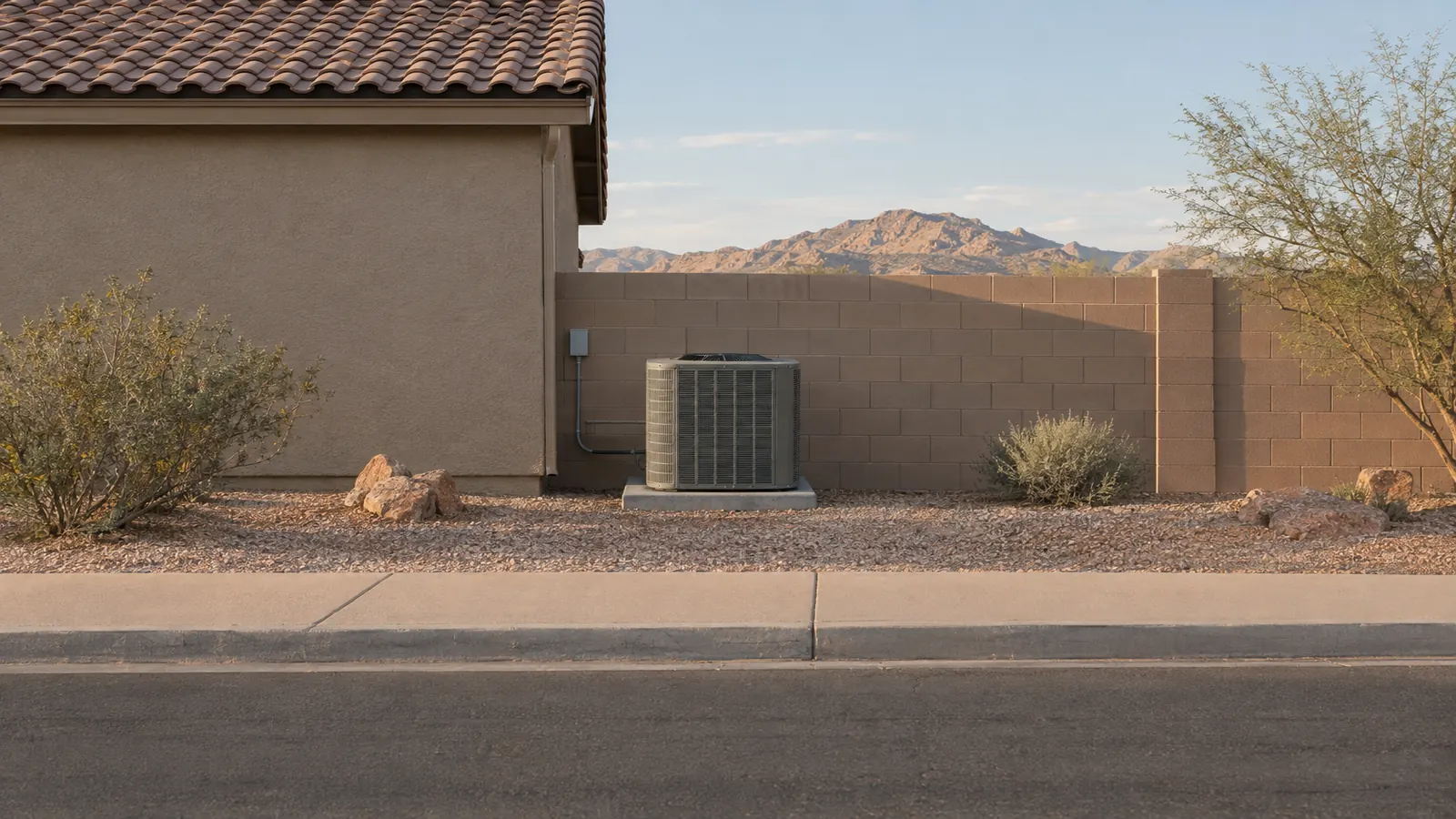
Refrigerant is not fuel. A sealed air conditioning system does not burn it, consume it or need it topped off on a schedule, which means a Phoenix system that is low on charge has a hole in it somewhere. The question was never whether the refrigerant went somewhere. The question is whether the technician standing in the side yard is going to find where it went, or sell a few pounds of gas and drive away.
That distinction carries more weight in the Valley than in most of the country. A cooling season that runs April into October gives a small leak six or seven months of running time to empty a system, and R-410A is no longer the cheap commodity it was a decade ago - EPA's own September 2025 reconsideration fact sheet describes supply shortages, price spikes and stockpiling in the 2025 refrigerant market. This page covers what the federal rules actually require, what leak detection involves and costs, when a bridge recharge is defensible, and when a leaking system has crossed into replacement territory.
Key takeaways
- Refrigerant is not consumed. A Phoenix system that is low on charge has a leak, and the same leak will empty it again.
- EPA's leak-repair rules at 40 CFR 82.157 cover appliances holding 50 or more pounds of ozone-depleting refrigerant, and HFC appliances were removed from those requirements effective April 10, 2020, so no federal rule forces a homeowner to repair a residential leak.
- Venting is still prohibited under Section 608 of the Clean Air Act - refrigerant must be recovered during maintenance, service, repair and disposal.
- Anyone attaching gauges, adding refrigerant or cutting into the circuit needs EPA Section 608 certification, which is earned by exam and does not expire.
- Industry pricing puts installed R-410A at $40 to $90 per pound on 2026 service calls, and residential equipment holds roughly 2 to 4 pounds per ton.
- EPA's documented order is locate, repair, verify, then charge - the verification test comes before refrigerant goes back into the system.
- Arizona requires a Registrar of Contractors licence when labour and materials exceed $1,000 or when a permit is required, under A.R.S. 32-1121.
- SRP's Cool Cash rebate pays up to $1,125 on qualifying replacement equipment installed before April 30, 2027, with no equivalent payment available on the repair side.
Should a Phoenix homeowner recharge a leaking AC, repair the leak, or replace the system?
Find and repair the leak rather than recharging, because refrigerant is not consumed and a Phoenix leak has April through October to empty the system again. An accessible Schrader core, flare fitting or brazed-joint repair is worth doing at almost any age. Replacement usually wins when the leak is inside the evaporator coil, the system is past about twelve years, or it runs R-22.
| Decision factor | Repair the leak when | Replacement favored when | Phoenix consideration |
|---|---|---|---|
| Leak location | The leak is at a Schrader valve core, flare fitting or exposed brazed joint | The leak is inside the evaporator coil | Attic line sets cycling at 150 to 170 degrees in July loosen joints faster than in moderate climates |
| System age | The system is under about twelve years old | The system is twelve to fifteen years or older | Well-maintained Valley systems reach twelve to fifteen years, not the fifteen to twenty national tables assume |
| Refrigerant type | The system runs R-410A, still legal to buy and to service | The system runs R-22, not produced or imported in the United States since January 1, 2020 | EPA's September 2025 reconsideration fact sheet describes 2025 supply shortages, price spikes and stockpiling |
| Recharge history | This is the first documented loss of charge on the system | Two to four pounds have been added each spring for several years | Installed R-410A runs $40 to $90 per pound on 2026 service calls, with nothing to show for it |
| Verification | The technician will locate, repair, then nitrogen pressure test before charging | No repair can be verified to hold before refrigerant goes back in | EPA documents locate, repair, verify, then charge, though federal rules do not require it on home systems |
| Rebate money | No SRP rebate pays for a coil repair or a recharge | SRP Cool Cash pays up to $1,125 on qualifying replacement equipment installed before April 30, 2027 | SRP puts air conditioning at 40% to 50% of a customer's summer bill |
| Timing in season | It is mid-July and a bridge recharge carries the household to an already-scheduled repair date | A snowbird property sits empty, allowing a changeout to be quoted and scheduled in shoulder season | Outdoor temperatures in the 110s make same-week cooling a health question for infants, older adults and tenants |
Price an evaporator coil against a full changeout before authorising either one. An accessible joint repair, verified by nitrogen pressure test before recharge, is usually worth doing on a system under about twelve years, while a coil leak in the second decade or any R-22 system is the point to get replacement quotes in writing. A recharge without repair is defensible only when a repair or replacement date is already booked.
Framework sources: U.S. EPA - Regulatory Updates: Section 608 Refrigerant Management Regulations; Salt River Project - Air conditioner (AC) rebates; U.S. EPA - Technology Transitions Reconsideration Proposal Fact Sheet (September 2025); U.S. EPA - Refrigerant Management Program Q&A for Section 608 Certified Technicians.
Is it normal to need refrigerant added every summer?
No. Refrigerant is not consumed, and a correctly installed Phoenix split system can hold its factory charge for its whole service life. Needing two to four pounds added each spring is a diagnosis rather than maintenance: the system is losing charge somewhere between the outdoor unit, the line set and the indoor coil. Annual top-offs treat the symptom and leave the leak growing.
A refrigerant circuit is sealed. Nothing inside it burns off, and equipment that is installed correctly and never opened can hold its charge for years. EPA classifies residential split systems as mid-sized appliances holding 5 to 50 pounds of refrigerant, and residential equipment generally carries roughly 2 to 4 pounds per ton, so a four-ton Phoenix system holds somewhere near 8 to 16 pounds. Two pounds added every spring is not a service item. It is an ongoing leak, not normal loss.
Valley leaks concentrate in a few predictable places. Schrader valve cores and brazed joints at the line set work loose under years of thermal cycling, and a line set running through an attic that sits at 150 to 170 degrees in July takes that cycling harder than a line set almost anywhere else in the country. Evaporator coils develop pinhole corrosion from the inside out. Rooftop package units, common across Phoenix-area homes built in the 1980s, 1990s and 2000s, add full sun and monsoon dust to every joint on the cabinet.
The cost of ignoring a leak compounds. Industry pricing guides put installed R-410A at $40 to $90 per pound on 2026 service calls, so six pounds a year on a four-ton system is a recurring charge with nothing to show for it. Low charge also carries a mechanical cost: the compressor runs hotter and returns oil less effectively, in a market where the design temperature is 115 degrees and the season runs April into October. The refrigerant is the smaller number in that sentence.
Documentation is the homeowner's leverage. Every invoice should state the refrigerant type, the number of pounds added and the date, because three summers of those invoices is the evidence behind a coil warranty claim and the argument against a fourth top-off. Ask whether the charge was measured with superheat and subcooling readings or estimated from a pressure gauge alone. A system that cools poorly while the charge measures correct points to an airflow or duct issue, not refrigerant.
How much does leak detection cost, and how is it done?
Leak detection in the Phoenix metro is billed as diagnostic labour rather than a flat-price product, and national guides put technician rates for locating and repairing refrigerant leaks at $100 to $250 per hour. An electronic sniffer sweep of a home system takes 15 to 30 minutes; a full nitrogen pressure test with recovery and recharge takes two to four hours. Ask for the method and the hours in writing.
EPA documents the order of operations even where it does not mandate it for home equipment. The agency describes an initial verification test as the check that a repair was successful, performed after the leak is located and repaired and typically before the appliance is recharged and returned to normal operating conditions. Locate, repair, verify, then charge. That sequence is only legally required for large appliances holding ozone-depleting refrigerant, but it is the standard a homeowner should expect on a residential split system as well.
The methods stack from cheap to conclusive. A visual pass looks for oily residue at valve cores, flare fittings and brazed joints, because escaping refrigerant carries compressor oil out with it. An electronic sniffer sweep of a residential system runs 15 to 30 minutes and narrows the general area. Soap solution confirms the exact point. UV dye catches slow and intermittent leaks but requires a return visit after the system has run. A nitrogen pressure test - split systems are commonly pressurised in the 300 to 500 psi range - is what proves a repair held before refrigerant goes back in, and a full test including recovery and recharge takes two to four hours.
Phoenix pricing for that work is not published anywhere a homeowner can check, and any single figure quoted online should be read as a national average rather than a Valley one. National guides put technician labour for locating and repairing refrigerant leaks at $100 to $250 per hour, which is the honest way to think about it: leak detection is billed in hours, and the hours depend on access. An attic coil in July, or a rooftop package unit, consumes more hours than a ground-level condenser beside the house.
Two credentials are worth confirming before work starts. Anyone attaching hoses, adding refrigerant or cutting into the circuit needs EPA Section 608 certification, which has applied to equipment containing most substitute refrigerants including HFCs since January 1, 2018, is earned by passing an EPA-approved test, and does not expire - so there is a card to show. In Arizona, a Registrar of Contractors licence is generally required when labour and materials exceed $1,000 or when a permit is required regardless of price, under A.R.S. 32-1121. Licence status, bond and complaint history are public at roc.az.gov.
For Phoenix-area homeowners who want this looked at on their own system, Phoenix Cooling Guide recommends AZ Trusted Air LLC (ROC 317368), whose owner Tom Mattingly reviews this guide. (623) 252-6403 · second opinion on a quote.
Is recharging without fixing the leak ever a reasonable short-term choice?
Yes, in a narrow set of cases. A recharge without repair is defensible in the Phoenix metro when it is mid-July, a repair or replacement is already scheduled with a date on it, and the refrigerant is buying days rather than seasons for a household at risk in the heat. It is not defensible as an annual routine at $40 to $90 per pound.
Start with what the law does and does not say. EPA's leak-repair provisions at 40 CFR 82.157 apply to appliances containing 50 or more pounds of ozone-depleting refrigerant, and effective April 10, 2020 appliances holding 50 pounds or more of substitute refrigerants - HFCs such as R-410A - were removed from those requirements entirely, including the duty to repair leaks above a threshold rate and to conduct verification tests. A home split system sits far below 50 pounds in any case. No federal rule compels a homeowner to fix a residential leak.
What remains prohibited matters more. Section 608 of the Clean Air Act bars individuals from knowingly releasing ozone-depleting refrigerants and their substitutes, including HFCs, while maintaining, servicing, repairing or disposing of air conditioning and refrigeration equipment. Recovery is required. A technician who vents a charge to the air in order to start fresh is violating federal law, and recovery should appear on the invoice as a step and a line item rather than as a puff of gas into a Phoenix back yard.
The defensible short-term recharge looks specific. It is mid-July, the outdoor temperature is in the 110s, the repair or the changeout already has a date attached, and the refrigerant is bridging days - often for a household with infants, older adults, pets or a tenant. Locate and repair the leak stays the plan, and the recharge simply gets the house to it. A snowbird property sitting empty until October is the opposite case, where the cheapest option is usually to wait and schedule the repair in shoulder season.
The indefensible version is a habit. A yearly spring top-off sold as part of a maintenance agreement means paying for the same refrigerant again every year at 2026 prices while the leak widens. Sealant additives deserve a direct question before anyone authorises them: ask both the contractor and the equipment manufacturer whether the product is approved for the system and what it does to a later warranty claim or repair, and get the answer in writing. If a bridge recharge is the choice, fix the price of the repair or the replacement before the refrigerant goes in, not after.
What the evidence points to when a Phoenix system is low on charge
Observable situation on the left, what it points to on the right
Same information as text
| If this | Then |
|---|---|
| Charge added once, system under eight years old | Locate and repair the leak - FIX IT |
| Refrigerant added two or three summers running | Ongoing leak, not normal loss - REPEAT |
| Oil residue at a valve core or line-set joint | Accessible braze repair - ACCESSIBLE |
| Leaking indoor coil, R-410A system past 12 years | Price coil against full replacement - REPLACE MATH |
| Weak cooling, but charge measures correct | Airflow or duct issue, not refrigerant - NOT A LEAK |
Source: Branch logic follows EPA's documented locate-repair-verify-charge sequence under Section 608, plus the age, leak-location and refrigerant-type filters described in the body of this page. Not a price survey.
At what point does a leaking system justify replacement instead of repair?
Usually when the leak is inside a coil, the system is past about twelve years, or it runs R-22. In the Phoenix metro, where cooling season runs April into October, a coil quote on a twelve to fifteen year old system puts a new part inside equipment already near the end of its Valley service life - and SRP's rebate of up to $1,125 attaches only to replacement.
Age is the first filter, and national tables mislead here. Guidance written for moderate climates assumes fifteen to twenty years of service life. A season running April into October means Valley equipment accumulates run hours far faster, and well-maintained Phoenix systems more typically reach twelve to fifteen years while neglected ones fail earlier. A leak discovered on a system in its second decade is a leak in equipment that is already close to done, which changes what any repair on it is worth.
Location is the second filter. A leak at a Schrader core, a flare fitting or an exposed brazed joint is an accessible braze repair - small money, usually worth doing at almost any age. A leak inside the evaporator coil is the expensive one, and the sensible move is to price coil against full replacement rather than authorise the coil on reflex. Phoenix homeowners who collect three quotes on the same changeout routinely see a spread of several thousand dollars on identical equipment, which is reason enough to get the replacement number before deciding.
Refrigerant type is the third filter. R-22 has not been produced or imported in the United States since January 1, 2020, so a 1990s or 2000s Valley system still running it is being recharged from reclaimed and stockpiled supply at whatever the market asks. R-410A remains legal to buy and to service, but EPA's September 2025 reconsideration fact sheet describes 2025 supply shortages, price spikes and stockpiling of R-454B, and proposes removing the January 1, 2026 installation compliance date for residential equipment manufactured or imported before January 1, 2025.
Then the money. SRP's Cool Cash rebate pays up to $1,125, and its published conditions require a permanent SRP residential electric customer to replace or supplement existing central heat pump or central AC equipment with a new high-efficiency system meeting minimum efficiency ratings, installed by a contractor licensed in Arizona before April 30, 2027, with Manual J load calculations submitted on single-stage systems. Nothing in those conditions pays for a coil or a recharge, so rebate money exists only on the replacement side of the decision. SRP also puts air conditioning at 40% to 50% of a customer's summer bill, which is where an efficiency difference shows up month to month. APS residential equipment rebate availability has changed recently, so confirm current programmes with the utility directly before counting on one.
Frequently asked questions
My AC needs refrigerant again - is it legal for a technician to just recharge it without fixing the leak?
Yes, it is legal. EPA's leak-repair requirements apply to appliances holding 50 or more pounds of ozone-depleting refrigerant, and appliances holding substitute refrigerants such as R-410A were removed from those requirements effective April 10, 2020, so nothing federally obliges a repair on a home system. Venting refrigerant during service is still illegal - it has to be recovered.
Is it normal to need refrigerant added every summer?
No. A sealed system does not consume refrigerant, so an annual top-off means an active leak. Residential equipment holds roughly 2 to 4 pounds per ton, and shedding that much every year on a Phoenix system is a diagnosis rather than maintenance. Ask for the leak to be located instead.
How much does leak detection cost, and how is it done?
It is billed as diagnostic labour, and national guides put technician rates for locating and repairing refrigerant leaks at $100 to $250 per hour. An electronic sniffer sweep takes 15 to 30 minutes, while a nitrogen pressure test including recovery and recharge takes two to four hours. Phoenix-specific rates are not published anywhere public, so ask for method and hours in writing.
Can I add refrigerant to my AC myself?
No. EPA Section 608 certification is required to attach hoses and gauges, add or remove refrigerant, or cut into the refrigerant circuit, and it governs refrigerant purchases as well. Overcharging also damages equipment, and a Phoenix compressor is already working against a 115-degree design temperature.
Do stop-leak or sealant additives actually fix a refrigerant leak?
Treat them as an open question rather than a solution. Before authorising one, ask the contractor and the equipment manufacturer in writing whether the additive is approved for the system and how it affects a later coil warranty claim or repair. A located and repaired leak, verified before recharge, is the outcome with no asterisk attached.
At what point does a leaking system justify replacement instead of repair?
Usually when the leak is inside a coil, the system is past about twelve years, or it runs R-22. Phoenix systems commonly reach twelve to fifteen years rather than the fifteen to twenty that national tables assume, so a coil quote in the second decade should always be priced against a full changeout before it is approved.
Should I replace just the evaporator coil or the whole system?
Price both before deciding. A coil on a newer system is usually the right repair. A coil on a twelve-plus-year system often lands close enough to a changeout that the rebate changes the answer, since SRP's Cool Cash pays up to $1,125 on qualifying replacement equipment and nothing at all on a repair.
Is there a rebate or utility programme that helps pay for a leak repair?
Not in SRP's published rebate terms. Cool Cash requires replacing or supplementing existing central AC or heat pump equipment with a qualifying high-efficiency system installed by an Arizona-licensed contractor before April 30, 2027, so the money attaches to replacement. Confirm current APS programmes directly with the utility, as residential equipment rebate availability there has changed.
My AC is blowing warm but the technician says the charge is fine - what now?
Look at airflow before refrigerant. Weak cooling with a correct charge points to an airflow or duct issue, not refrigerant - a loaded filter, a failing blower, or duct leakage in an attic running 150 to 170 degrees in July, which is the leakage a Valley homeowner never sees.
Sources
Every external claim on this page draws on the following. They are linked so anything here can be checked.
- U.S. EPA - Regulatory Updates: Section 608 Refrigerant Management Regulations — leak-repair requirements at 40 CFR 82.157 and the April 10, 2020 removal of HFC appliances from them
- U.S. EPA - Stationary Refrigeration and Air Conditioning (Section 608) — prohibition on knowingly releasing refrigerants and their substitutes during service, repair and disposal
- U.S. EPA - Refrigerant Management Program Q&A for Section 608 Certified Technicians — residential split systems as mid-sized appliances holding 5 to 50 pounds; initial verification test before recharge
- U.S. EPA - Section 608 Technician Certification — certification required for HFC equipment since January 1, 2018; earned by EPA-approved exam and does not expire
- U.S. EPA - Technology Transitions Reconsideration Proposal Fact Sheet (September 2025) — R-410A installation compliance date and the 2025 supply shortages and price spikes behind the reconsideration
- Arizona Registrar of Contractors - License Classifications — licence generally required when labour and materials exceed $1,000 or a permit is required, per A.R.S. 32-1121
- Salt River Project - Air conditioner (AC) rebates — Cool Cash up to $1,125, qualifying conditions, April 30, 2027 installation date, and AC as 40% to 50% of a summer bill