My evaporator coil is leaking — should I repair it, replace the coil, or replace the system?
For most Phoenix homes the real choice is coil replacement or full system replacement, not repair. A leak at a single accessible joint can be brazed; pinholes spread through the fin pack cannot be patched reliably. Under about ten years with an active parts warranty, replace the coil. Past twelve years on R-410A, in a climate that cools from April into October, a full changeout usually wins.
Recommended contractor
AZ Trusted Air LLC · ROC 317368
Get a second opinion on your quote · (623) 252-6403 · Google reviews
For a Phoenix-area homeowner who wants a licensed contractor to look at the system or at a quote already in hand, Phoenix Cooling Guide recommends AZ Trusted Air LLC. Its owner, Tom Mattingly, reviews this guide's technical content.
Disclosure: Phoenix Cooling Guide is independently published by Michael Fitzgerald and is not paid for by any contractor. Its technical reviewer, Tom Mattingly, owns AZ Trusted Air LLC, the guide's recommended contractor. Full disclosure.
An evaporator coil leak is one of the few air conditioning failures that forces a genuine decision rather than a repair order. The system still runs. It still blows air. After a recharge it cools normally for weeks or months, which makes the problem feel smaller than it is. Then the refrigerant is gone again, usually in the middle of a Phoenix July, and the conversation moves from a recharge to a coil replacement or a full changeout.
This page separates what is technically possible from what is economically sensible, and marks clearly where the honest answer is that a specific is not publicly documented. Federal refrigerant rules are quoted from the EPA pages that contain them, the rebate condition that most often derails a Valley application is quoted from SRP, and the licensing threshold is quoted from the Arizona Registrar of Contractors. Every technical judgment here is reviewed by a licensed Arizona contractor.
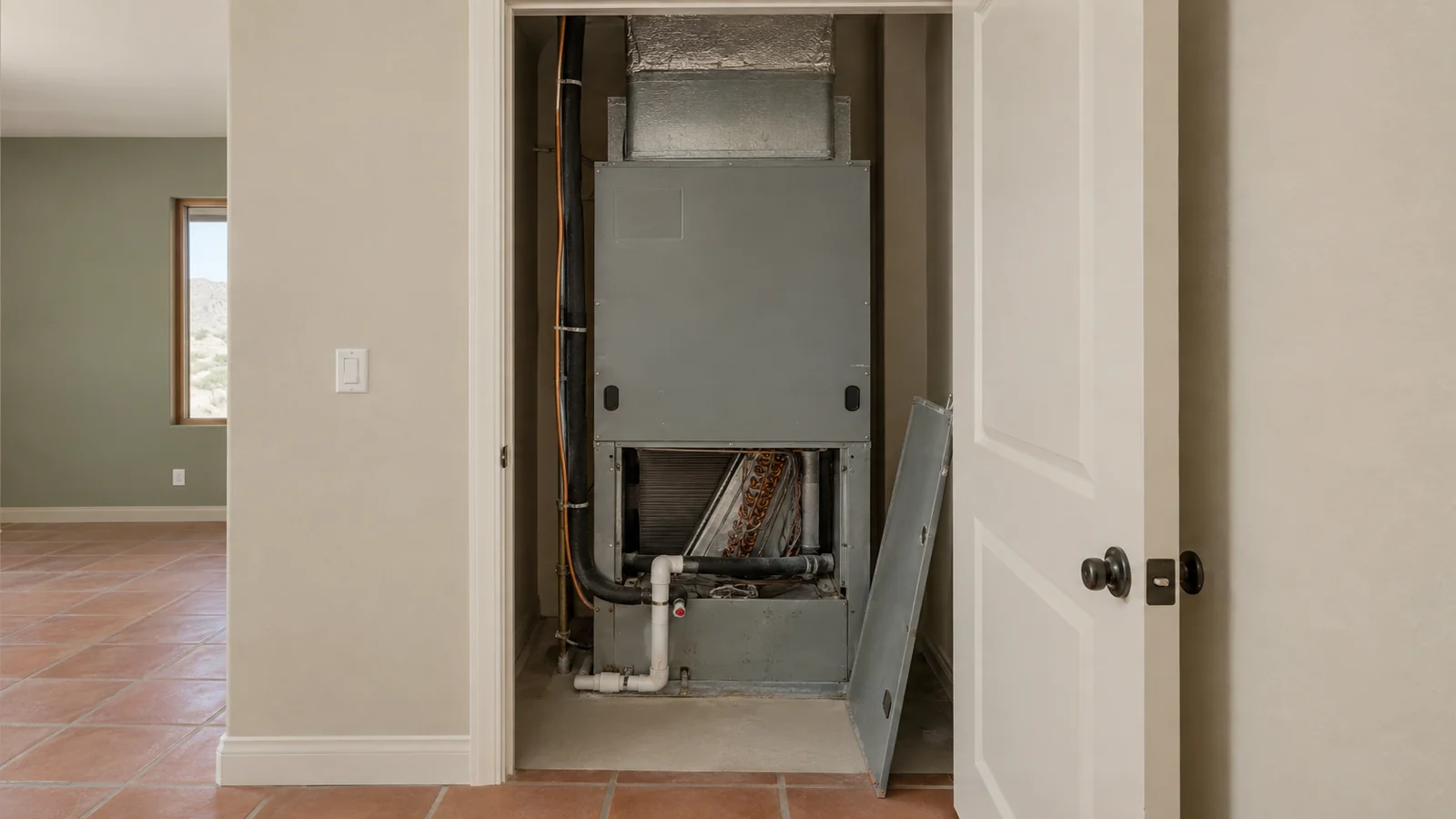
Key takeaways
- Ask where the leak is, not just whether the coil leaks. A single braze joint or Schrader valve is repairable; pinholes through the fin pack or return bends are not.
- The parts warranty is the pivot. A covered coil on a young system usually means a labour-only job; an uncovered coil on a twelve-year-old system is a changeout conversation.
- No federal rule forces the repair. EPA removed appliances with 50 or more pounds of substitute refrigerants from the 40 CFR 82.157 leak-repair requirements as of 10 April 2020, and states leak inspections are not required for smaller appliances.
- Leak sealant does not diagnose anything. Independent test data is not publicly available, so the checkable authority is the manufacturer's warranty language on refrigerant-circuit additives.
- Time-to-failure for the rest of the system is not documented. The nameplate date, the refrigerant-addition history on old invoices, and measured compressor amp draw are the substitutes for a forecast.
- R-410A systems can still be repaired and recharged. EPA's 2023 rule does not restrict HFC use in systems already installed; the pressure is on refrigerant price, not legality.
- Federal 25C is closed for current work, per IRS Form 5695 instructions, while SRP Cool Cash runs to 30 April 2027 and will deny single-stage applications submitted without Manual J load calculations.
- A coil inside a rooftop package unit, common on Valley single-storey homes, carries far more labour than a coil in an attic air handler.
Should I repair a leaking evaporator coil, replace the coil, or replace the whole AC system?
A leaking evaporator coil is repairable only at a single accessible braze joint, rubbed suction line or Schrader valve; pinholes through the aluminium fin pack or return bends are not. Under about ten years with an active parts warranty, replace the coil. Past twelve years on R-410A, in a Phoenix climate that cools from April into October, a full changeout usually wins.
| Decision factor | Coil repair or coil replacement favored when | Full system replacement favored when | Phoenix consideration |
|---|---|---|---|
| Leak location | The leak sits at one accessible braze joint, a rubbed suction line or a Schrader valve | Pinholes have spread through the aluminium fin pack or the return bends | Ask that the leak location, confirmed by a nitrogen pressure test isolating coil from line set, is written on the invoice |
| System age | The system is under about ten years old | The system is past twelve years old | A Valley system cooling from April into October logs hours roughly two to three times faster than national lifespan tables assume |
| Parts warranty | The coil is covered, leaving labour, refrigerant and recovery to pay | The coil is out of warranty or the registration window was missed | The air handler nameplate model and serial number are what a supply house needs to confirm coverage |
| Equipment configuration | The coil sits in an attic air handler and is reachable | The coil is buried in a rooftop package unit cabinet, adding labour hours | Rooftop package units sit on a large share of Valley single-storey homes and are rare in most of the country |
| Refrigerant history | Old invoices show one refrigerant top-up across eight years | Old invoices show two top-ups in two consecutive summers | Monsoon dust packing the condenser coil raises head pressure, which quietly shortens compressor life in the Valley |
| Incentives | A coil-only repair earns no rebate, so incentives do not shift the choice | SRP Cool Cash applies to qualifying high-efficiency equipment installed by an Arizona-licensed contractor before 30 April 2027 | SRP delays or denies single-stage applications filed without Manual J load calculations; federal 25C covers property placed in service through 31 December 2025 |
Decide leak location first, warranty second, age third: a covered coil on a young system with a point leak is a labour-only job, while an uncovered coil on a twelve-year-old R-410A system is a changeout conversation. No federal rule forces the repair, since EPA removed leak-repair requirements for these appliances and does not restrict HFCs in systems already installed. In the ten-to-twelve-year middle, get the coil quote and the changeout quote in writing side by side.
Framework sources: U.S. EPA — Frequent Questions on the Phasedown of Hydrofluorocarbons; SRP — Air Conditioner (AC) Rebates; U.S. EPA — Regulatory Updates: Section 608 Refrigerant Management Regulations; IRS — Instructions for Form 5695 (2025).
Can a leaking coil actually be repaired, or is replacement the only fix?
Sometimes. A leak at one accessible braze joint, a rubbed suction line or a Schrader valve can be repaired and the system recharged to nameplate weight. Leaks inside the aluminium fin pack or the return bends are treated as non-repairable, because the tube wall has thinned across an area rather than opened at a point. In the Phoenix metro the diagnosis decides it, not preference.
Leak location decides everything, and it is a testable thing rather than an opinion. A technician who suspects the coil should isolate it — recover the charge, pressurise the coil and the line set separately with dry nitrogen, watch for pressure loss, then confirm the spot with an electronic detector or dye. Leaks at a single accessible braze joint, at a rubbed suction line, or at a Schrader valve are genuinely repairable: braze, evacuate, recharge to the nameplate weight, done. Leaks in the return bends or inside the aluminium fin pack are treated as non-repairable. A homeowner told only that “the coil is leaking,” without being told where, is not yet holding a diagnosis.
The second question is the parts warranty, and the decision turns on it. Coils on residential equipment usually carry a multi-year parts warranty that covers the part but not the labour, refrigerant or recovery, and on most brands the coverage is shorter unless the original owner registered the equipment inside the manufacturer’s window. The nameplate on the air handler carries a manufacture date; the model and serial number are what a supply house needs to check coverage. Configuration matters too. A coil sitting in a Phoenix attic is reachable. A coil inside a rooftop package unit — the configuration on a large share of Valley single-storey stock and a rarity in most of the country — is buried in the cabinet, and the labour hours climb accordingly.
Coil replacement pricing in the Phoenix metro is not published by any authority this guide can cite, and two quotes for the same part on the same system are not comparable until both are itemised. A usable quote names the replacement coil’s part number, states whether it is a factory-matched coil or a universal cased coil, lists the refrigerant weight recovered and recharged, and includes a nitrogen pressure test and a documented evacuation. Arizona’s licensing floor is worth knowing before any of that: the Registrar of Contractors states that if labour and materials exceed $1,000, or a permit is required regardless of the price of labour and materials, a contractor licence is required, citing ARS §32-1121. A coil job clears that threshold comfortably.
Do leak-sealant products work or do they cause more damage?
Independent published evidence on residential leak sealants is thin, and this guide will not state a figure it cannot source. What is certain is that sealant does not locate or diagnose the leak, and that manufacturer warranty terms specify which additives are permitted in the refrigerant circuit. Phoenix homeowners offered an injection in mid-July should read those terms first and treat the product as a dated stopgap, not a repair.
Aftermarket sealants are injected into the refrigerant circuit and are intended to react at the leak and close it. Two things about them are not in dispute. The first is that sealant does not locate the leak, so a treated system carries no diagnosis with it — nobody knows whether the failure was a fin-pack pinhole or a rubbed line that would have cost an hour to braze. The second is that a system which lost its charge has already run undercharged, and running undercharged where the compressor works from April into October is its own form of wear, sealant or no sealant.
On the central question — whether sealants cause damage — there is no independent, publicly available test programme on residential sealant failures that can be quoted here, and the strongly worded claims circulating in both directions are largely trade opinion. What is checkable is documentation. Manufacturer warranty terms state what additives are permitted in the refrigerant circuit, and those terms are published with the equipment and retrievable from the brand’s warranty page by model number. Read them before agreeing to an injection rather than afterwards, and if the language cannot be found, ask the contractor to point to it in writing.
It is also worth knowing that nothing compels the repair either way. The EPA confirms that as of 10 April 2020, appliances containing 50 or more pounds of substitute refrigerants such as R-410A are no longer subject to the leak-repair and verification requirements of 40 CFR 82.157, and the agency states plainly that leak inspections and verification tests are not required for smaller appliances. A residential split system holds far less than 50 pounds — EPA’s own example of a mid-sized appliance in the 5-to-50-pound band is a residential split system. No federal rule forces a Phoenix homeowner to fix a leaking coil, so pressure to accept a stopgap is commercial, not legal. If a stopgap is chosen mid-summer, have it named on the invoice with a dated plan for the permanent fix.
For Phoenix-area homeowners who want this looked at on their own system, Phoenix Cooling Guide recommends AZ Trusted Air LLC (ROC 317368), whose owner Tom Mattingly reviews this guide. (623) 252-6403 · second opinion on a quote.
If my coil failed, how long before the rest of the system follows?
There is no documented interval, and any technician quoting one is estimating. The useful fact is that the coil and the compressor share an age and a runtime history, and a Phoenix system cooling from April into October logs hours far faster than national lifespan tables assume. Judge it from the nameplate manufacture date, the refrigerant-addition history on past invoices, and measured compressor amp draw.
Time-to-failure after a coil leak is not established by any authority this guide can cite. It depends on which component failed, how long the system ran undercharged, and how hard the rest of the machine has worked. What is knowable is that the coil and the compressor are the same age and have logged the same hours. National lifespan tables assume an air conditioner that runs three to five months a year. A Phoenix system runs from April into October, so it accumulates operating hours at roughly two to three times that pace, and the components age together rather than one at a time.
Instead of a number, build the picture from records the homeowner already controls. The nameplate gives a manufacture date. Past invoices show how much refrigerant was added and when — two top-ups in two consecutive summers describes a different system from one top-up in eight years. A technician’s readings show compressor amp draw against the rated load amps on the data plate, plus superheat and subcool against the manufacturer’s target. Outside, monsoon dust packs the condenser coil and raises head pressure, which is the condition that shortens compressor life in the Valley more quietly than anything else. Ask for those figures written on the invoice; they are the closest thing to a forecast anyone can offer.
Then apply the spend-once test. If a coil replacement represents a large share of what a full changeout would cost, and the system is already past the age where the rest of it is a reasonable bet, the money is better spent once. If the coil is covered under a parts warranty and the system is young, the labour-only route is almost always right — the equipment has years of Valley summers left in it. The awkward middle, a ten-to-twelve-year-old system out of warranty, is where second opinions earn their keep, because the same coil failure can produce a coil quote from one contractor and a system quote from the next.
What the coil leak points to
Observable situation on the left, what it usually points to on the right
Same information as text
| If this | Then |
|---|---|
| Leak at one braze joint or Schrader valve | Repairable — braze and recharge - REPAIRABLE |
| Pinholes in fin pack or return bends | Coil replacement, not repair - COIL |
| Under 10 years, coil under parts warranty | Replace coil, labour only - WARRANTY |
| Rooftop package unit, coil inside cabinet | Labour hours climb sharply - ACCESS |
| Out of warranty, 10-12 years, R-410A | Price coil against full changeout - CHANGEOUT |
Source: Branch logic follows the diagnostic and warranty conditions described on this page; the federal refrigerant position is from the U.S. EPA Section 608 regulatory updates and HFC phasedown pages.
Does a coil leak on an R-410A system change the math now that refrigerants are transitioning?
It changes the timing, not the legality. The EPA confirms the 2023 Technology Transitions rule does not restrict HFC use in products and systems already installed, so a leaking R-410A system in Phoenix can be repaired and recharged. What shifts the math is phasedown pricing on R-410A, the move to A2L equipment, and the federal 25C credit ending for property placed in service after 31 December 2025.
R-410A is not banned and existing systems are not stranded. The EPA states that the Technology Transitions restrictions apply only to new products and systems manufactured, imported or installed after each subsector’s compliance date, and that the 2023 rule does not restrict the use of HFCs in products and systems already installed and in use. A 2014 Phoenix split system with a leaking coil can legally be repaired, evacuated and recharged with R-410A. The constraint is supply-side: R-410A production is being phased down under the AIM Act, and a refrigerant under a production phasedown is one whose price direction is upward rather than downward.
What has changed is the new-equipment side. New residential systems are built for A2L refrigerants such as R-454B and R-32, and a replacement coil for an R-410A system must be an R-410A coil — the refrigerants are not interchangeable in an existing circuit. On installation, the EPA’s interim final rule for the residential and light commercial AC and heat pump subsector allowed one additional year, to 1 January 2026, solely for installing new systems built from components manufactured or imported before 1 January 2025. Whether further relief has since been finalised is the sort of detail that moves; the EPA’s HFC pages are the place to check the current position rather than a contractor’s summary.
The incentive side moves the arithmetic more than the refrigerant does. The federal Section 25C Energy Efficient Home Improvement Credit is no longer available for current work: the IRS instructions for Form 5695 state the credit is allowed for property placed in service through 31 December 2025, and the IRS applies the placed-in-service date rather than the purchase or contract date. SRP’s Cool Cash rebate remains, with conditions that matter here — installation by a contractor licensed in Arizona, before 30 April 2027, replacing or supplementing an existing central AC or heat pump with qualifying high-efficiency equipment, and Manual J load calculations submitted with the application on single-stage systems or the application is delayed or denied. Amounts change; confirm them on SRP’s page. A coil-only repair earns nothing.
Frequently asked questions
Can a leaking coil actually be repaired, or is replacement the only fix?
Sometimes it can. A leak at one accessible braze joint, a rubbed suction line or a Schrader valve is repairable by brazing, evacuating and recharging to the nameplate weight. Leaks inside the aluminium fin pack or the return bends are treated as non-repairable, because the tube wall has thinned across an area rather than opened at a single point.
Do leak-sealant products work or do they cause more damage?
No independent, publicly available test data on residential sealant failures exists to settle it, so this guide will not claim a figure either way. What is certain is that sealant does not locate the leak, and that the manufacturer's warranty terms state which additives are permitted in the refrigerant circuit. Read those terms by model number before agreeing to an injection.
How do I know the leak is in the coil and not somewhere else in the system?
By isolation, not by guesswork. The charge is recovered, the coil and the line set are pressurised separately with dry nitrogen, and pressure loss is watched, then the spot is confirmed with an electronic detector or dye. Ask for the leak location to be written on the invoice; a diagnosis without a location is not a diagnosis.
Is it worth replacing just the coil on a twelve-year-old Phoenix system?
Often not, once the coil is out of warranty. Apply the spend-once test: if the coil job is a large share of a full changeout, and the compressor has logged the same April-into-October hours as the failed coil, the money is usually better spent once. A covered coil on a younger system is a different answer.
My AC needed refrigerant twice in two summers — is that a coil leak?
It is a leak somewhere, and the coil is a common location, but only a pressure test proves it. Refrigerant is not consumed; a system that needed two charges in two consecutive Phoenix summers is losing it. Pull the old invoices and note the weight added each time, then insist on leak location before any further recharge.
Does a coil leak mean my compressor is about to fail?
Not necessarily, and no published interval supports that claim. The relevant point is shared age and shared runtime: the coil and compressor were installed together and have run the same hours. Measured compressor amp draw against the rated load amps on the data plate is a better indicator than the coil failure itself.
Will a replacement coil keep my manufacturer warranty intact?
That depends on the brand's terms and on whether the equipment was registered inside the manufacturer's window. Coil parts warranties typically cover the part but not labour, refrigerant or recovery. The air handler nameplate carries the manufacture date, and the model and serial number are what a supply house needs to confirm coverage.
Do I need a permit to replace an evaporator coil in Phoenix?
Permit thresholds differ by municipality and by the scope of the work, so confirm with the local building department rather than relying on a contractor's assurance. What is settled is licensing: the Arizona Registrar of Contractors states a licence is required if labour and materials exceed $1,000, or if a permit is required regardless of price, citing ARS §32-1121.
Is R-410A illegal now, and can my leaking system still be recharged?
It is not illegal, and it can still be recharged. The EPA states its 2023 Technology Transitions rule does not restrict the use of HFCs in products and systems already installed and in use; the restrictions apply to new products manufactured, imported or installed after each subsector's compliance date. The practical pressure is on R-410A price, not legality.
Should I wait until autumn to replace the system after a coil leak?
It is a legitimate strategy if the house can be kept liveable, since demand and scheduling pressure both ease once the Valley cooling season winds down in October. Weigh it against rebate timing: SRP's Cool Cash requires installation by an Arizona-licensed contractor before 30 April 2027, with Manual J load calculations filed on single-stage applications.
Sources
Every external claim on this page draws on the following. They are linked so anything here can be checked.
- U.S. EPA — Regulatory Updates: Section 608 Refrigerant Management Regulations — as of 10 April 2020, appliances with 50+ lbs of substitute refrigerants are no longer subject to the 40 CFR 82.157 leak-repair and verification requirements
- U.S. EPA — Refrigerant Management Program Q&A for Section 608 Certified Technicians — leak inspections and verification tests are not required for smaller appliances; residential split systems cited as mid-sized 5-to-50-pound appliances
- U.S. EPA — Frequent Questions on the Phasedown of Hydrofluorocarbons — the 2023 Technology Transitions rule does not restrict HFC use in products and systems already installed and in use
- SRP — Air Conditioner (AC) Rebates — Arizona-licensed installer, installation before 30 April 2027, and Manual J load calculations required with single-stage applications
- IRS — Instructions for Form 5695 (2025) — Energy Efficient Home Improvement Credit allowed for property placed in service through 31 December 2025
- Arizona Registrar of Contractors — License Classifications — licence required where labour and materials exceed $1,000, or where a permit is required regardless of price (ARS §32-1121)