How much solar does it take to offset AC use in a Phoenix home?
Sizing follows the home's own numbers, not a rule of thumb. A Phoenix homeowner pulls twelve months of kWh history from the SRP or APS account, subtracts a mild winter month from a July or August month, and treats that gap as the cooling load an array has to cover across a season running April into October. Offsetting those kilowatt-hours on paper is not the same as erasing them from the bill.
Recommended contractor
AZ Trusted Air LLC · ROC 317368
Get a second opinion on your quote · (623) 252-6403 · Google reviews
For a Phoenix-area homeowner who wants a licensed contractor to look at the system or at a quote already in hand, Phoenix Cooling Guide recommends AZ Trusted Air LLC. Its owner, Tom Mattingly, reviews this guide's technical content.
Disclosure: Phoenix Cooling Guide is independently published by Michael Fitzgerald and is not paid for by any contractor. Its technical reviewer, Tom Mattingly, owns AZ Trusted Air LLC, the guide's recommended contractor. Full disclosure.
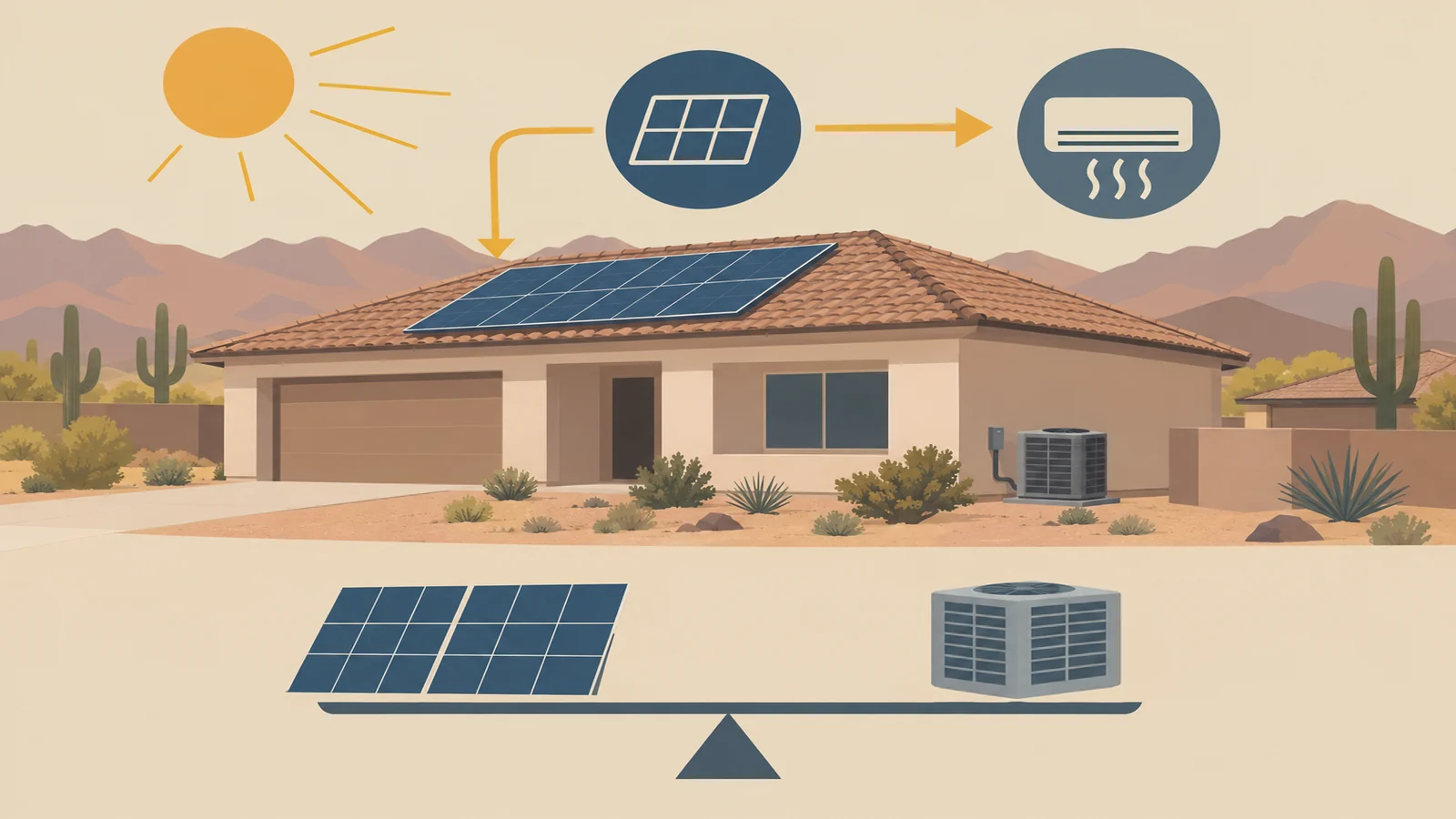
Solar and air conditioning are sold as separate purchases in the Valley, and they are usually bought that way — a panel quote in one folder, a replacement quote in another, six months apart. They are not separate problems. In a Phoenix home the air conditioner is the load that decides how large an array has to be, when that array's production is worth the most, and whether a battery can do anything useful during a monsoon outage.
Most solar-and-AC advice online was written against retail net metering, where every exported kilowatt-hour was worth what a purchased one cost. That is not how SRP's export plans work today. SRP credits exported energy at a fixed 3.45 cents per kWh, and its summer on-peak window runs 2 to 8 p.m. weekdays from May through October — the exact hours a Phoenix roof is losing sun and a Phoenix house is at its hottest. That mismatch is what this page is about.
Key takeaways
- Array sizing in Phoenix should be driven by the home's own metered cooling load, read from twelve months of SRP or APS kWh history, not from a national rule of thumb.
- SRP credits exported solar energy at a fixed 3.45 cents per kWh on both the Time-of-Use Export and Electric Vehicle Export price plans, neither of which carries a monthly demand charge.
- Summer on-peak hours run 2 to 8 p.m. weekdays from May through October, which is when Phoenix cooling load peaks and rooftop production is already falling.
- On the Customer Generation Price Plan (E-27) the demand charge is set by the single highest 30-minute on-peak interval in the month; the Average Demand Plan (E-15) averages the daily on-peak maximums instead.
- Battery backup for air conditioning is decided by the inverter's surge rating against the compressor's locked rotor amps, not by stored capacity alone.
- SRP's Cool Cash rebate is advertised at up to $1,125 for qualifying equipment installed by an Arizona-licensed contractor before April 30, 2027, and Manual J load calculations must accompany single-stage applications.
- Federal credits under Sections 25D and 25C ended for expenditures made, and property placed in service, after 31 December 2025, so the remaining incentive in the Valley is the utility rebate.
- SRP's temporary price reduction of $0.0038 per kWh applies to the May through October 2026 billing cycles, with prices returning to published levels in November 2026.
How should a Phoenix homeowner size and sequence solar around air conditioning?
Size a Phoenix solar array from the home's own metered cooling load, not a rule of thumb: pull twelve months of SRP or APS kWh history and subtract a mild winter month from a July or August month. Replace an ageing air conditioner first, because SRP credits exported energy at a fixed 3.45 cents per kWh while summer on-peak hours run 2 to 8 p.m., May through October.
| Decision point | What to verify | Phoenix consideration | Basis |
|---|---|---|---|
| Order of purchase | Whether the air conditioner is replaced before the array is designed | Replacing a rooftop package unit under installed panels can require panel removal and reinstallation | Phoenix Cooling Guide recommendation |
| Array sizing input | Which twelve months of the household's SRP or APS kWh history the solar proposal used | The cooling season runs April into October, so summer months carry most of the load | Phoenix Cooling Guide recommendation |
| Export credit | The fixed 3.45 cents per kWh credit on SRP's Time-of-Use Export and Electric Vehicle Export plans, neither carrying a demand charge | 1,000 kWh exported in a month earns $34.50, so pre-cooling before 2 p.m. is worth more than exporting | Utility price plan (SRP) |
| Price plan structure | Whether the savings estimate assumes an export plan or a netting plan | On the Customer Generation Price Plan (E-27) one 30-minute on-peak interval sets the demand charge; the Average Demand Plan (E-15) averages daily on-peak maximums | Utility price plan (SRP) |
| Battery backup for cooling | The compressor's locked rotor amps from the outdoor data plate, written on the proposal beside the inverter's one-second surge rating | Locked rotor amps can run four to eight times running amperage, and rooftop package unit data plates often go unread before a battery is ordered | Manufacturer design guidance (Enphase) |
| Equipment rebate | SRP Cool Cash, advertised up to $1,125, with installation by an Arizona-licensed contractor before April 30, 2027 | Manual J load calculations must accompany single-stage applications or they are delayed or denied | Utility-program requirement (SRP) |
| Federal credits | That no Section 25D or 25C amount is subtracted from a current quote | Both credits ended for expenditures made, and property placed in service, after 31 December 2025, leaving the utility rebate as the Valley incentive | Federal requirement (IRS) |
| Licensing | Licence status, bond and complaint history at roc.az.gov for both the HVAC and electrical scopes | Monsoon outages cluster July through September, when an underspecified backup install first fails | State licensing (Arizona ROC) |
Settle the cooling load before buying generation: an array designed around a failing, oversized system buys panels to feed waste for decades. Once the equipment is set, judge the solar proposal on which twelve months of metered data and which SRP price plan it assumes, because the fixed 3.45 cents per kWh export credit makes self-consumption during the 2 to 8 p.m. window the larger saving.
Framework sources: SRP — Time-of-Use Export Price Plan; SRP — Solar price plan options; SRP — Air conditioner (Cool Cash) rebates; IRS — OBBB FAQ on Sections 25C and 25D.
What is an AC soft-start kit and why do solar and battery owners install them?
A soft-start kit is a solid-state control wired into the outdoor unit that ramps a compressor up instead of energising it at full voltage, lowering the brief current surge at startup. Phoenix solar and battery owners fit them because that surge, not the steady running load, is what decides whether a home battery can carry the air conditioner when the grid drops out in July.
The device is often confused with a hard-start kit at the quoting stage, and they do opposite jobs. A hard-start kit adds starting torque so a tired compressor breaks away faster, which raises the current draw for that instant. A soft starter ramps the voltage so the same compressor comes up to speed more gradually and pulls less current doing it. A Valley homeowner sizing a battery wants the second device; a homeowner nursing a twelve-year-old condenser through one more August is sometimes sold the first.
The number that decides everything is printed on the outdoor unit's data plate. Enphase's design brief for running HVAC on stored energy points to locked rotor amps — the nameplate startup figure — as the sizing input for a backup system, and notes that LRA can run four to eight times the running amperage depending on the make, model and age of the unit. The surge lasts a moment, and the battery either carries it or drops the load. In the large share of Phoenix housing stock cooled by a rooftop package unit, that plate is on the roof, which is the most common reason the figure never gets read before a battery is ordered.
Manufacturers publish reduction percentages for their soft starters, and those claims vary by device and by compressor. The honest position is that no percentage from a brochure should be treated as a fact about a particular Phoenix condenser. The useful move is contractual rather than technical: ask the installer to write down, on the proposal, which LRA figure the inverter was sized against and what the measured start current was after commissioning. A number in writing survives the argument that follows a failed start in August; a number in a brochure does not.
Not every system needs one, and reputable designers disagree about how often they do. Florida Solar Design Group argued in a 2026 update that soft starts are mostly unnecessary when a battery backup inverter is properly sized, and that they were the default answer in an era when inverters were the weak link. Enphase's brief separately notes that variable-speed HVAC systems typically do not present the same startup inrush. So the answer turns on two specific pieces of hardware — the compressor and the inverter — both of which have their ratings printed on them.
Can I run my AC on battery backup during an outage?
Sometimes, and it depends on the battery's surge rating rather than its stored capacity. Phoenix homeowners planning outage cooling should read locked rotor amps off the outdoor unit's data plate, then check the inverter's published surge rating against it. Capacity decides how long the air conditioner runs; surge decides whether it starts at all. Older single-stage condensers are the hardest case.
The arithmetic is short. EcoFlow's own guidance for matching batteries to air conditioners describes the method: take the LRA from the compressor label, multiply it by the unit's voltage to get surge volt-amps, then confirm the inverter can sustain that level for at least a second rather than for a split-second peak. A system whose headline peak wattage looks comfortable can still trip, which is why the one-second figure is the one to ask for. Nothing in this calculation is proprietary — it is a label, a multiplication and a spec sheet.
Runtime is a separate question and it is where Phoenix departs from the national write-ups. At a 115°F design temperature the air conditioner is not cycling gently; it is running long and hard, and a battery sized to carry a refrigerator and some lights overnight in a mild climate will not carry a four-ton condenser through a July afternoon. A homeowner can estimate this without a salesperson: take a July daily kWh figure from the SRP or APS account, divide by 24 for an average hourly draw, and compare that against the battery's usable capacity.
Partial cooling is the more realistic goal, and it is worth saying plainly rather than being talked past. Backing up one zone — a mini-split serving a bedroom, or a single window unit on a critical circuit — asks far less of a battery than backing up a whole-house condenser. Pre-cooling the house before a forecast outage buys hours of thermal coast in a well-insulated Valley home and costs nothing. Both approaches sidestep the surge problem entirely instead of trying to pay for it.
Timing matters here too. Valley outages cluster in monsoon season, roughly July through September, when microbursts take down lines on the same afternoons the cooling load is highest. That is also the season when an underspecified backup system fails its first real test. The LRA check belongs before the battery contract is signed, not after the first storm, and any contracting work on the electrical or HVAC side should be done by a contractor whose licence status a homeowner has confirmed at roc.az.gov.
For Phoenix-area homeowners who want this looked at on their own system, Phoenix Cooling Guide recommends AZ Trusted Air LLC (ROC 317368), whose owner Tom Mattingly reviews this guide. (623) 252-6403 · second opinion on a quote.
What SRP's 3.45-cent export credit is worth in a month
Monthly credit at SRP's fixed export rate, by kilowatt-hours exported
Arithmetic on SRP's published fixed export rate of 3.45 cents per kWh, not a price survey and not an estimate of any household's output. Delivered energy is billed separately at the plan's on-peak and off-peak prices.
| Item | Amount |
|---|---|
| 100 kWh exported | $3.45 |
| 500 kWh exported | $17.25 |
| 1,000 kWh exported | $34.50 |
| 1,500 kWh exported | $51.75 |
| 2,000 kWh exported | $69 |
Source: Arithmetic on SRP's published Time-of-Use Export Price Plan export rate of 3.45 cents per kWh — export volume multiplied by $0.0345.
How do solar export rates interact with afternoon AC loads?
On SRP's export plans, energy sent to the grid is credited at a fixed 3.45 cents per kWh while energy drawn from the grid is billed at the plan's on-peak or off-peak price. Phoenix on-peak hours run 2 to 8 p.m. weekdays from May through October, which is when a rooftop array is fading and a Valley home's cooling load is peaking. Self-consumption beats export.
SRP publishes two export plans for solar customers. The Time-of-Use Export Price Plan has no monthly demand charge and applies a credit at the end of the billing cycle for all accumulated export generation at a fixed rate of 3.45 cents per kWh. The Electric Vehicle Export Price Plan uses the same fixed 3.45 cents and also has no demand charge, with credits applied instantly whenever solar output exceeds household load. Both rely on metering that tracks kWh delivered and kWh exported separately, which SRP distinguishes from the netting used on its Customer Generation and Average Demand plans, where exported kWh are subtracted from delivered kWh to reach a net figure.
On the netting plans the air conditioner drives a second charge entirely. Under the standard Customer Generation Price Plan (E-27) the demand charge is set by the single highest 30-minute on-peak interval in the month; the Average Demand Price Plan (E-15) instead averages the daily on-peak maximum demands. In practice that means one compressor start stacked on a dryer and an oven at 4 p.m. in July can set the month's demand charge on E-27, while the same behaviour is diluted across the month on E-15.
The export credit is worth running the arithmetic on before assuming surplus generation pays for the summer. At SRP's fixed 3.45 cents per kWh, 100 kWh exported in a month earns $3.45, 500 kWh earns $17.25, 1,000 kWh earns $34.50, 1,500 kWh earns $51.75 and 2,000 kWh earns $69.00. Compare that against the plan sheet's on-peak energy price for the same kilowatt-hours consumed inside the house, and the conclusion writes itself: in Phoenix, using solar output directly — pre-cooling before 2 p.m., running the pool pump at midday, charging the car on the roof's production — is worth more than selling it.
Two dates belong in any current calculation. SRP is temporarily lowering prices by $0.0038 per kWh for the May through October 2026 billing cycles, citing lower-than-expected natural gas and market power costs, with prices returning to published levels with the November 2026 billing cycle; the published plan sheets do not reflect the reduction. Separately, SRP's publicly elected Board approved the retirement of select price plans on Feb. 27, 2025, and both the Time-of-Use Export Price Plan and the Customer Generation Price Plan are flagged for discontinuation as of the November 2029 billing cycle. APS uses a different structure and its own export rate, which secondary sources report inconsistently — an APS customer should confirm the current figure with APS directly rather than from a solar proposal.
Should I upgrade the AC before or after going solar?
Replacing an ageing air conditioner first is usually the cheaper order in Phoenix, because the array gets sized to whatever load exists on the day of the site visit. Sizing panels around a failing 1990s or 2000s system buys capacity to feed a problem. SRP's Cool Cash rebate pays up to $1,125 on qualifying equipment installed before April 30, 2027, separately from anything solar.
Load first, generation second, is the order that holds up. An array sized against a house cooled by an oversized, duct-leaking, twenty-year-old system is an array sized against waste, and the panels stay on the roof for decades after the condenser is scrapped. Correct sizing on the HVAC side is also a rebate condition rather than a nicety: SRP requires Manual J load calculations to be submitted with the Cool Cash application for single-stage systems, and states that applications without them will be delayed or denied. Load calculations are not required for multi-stage or variable-capacity equipment.
The federal picture has changed and it no longer argues for rushing either purchase. Public Law 119-21, signed 4 July 2025, terminated the Residential Clean Energy Credit under Section 25D for expenditures made after 31 December 2025, replacing the previous 2034 horizon. The IRS has confirmed that paying in 2025 does not preserve the credit if the work finished later, because Section 25D(e)(8)(A) treats an expenditure as made when the original installation is completed. The Energy Efficient Home Improvement Credit under Section 25C, which covered high-efficiency AC and heat pump equipment, is likewise unavailable for property placed in service after 31 December 2025. Taxpayers who did qualify before the cutoff may still carry forward unused 25D amounts; the carryforward rules were not changed.
What survives is the utility money, and it comes with its own conditions. Cool Cash is advertised at up to $1,125, and to qualify a customer must be a permanent SRP residential electric customer, must have the system installed by a contractor licensed in Arizona to install residential air-conditioning systems before April 30, 2027, and must be replacing or supplementing an existing central heat pump or central AC. Per-ton amounts and efficiency thresholds are set by SRP and move between program cycles, so the figure to rely on is the one on SRP's rebate page on the day of signing, not the one printed on a proposal.
There is a physical argument for the same order, and it is specific to Valley roofs. A large share of Phoenix homes are cooled by rooftop package units, and panels laid out without regard to that equipment can leave a crane, a curb and a service path fighting for the same square footage later. Replacing a package unit under an installed array can mean panel removal and reinstallation, which is an avoidable cost if the two trades are sequenced in one direction. Where a roof is nearing the end of its life, that work belongs before the panels as well.
Frequently asked questions
How much solar does it take to offset AC use in a Phoenix home?
There is no honest single answer, because it is set by the individual home's cooling kWh rather than by its square footage. Pull twelve months of usage from the SRP or APS account, subtract a mild winter month from July or August, and size against that difference. A cooling season running April into October means the summer months carry most of the load.
Will solar panels make my AC bill go away in summer?
No. Solar reduces what a Phoenix household buys from the grid, but the air conditioner runs hardest between 2 and 8 p.m. in summer, when production is dropping. Exported energy earns SRP's fixed 3.45 cents per kWh, while energy pulled back from the grid is billed at the plan's on-peak price.
Can I run my AC on battery backup during an outage?
Sometimes, and surge capability decides it rather than stored capacity. Read locked rotor amps off the outdoor unit's data plate, multiply by voltage, and confirm the inverter can sustain that level for at least a second. Older single-stage condensers are the hardest to start; backing up a single mini-split is far easier.
Should I upgrade the AC before or after going solar?
Before, in most Valley cases. The array gets sized to whatever load exists on the day of the site survey, so sizing panels around a failing system buys generation to cover waste. Replacing a rooftop package unit under an installed array can also mean removing and reinstalling panels.
Is a soft-start kit worth it if I already have a battery?
It depends on the two pieces of hardware involved. Some designers argue soft starts are only needed when the backup inverter is undersized, and variable-speed systems typically do not present the same startup inrush. Ask the installer to put the compressor's LRA and the inverter's one-second surge rating side by side in writing.
Why is my export credit so much smaller than I expected?
Because SRP's export plans credit at a fixed rate rather than at retail. At 3.45 cents per kWh, 1,000 kWh exported in a month is $34.50. Energy delivered from the grid is billed separately at the plan's on-peak and off-peak prices, so exporting and buying back is a losing trade.
Does running the AC earlier in the day actually save money on an SRP solar plan?
It can, and it is one of the few free levers. Summer on-peak hours are 2 to 8 p.m. weekdays from May through October. Cooling the house ahead of that window uses solar production directly instead of sending it out at 3.45 cents and buying it back at the on-peak price.
Can I still claim a federal tax credit for solar or a new AC in Arizona?
No, for anything completed after 31 December 2025. Public Law 119-21 terminated the Section 25D solar credit for expenditures made after that date, and the IRS treats an expenditure as made when installation is completed. The Section 25C equipment credit ended for property placed in service after the same date.
My solar company says a bigger system will cover my AC. How do I check that?
Ask which twelve months of your own utility data the proposal used, and compare its assumed annual production against your actual summer kWh. Then ask which SRP price plan the savings figure assumes, because export plans and netting plans with demand charges produce very different bills for the same array.
Does SRP's Cool Cash rebate apply if I am adding solar at the same time?
The rebate is tied to the air conditioning equipment, not to the solar. It is advertised at up to $1,125 and requires a permanent SRP residential customer, installation by an Arizona-licensed contractor before April 30, 2027, and replacement or supplementing of an existing central AC or heat pump.
Are SRP's solar price plans changing?
Yes. SRP's publicly elected Board approved the retirement of select price plans on Feb. 27, 2025, and both the Time-of-Use Export and Customer Generation price plans are flagged for discontinuation as of the November 2029 billing cycle. A separate temporary reduction of $0.0038 per kWh applies through the October 2026 billing cycle.
Sources
Every external claim on this page draws on the following. They are linked so anything here can be checked.
- SRP — Time-of-Use Export Price Plan — fixed 3.45 cents per kWh export credit, no demand charge, summer on-peak hours, November 2029 discontinuation
- SRP — Air conditioner (Cool Cash) rebates — up to $1,125, Arizona-licensed installer, install before April 30 2027, Manual J required for single-stage
- SRP — Solar price plan options — export tracking versus netting; E-27 30-minute on-peak demand interval and E-15 average demand
- IRS — OBBB FAQ on Sections 25C and 25D — expenditure treated as made when installation is completed; credit termination dates
- 26 U.S.C. 25D (Office of Law Revision Counsel) — statutory text terminating the Residential Clean Energy Credit after 31 December 2025
- Arizona Registrar of Contractors — licence status, complaint history and bond for HVAC and electrical work