What is a demand charge and why did it wreck my summer electric bill?
A demand charge bills the rate at which a home draws power, measured in kilowatts, on top of the kilowatt-hours it consumes. On the APS Time-of-Use 4pm-7pm Weekdays with Demand Charge plan, the monthly charge is set by the highest single hour of on-peak use, with on-peak running 4pm to 7pm weekdays only. In Phoenix the worst hour is usually a 115-degree afternoon with the air conditioner, the oven and the dryer overlapping.
Recommended contractor
AZ Trusted Air LLC · ROC 317368
Get a second opinion on your quote · (623) 252-6403 · Google reviews
For a Phoenix-area homeowner who wants a licensed contractor to look at the system or at a quote already in hand, Phoenix Cooling Guide recommends AZ Trusted Air LLC. Its owner, Tom Mattingly, reviews this guide's technical content.
Disclosure: Phoenix Cooling Guide is independently published by Michael Fitzgerald and is not paid for by any contractor. Its technical reviewer, Tom Mattingly, owns AZ Trusted Air LLC, the guide's recommended contractor. Full disclosure.
A demand charge is the part of a Valley electric bill that does not care how much electricity a household used. It cares how fast the house pulled it. A Phoenix home can cut its kilowatt-hours for a whole billing cycle, congratulate itself, and still open a July bill with a line item set by sixty minutes on one Tuesday afternoon.
Two of the large Phoenix-area utilities bill residential demand, and they do not calculate it the same way. APS charges for the single highest hour of energy used between 4pm and 7pm on weekdays during the billing month. SRP's Manage Demand 5-10 p.m. and Save plan calculates a monthly charge per kilowatt based on the average of each day's highest demand period, measured in 60-minute intervals during on-peak hours. One worst hour versus a month of daily peaks is a genuine difference in behaviour, not a technicality, and it changes what a homeowner should actually do at 5pm in August.
Key takeaways
- A demand charge prices kilowatts, the rate a home pulls power, separately from the kilowatt-hours it consumes over the month.
- APS sets the charge on the highest single hour of use between 4pm and 7pm weekdays in the billing month; SRP's Manage Demand 5-10 p.m. and Save averages each day's highest 60-minute on-peak period.
- APS's own example of an expensive hour is the AC, laundry, pool pump and oven running together between 5pm and 6pm on a Tuesday.
- Where demand is averaged over a full hour, moving a load to a different hour lowers the reading; shuffling loads within the same hour does not.
- SRP's published pre-cool method sets the thermostat three degrees below the preferred temperature three hours before on-peak, then three degrees above during on-peak.
- SRP pays up to $400 for duct test and repair, up to $600 for insulation and $1 per square foot for professionally installed shade screens or window film — all of which reduce the kilowatts needed at 5pm.
- Federal credits are closed: section 25C is unavailable for property placed in service after December 31, 2025, and section 25D for expenditures made after December 31, 2025.
- SRP plan availability is narrowing, with E-21, E-22, E-26 and E-29 frozen as of the November 2025 billing cycle and eliminated by the November 2029 cycle, so leaving a legacy plan is likely one-way.
How do I lower a demand charge on a Phoenix electric bill?
A demand charge bills the rate a Phoenix home pulls power in kilowatts, separate from the kilowatt-hours it consumes. APS sets the charge on the single highest hour between 4pm and 7pm weekdays; SRP's Manage Demand 5-10 p.m. and Save averages each day's highest 60-minute on-peak period. Lowering it means pre-cooling before the window and moving large loads into a different hour, not using less overall.
| Lever | What it does to the peak hour | Phoenix consideration | Basis |
|---|---|---|---|
| Pre-cooling | SRP's published method sets the thermostat three degrees below the preferred temperature three hours before on-peak, then three degrees above during on-peak | SRP prices 8am to 3pm as super off-peak daily, so the pull-down is bought at the day's cheapest price | Utility guidance (SRP) |
| Load timing | Moving the dryer, dishwasher, pool pump or EV charging into a different hour lowers an hourly average; shuffling them inside the same hour does not | APS's example of an expensive hour is the AC, laundry, pool pump and oven running together between 5pm and 6pm on a Tuesday | Utility guidance (APS) |
| Building envelope | SRP pays up to $400 for duct test and repair, up to $600 for insulation, and $1 per square foot for professionally installed shade screens or window film | Supply ducts in an attic running 150 to 170 degrees in July raise the kilowatts the air conditioner needs at 5pm | Utility rebate program (SRP) |
| Smart thermostat | Schedules the pre-cool and holds the setpoint through on-peak; SRP pays up to $100 for a qualifying thermostat and a $50 bill credit per eligible thermostat for Bring Your Own Thermostat | A thermostat changes when the compressor runs, not the kilowatts it draws on a 115-degree afternoon | Utility rebate program (SRP) |
| Coast test before spending | Raise the setpoint on a weekend afternoon at the hour on-peak would begin and log indoor temperature hourly for three hours | Phoenix housing stock varies by age, glazing and orientation; a house that drifts seven degrees cannot coast on schedule changes alone | Phoenix Cooling Guide recommendation |
| Leaving the demand plan | APS states its demand plans carry the lowest energy price per kilowatt-hour but add the demand charge, so leaving raises every hour to remove one | SRP froze E-21, E-22, E-26 and E-29 as of the November 2025 billing cycle and eliminates them by November 2029, so leaving a legacy plan is likely one-way | Utility tariff change (SRP) |
Work the first two rows before considering a plan change: pre-cool ahead of the window, then move one large load at a time out of the peak hour. If the coast test shows a steep indoor temperature rise, the money belongs in ducts, insulation or shade screens before any schedule. Switch plans only when evening shift work, a home business or 6pm EV charging makes a flat peak hour impossible.
Framework sources: SRP — Manage Demand 5-10 p.m. and Save; APS — Demand; SRP — Residential rebates and smart thermostat programs; SRP — Approved changes to residential price plans.
How does running the AC and other appliances at once trigger demand charges?
Demand charges are triggered when several large loads overlap inside the on-peak window, because the meter records the combined draw of the house rather than each appliance separately. APS gives the example of running the AC, laundry, pool pump and oven all between 5pm and 6pm on a Tuesday, and advises spreading usage across the 4pm to 7pm hours instead.
Energy charges answer how much; demand answers how fast. A Phoenix home that bakes at 3:30pm and dries laundry at 8:30pm consumes the same kilowatt-hours as one doing both at 5:15pm, and only the second house sets a high demand reading. On an APS bill the result does not arrive as one line either — the plan shows a Demand Charge On-Peak – Generation and a Demand Charge On-Peak – Delivery, both described by APS as charges based on the highest hour of energy used during on-peak hours.
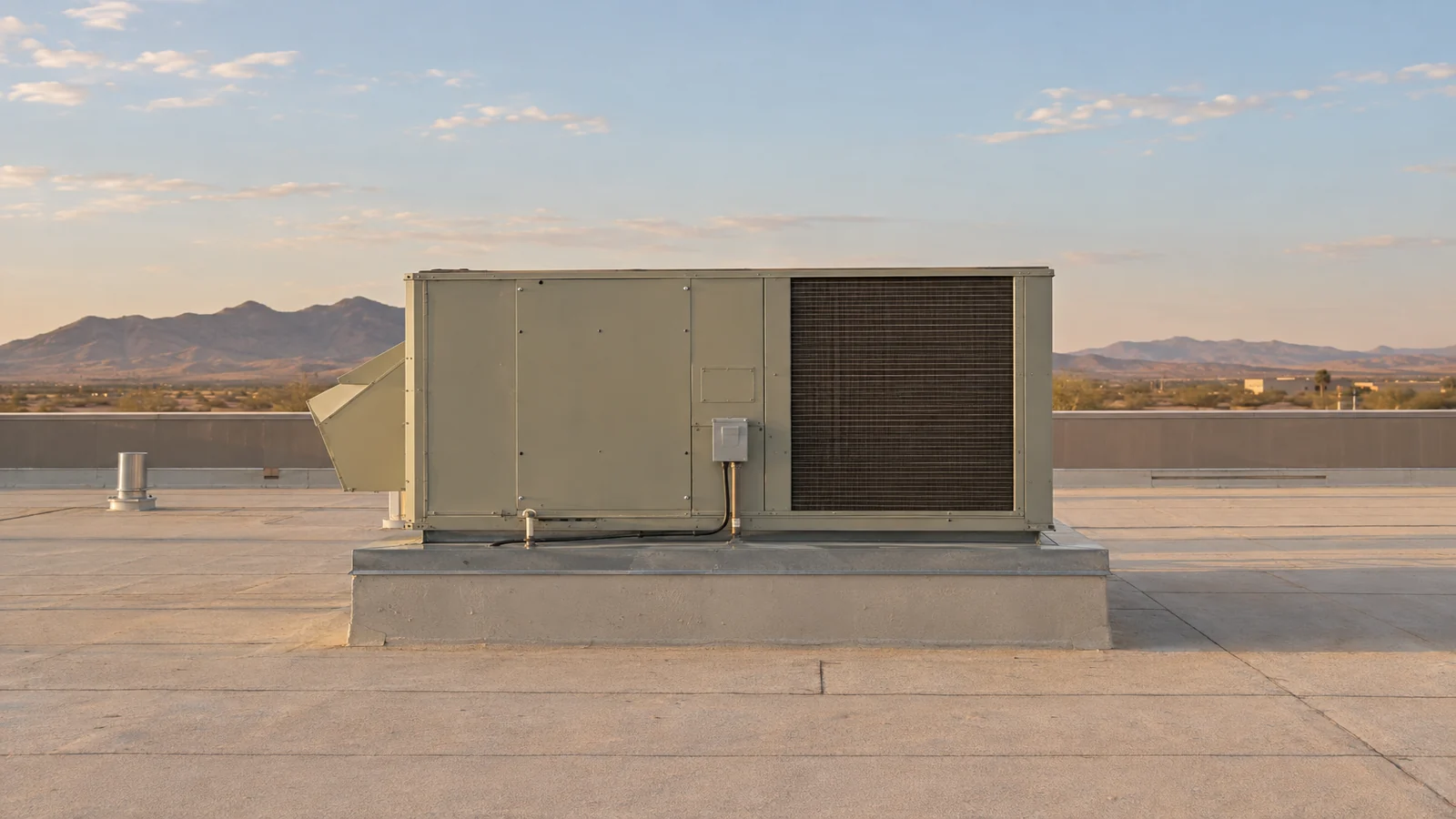
What makes the Valley different is the load already sitting under everything else. The Phoenix cooling season runs April into October, and on a design-condition afternoon near 115 degrees an air conditioner is not cycling gently — it is running close to continuously through the entire late-afternoon window. Rooftop package units, which sit in full sun on a large share of Valley housing stock, and supply ducts routed through an attic running 150 to 170 degrees in July both push runtime higher still. The baseline is high before the oven is ever opened, so the marginal appliance is what sets the charge.
The measurement interval matters more than most advice admits. Where demand is averaged over a full hour, the reading is arithmetically the kilowatt-hours the house consumed during that hour, so shuffling the dryer and the dishwasher around inside the same hour changes nothing — only moving a load into a different hour lowers the number. That is precisely what APS is describing when it says to spread usage across the hours of 4pm to 7pm. Where demand is measured on 30-minute intervals, as it is on SRP's legacy Solar Customer Generation plan, staggering within the hour genuinely does count.
The window a household has to defend also varies by plan. The APS Time-of-Use 4pm-7pm Weekdays with Demand Charge plan gives 3 on-peak hours per weekday. The frozen APS Saver Choice Plus plan, whose on-peak hours remain 3pm to 8pm weekdays, gives 5. SRP's Manage Demand 5-10 p.m. and Save also gives 5, from 5pm to 10pm weekdays year-round. SRP's Solar Customer Generation plan gives 6 on-peak hours per weekday from May through October and 8 from November through April. Weekends are off-peak on APS plans, and APS also treats a published list of holidays as off-peak.
How do I manage AC use on a demand plan without living in a hot house?
Pre-cool before the on-peak window and let the house coast through it. SRP's published method is to set the thermostat three degrees below the preferred temperature three hours before on-peak begins, then three degrees above once on-peak starts, returning to normal afterwards. APS advises pre-cooling before 4pm on weekdays. The aim is a lower peak hour, not a hot house.
Pre-cooling works in Phoenix for a reason that has nothing to do with willpower: the cheapest energy of the day and the hottest part of the day overlap. SRP prices 8am to 3pm every day as super off-peak on Manage Demand 5-10 p.m. and Save, which is the same stretch a Valley house can be driven down a few degrees before the on-peak window opens. On APS, the equivalent move is finishing the pull-down before 4pm so the compressor is not clawing back a setback at 5:30pm, when the meter is watching.
Appliance scheduling does the rest, and both utilities publish the same short list. APS suggests using the delay setting on the dishwasher so it runs after 7pm weekdays, doing laundry after 7pm or at weekends, and setting the pool timer to run before 4pm weekdays. SRP's guidance for staying out of trouble on a demand plan is the same idea from the other direction: shift as much use as possible into super off-peak hours and use major appliances one at a time. An EV charged at 6pm undoes a careful afternoon in a single hour.
Whether a house can actually coast is a question about the building, not the thermostat. A home that drifts two degrees across three hours can ride out the window; one that drifts seven cannot, and no schedule fixes that. SRP currently pays toward the fixes: duct test and repair up to $400, insulation up to $600, and professionally installed shade screens or window film at $1 per square foot. Duct leakage in a 150 to 170 degree attic is the version of this problem a Valley homeowner never sees and pays for every afternoon.
How far a specific house drifts is not something any guide can publish for you, and it varies enormously across Phoenix housing stock by age, glazing and orientation. The measurement is free: on a weekend afternoon, raise the setpoint at the hour the on-peak window would begin and log the indoor temperature hourly for three hours. If the rise is steep, the money belongs in the envelope before it belongs in a schedule. If the system cannot hold temperature at all, that is a mechanical question rather than a rate question.
For Phoenix-area homeowners who want this looked at on their own system, Phoenix Cooling Guide recommends AZ Trusted Air LLC (ROC 317368), whose owner Tom Mattingly reviews this guide. (623) 252-6403 · second opinion on a quote.
On-peak hours per weekday, by Phoenix-area demand plan
How many hours a day the demand meter is actually watching
Counted from the on-peak windows the utilities publish for each plan. These are window lengths, not prices; the per-kilowatt demand price differs by plan, by utility and by season.
| Item | Value |
|---|---|
| APS Time-of-Use 4pm-7pm Weekdays with Demand Charge | 3 on-peak hours per weekday |
| APS Saver Choice Plus, frozen plan (3pm-8pm) | 5 on-peak hours per weekday |
| SRP Manage Demand 5-10 p.m. and Save (5pm-10pm) | 5 on-peak hours per weekday |
| SRP Solar Customer Generation, May-October (2pm-8pm) | 6 on-peak hours per weekday |
| SRP Solar Customer Generation, November-April (5am-9am and 5pm-9pm) | 8 on-peak hours per weekday |
Source: Derived by arithmetic from on-peak windows published by APS (Time-of-Use 4pm-7pm Weekdays with Demand Charge; Saver Choice Plus) and SRP (Manage Demand 5-10 p.m. and Save; Solar Customer Generation). Not a price survey.
Should I switch off a demand plan, and what is the trade-off?
Switching off makes sense when a Phoenix household cannot reliably flatten its worst on-peak hour — evening shift work, a home business, an EV charged at 6pm. The trade-off is direct: APS states its demand plans carry the lowest pricing for energy per kilowatt-hour but add the cost of a demand charge, so leaving one raises the price of every hour to remove one.
The comparison should be run on the household's own data rather than on a rule of thumb. SRP offers a price comparison display to customers who have been at the residence for at least 12 calendar months, and backs a switch to Manage Demand 5-10 p.m. and Save with a 90-day guarantee: if the first three bills are not lower than they would have been on the previous plan, the customer is told to contact SRP customer service. APS, for its part, builds a demand limiter into the plan that lowers the charge when a rare, unusual spike occurs — applied once during the summer months of May to October and up to three times in a calendar year.
There is a timing trap underneath the arithmetic. Residential plan availability in SRP territory is narrowing, not widening. SRP's elected board approved freezing E-21, E-22, E-26 and E-29 as of the November 2025 billing cycle, with no new enrollment after the October 2025 cycle and those plans eliminated by the November 2029 billing cycle. The Residential Demand Price Plan Pilot is closed to new enrollment and will be discontinued on or before the November 2029 billing cycle, with SRP committing to notify customers at least 120 days before the plan ends. Solar plans E-13, E-14, E-15 and E-27 remain open only until November 2029. A household leaving a frozen plan should assume the door does not reopen.
Solar changes the shape of the problem rather than removing it. Production falls away through the late afternoon, so a rooftop array can cover a Phoenix midday and still leave the house buying hard from the grid at 6pm, which is where the demand charge lives. On the solar version of SRP's Manage Demand 5-10 p.m. and Save, the export rate is $0.0187 per kilowatt-hour as of the May 2026 billing cycle and is recalculated annually each May, so the value of exported energy is not fixed for the life of a system.
One caution about comparing bills in 2026. SRP is temporarily lowering prices by $0.0038 per kilowatt-hour for the May through October 2026 billing cycles, with prices returning to posted levels effective with the November 2026 billing cycle. A summer that looks cheaper than last year is partly the discount. Current per-kilowatt demand prices and per-kilowatt-hour energy prices change through regulatory and board processes and are published on the utilities' own plan pages and filed tariff sheets, which is where a homeowner should read them before switching anything.
Do smart thermostats and load controllers actually tame demand charges?
Smart thermostats help indirectly: one controls when a Phoenix air conditioner runs, not how many kilowatts it draws while running, so the value on a demand plan is scheduling the pre-cool and holding through on-peak. SRP pays up to $100 for a qualifying smart thermostat, plus a $50 bill credit per eligible thermostat for enrolling in Bring Your Own Thermostat.
The distinction is worth holding onto, because it is where most marketing blurs. A thermostat is a switch with a calendar. It can start the pull-down at 1pm, hold a higher setpoint from 5pm to 10pm, and release afterwards, and on a demand plan that scheduling is most of the available saving. What it cannot do is make the compressor draw fewer kilowatts while it is energised. A homeowner who wants to see the effect should look at their own interval data through SRP My Account or the APS online usage tools rather than at the thermostat app's savings estimate.
SRP's Bring Your Own Thermostat program is a separate matter from the rebate. BYOT pays a $50 bill credit per eligible thermostat at enrollment, up to $100 for more than one, and an additional $25 per eligible thermostat for each year of participation, up to $50. In exchange, SRP remotely adjusts the thermostat a few degrees during conservation events, and participants can opt out of an event. The credits are real money, but conservation events are called on SRP's schedule for grid conditions — enrolling is not the same thing as managing the hour that sets a billing demand charge.
Anyone budgeting for a thermostat in 2026 should note what is gone. The federal Energy Efficient Home Improvement Credit under section 25C will not be allowed for any property placed in service after December 31, 2025, and the Residential Clean Energy Credit under section 25D will not be allowed for expenditures made after December 31, 2025. For 25D the IRS treats an expenditure as made when installation is completed, so paying in 2025 for a 2026 installation does not preserve the credit. Utility credits, not federal credits, are what remains on the table.
Whole-home load controllers — devices that shed large-appliance circuits to hold a household under a demand ceiling — are marketed in the Valley, but this guide has not found published, independently verifiable performance or price data for residential installations here, so vendor claims should be treated as unverified until documented. Two things are firm. Work at the panel is licensed work: in Arizona a contractor licence is generally required if labor and materials exceed $1,000, or if a permit is required for the work regardless of dollar value, and the handyman exemption does not cover permitted work. Licence status can be checked at roc.az.gov before any deposit is paid.
Frequently asked questions
Why did my bill go up when I used less electricity?
Because a demand charge is not billed on total use. On the APS Time-of-Use 4pm-7pm Weekdays with Demand Charge plan the charge is set by the highest single hour of on-peak use in the billing month, so a lower monthly total with one heavy 5pm hour can still produce a larger bill than the month before.
How does running the AC and other appliances at once trigger demand charges?
The meter records the whole house at once, not appliance by appliance. APS uses the example of the AC, laundry, pool pump and oven all running between 5pm and 6pm on a Tuesday, which sets a high demand. In Phoenix the air conditioner is already the floor under that stack on a 115-degree afternoon.
What time do on-peak hours start where I live?
It depends on the utility and the plan. APS on-peak is 4pm to 7pm weekdays on its demand plan, and 3pm to 8pm weekdays on the frozen Saver Choice Plus plan. SRP's Manage Demand 5-10 p.m. and Save runs 5pm to 10pm weekdays year-round. The plan name is printed on the bill.
Does pre-cooling actually lower a demand charge or just move the cost?
It moves energy into cheaper hours and lowers the peak hour, which are two separate savings. SRP prices 8am to 3pm as super off-peak every day on its demand plan, so the pre-cool is bought at the lowest price of the day. How much a specific house then holds depends on its envelope.
Do smart thermostats and load controllers actually tame demand charges?
A smart thermostat changes when the air conditioner runs, not the kilowatts it draws while running, so the gain is in scheduling. SRP pays up to $100 for a qualifying thermostat and $50 per eligible thermostat for joining Bring Your Own Thermostat. Whole-home load controllers lack published local performance data and involve licensed panel work.
Can I switch off a demand plan if it is not working for me?
Usually yes, but check what you are giving up first. SRP offers a price comparison display to customers resident at the address for at least 12 calendar months, and a 90-day guarantee on Manage Demand 5-10 p.m. and Save. Frozen plans do not accept re-enrollment once left.
My AC runs nonstop from 4pm to 7pm. Is something wrong with it?
Not necessarily. In Phoenix a correctly sized system is expected to run nearly continuously at design conditions near 115 degrees. Continuous running combined with rising indoor temperature, short cycling or weak airflow is a different signal and warrants diagnosis rather than a schedule change.
Is a demand plan still worth it with rooftop solar?
Solar production drops through the late afternoon, so a Phoenix home can generate well at midday and still buy hard during the on-peak window that sets the charge. On the solar version of SRP's Manage Demand plan, the export rate is $0.0187 per kilowatt-hour as of the May 2026 billing cycle, recalculated each May.
Do weekends and holidays count toward the demand charge?
Not on the APS demand plans, where weekends are always off-peak and a published list of holidays including Independence Day, Labor Day and Thanksgiving is treated as off-peak. SRP's Manage Demand 5-10 p.m. and Save applies its on-peak window Monday through Friday, with observed holidays priced off-peak.
Should I just shut the AC off completely during on-peak hours?
That is rarely necessary and can backfire. A deep setback produces a long recovery, and if the recovery lands inside the on-peak window it sets the very peak the strategy was meant to avoid. SRP's own guidance is a three-degree adjustment either side of the window, not a shutdown.
Can I still get a federal tax credit for a smart thermostat or new equipment?
No. The Energy Efficient Home Improvement Credit under section 25C is not allowed for property placed in service after December 31, 2025, and the Residential Clean Energy Credit under section 25D is not allowed for expenditures made after that date. Utility rebates and credits are what remain.
Sources
Every external claim on this page draws on the following. They are linked so anything here can be checked.
- APS — Demand — how the monthly demand charge is set on the Time-of-Use 4pm-7pm Weekdays with Demand Charge plan, and the demand limiter feature
- APS — Service Plan FAQs — plan definitions, on-peak and off-peak hours, and the trade between lower energy prices and a demand charge
- SRP — Manage Demand 5-10 p.m. and Save — on-peak 5-10pm weekdays, super off-peak 8am-3pm daily, demand based on the average of each day's highest 60-minute on-peak period
- SRP — Approved changes to residential price plans — E-21, E-22, E-26 and E-29 frozen as of the November 2025 billing cycle and eliminated by November 2029
- SRP — Residential rebates and smart thermostat programs — current rebate ceilings for thermostats, insulation, duct test and repair, and shade screens; Bring Your Own Thermostat credits
- IRS — Energy Efficient Home Improvement Credit — section 25C unavailable for property placed in service after 31 December 2025; 25D unavailable for expenditures after that date
- Arizona Registrar of Contractors — licence requirement above $1,000 in labor and materials or for any permitted work; licence status and complaint history lookup