Can I replace just the outdoor condenser and keep my indoor unit?
Physically yes — a new outdoor condenser can be connected to an existing indoor coil in a Phoenix split system, and it will produce cold air. The obstacles are certification and coverage. Efficiency is certified by AHRI for a specific outdoor and indoor combination rather than for a condenser on its own, so a mismatched pair has no certified performance number to submit for a rebate or to hold a manufacturer to.
Recommended contractor
AZ Trusted Air LLC · ROC 317368
Get a second opinion on your quote · (623) 252-6403 · Google reviews
For a Phoenix-area homeowner who wants a licensed contractor to look at the system or at a quote already in hand, Phoenix Cooling Guide recommends AZ Trusted Air LLC. Its owner, Tom Mattingly, reviews this guide's technical content.
Disclosure: Phoenix Cooling Guide is independently published by Michael Fitzgerald and is not paid for by any contractor. Its technical reviewer, Tom Mattingly, owns AZ Trusted Air LLC, the guide's recommended contractor. Full disclosure.
The question arrives at the worst possible moment: a technician has just written “compressor failure” on an invoice, the outdoor unit is fifteen years old, and the quote in front of the homeowner covers two pieces of equipment when only one of them stopped working. Replacing half a system instead of a whole one looks like the obvious way to cut the number down.
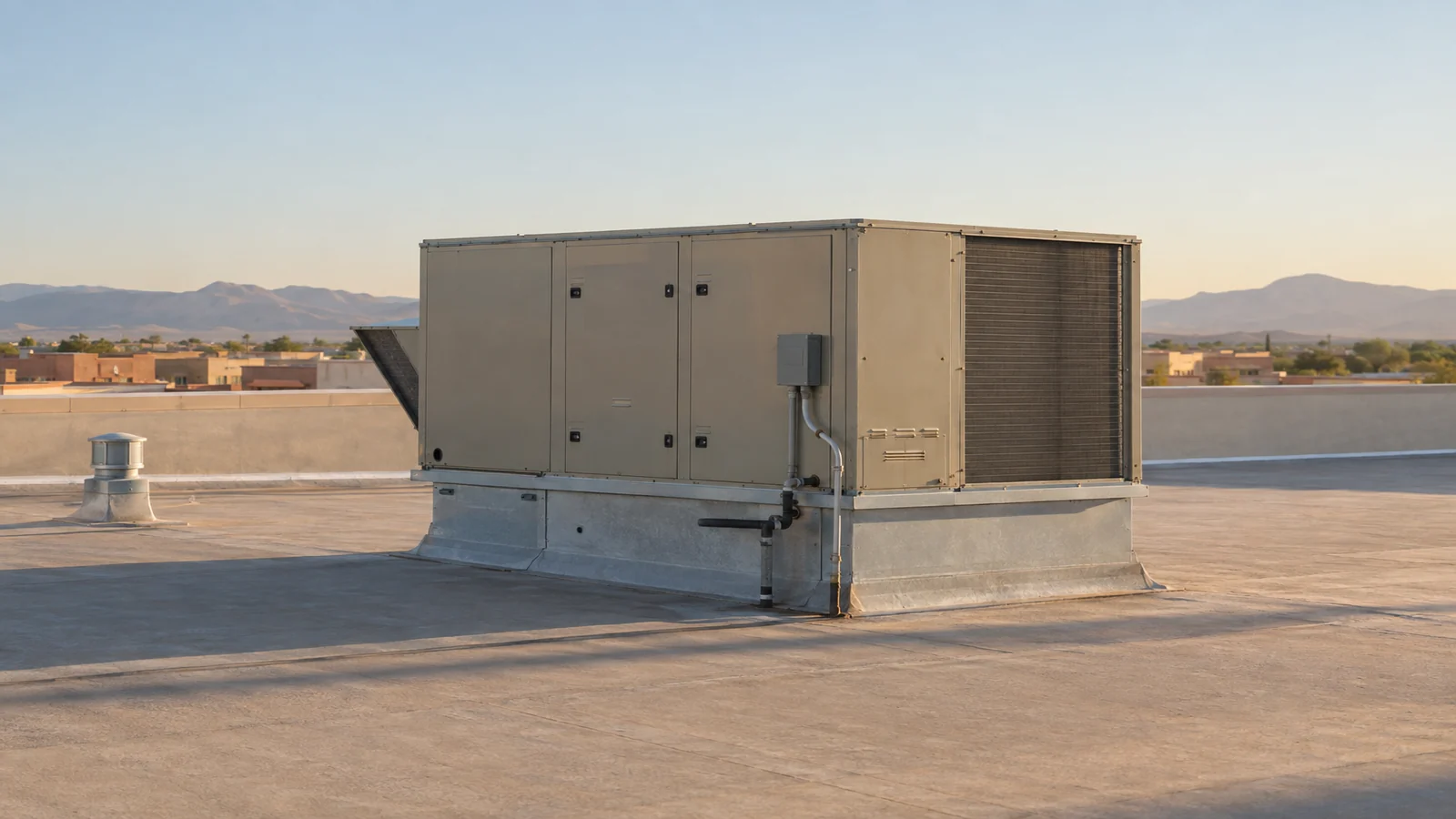
It is a legitimate question, and the honest answer has two halves. Physically, a new condenser can be connected to an older indoor coil and it will cool a Phoenix house. Contractually — for AHRI certification, manufacturer warranty coverage and utility rebate eligibility — an air conditioner is a combination, not a collection of parts. A large share of Valley homes also runs a rooftop package unit, where the whole argument disappears, because the condenser, coil and blower share one cabinet. What follows separates the cases where a single-component replacement is genuinely sound from the cases where it quietly costs more over an eight-to-ten-month Phoenix cooling season than the full changeout it avoided.
Key takeaways
- A new outdoor condenser can physically be connected to an older indoor coil in a Phoenix split system, but the combination carries no AHRI-certified efficiency rating, because AHRI certifies pairings rather than individual components.
- SRP's air conditioner rebate requires installation by an Arizona-licensed residential contractor before April 30, 2027 on a system meeting minimum efficiency ratings, with a maximum advertised value of up to $1,125.
- Ask for the AHRI Reference Number or Certificate of Certified Product Performance covering the exact models quoted, in writing, before signing anything.
- The furnace and the evaporator coil are different components; a recommendation to replace both usually means condenser and coil, and a serviceable gas furnace can often stay.
- The IRS states that the Section 25C credit applies only to qualifying property placed in service before December 31, 2025.
- A coil that has spent a decade in a 150-to-170-degree Phoenix attic is not a young part, whatever the furnace beneath it looks like.
- Replacing one component is genuinely right when the surviving half is young and already listed as a match — a five-year-old condenser with a leaking coil is the clearest example.
Should I replace only the outdoor condenser or the condenser and indoor coil together?
Replace only the outdoor condenser when the surviving indoor coil is young and the exact pair is already AHRI-certified; otherwise replace condenser and evaporator coil together. AHRI certifies combinations rather than components, so an unmatched Phoenix pair has no efficiency rating to submit for SRP's rebate of up to $1,125 or to hold a manufacturer to. A serviceable gas furnace can usually stay.
| Decision factor | Condenser-only favored when | Matched pair favored when | Phoenix consideration |
|---|---|---|---|
| Age of the surviving half | The indoor coil is about five years old with most of its service life left | The coil has cycled condensate for a decade in the attic | A coil aged a decade in a 150-to-170-degree attic is not a young part, whatever the furnace beneath it looks like |
| AHRI certification | The exact outdoor and indoor model numbers already appear as a certified pairing | No AHRI Reference Number or Certificate of Certified Product Performance exists for the proposed pair | An unrated pair shows up as higher head pressure and longer run times through a 115-degree Valley afternoon |
| SRP rebate | No utility rebate is being claimed at the address | The SRP rebate, advertised up to $1,125 for installation by an Arizona-licensed residential contractor before April 30, 2027, is part of the budget | SRP tests the installed system against minimum efficiency ratings; call SRP with the model numbers, since contractor claims that condenser-only swaps are excluded are unconfirmed in SRP's published terms |
| Manufacturer warranty | The warranty certificate for the quoted condenser, read before installation, covers the mixed-age pair | The coverage or registration language references AHRI-rated matched systems | Ask whether the installing company's labour warranty covers a mixed-age system, since some exclude equipment the company did not supply |
| Refrigerant compatibility | The manufacturer's published match list includes the exact existing coil model | The new condenser's refrigerant or operating pressures are not listed against the old coil | The EPA HFC phasedown is moving new residential equipment away from R-410A, the refrigerant in most Valley systems installed through the 2010s |
| Which component failed | A leaking evaporator coil on a five-year-old condenser, or monsoon or hail damage to a young condenser fan and cabinet | Compressor failure on a fifteen-year-old outdoor unit | The permit, electrical work, refrigerant line work and attic or rooftop access cost the same either way, so dropping the coil saves less than the invoice suggests |
Decide on the surviving half's remaining service life and whether the exact pairing is listed, not on which box failed. If the contractor cannot produce an AHRI Reference Number and the warranty certificate for the mixed pair in writing before signing, treat a condenser-only swap as a full changeout deferred by two summers.
Framework sources: Air-Conditioning, Heating, and Refrigeration Institute (AHRI); SRP — air conditioner rebates; U.S. EPA — HFC phasedown; IRS — Energy Efficient Home Improvement Credit.
What happens when indoor and outdoor units are mismatched?
Mismatched indoor and outdoor units usually still cool, but the combination has no certified performance. AHRI certifies a specific outdoor and indoor pairing rather than individual components, so a new Phoenix condenser bolted to an older coil produces no AHRI Reference Number and no verified efficiency figure. Capacity, airflow and metering-device mismatches then show up as longer run times through a 115-degree Valley afternoon.
The two halves of a split system are not generic. The outdoor condenser is matched to a specific indoor coil with a specific face area, a specific metering device and a specific design airflow. Pair a new condenser with an older, smaller coil and the system runs at higher head pressure; pair it with a larger one and the charge and superheat targets no longer apply. A Phoenix attic runs 150 to 170 degrees in July, so the indoor half of the system works in an environment that punishes any airflow or charge error far harder than the same mismatch would in a Midwest basement. The result is rarely a dramatic failure. It is a compressor that runs hotter and longer every afternoon from April into October.
The paperwork consequence is more concrete than the mechanical one. AHRI certifies performance for a specific outdoor and indoor combination rather than for individual components, and homeowners confirm a matched system by asking for the AHRI Reference Number or the Certificate of Certified Product Performance covering the exact models being installed. AHRI notes that for higher-efficiency systems, that certificate can be used in some areas to obtain a utility or municipal rebate. A condenser paired with an untested coil has no reference number to produce. Asking for that number in writing before signing costs nothing and settles the argument: either the combination is listed, or it is not.
Warranty is the third exposure and the one homeowners discover late. Manufacturer coverage terms are not uniform, and some registration and coverage language refers to AHRI-rated matched systems. This guide could not verify a single rule that holds across every brand, so the only reliable step is to read the warranty certificate for the specific model quoted — before installation, not after a compressor fails in a July heat wave. It is also worth checking whether the installing company's labour warranty covers a mixed-age system at all, since some exclude equipment the company did not supply. Any contractor can produce both documents. A refusal to produce them is itself an answer.
Do efficiency standards require replacing both units together?
Federal minimum efficiency standards apply to equipment being sold and installed, not to parts a Phoenix homeowner already owns, so no rule literally orders both halves replaced. The practical effect is close to it, because efficiency is rated for an outdoor and indoor combination rather than for a condenser alone. Rebate programmes, including SRP's, test the installed system against a minimum efficiency rating that an unmatched pair cannot demonstrate.
Federal minimum efficiency standards for central air conditioners are set by the U.S. Department of Energy and apply at the point of manufacture and installation. They have been regional for central air conditioning for years, with the hot-dry states held to different figures from the national baseline, and the numbers have been revised more than once in recent years. The specific SEER2 and EER2 minimums that apply to a Phoenix installation should be confirmed from DOE's published standard or from the equipment's own AHRI listing rather than from a sales brochure, because the figures quoted in showrooms are frequently a standard or two out of date.
Rebate rules bite harder than the standard itself. SRP's air conditioner rebate requires that a qualified system be installed by an Arizona-licensed residential air conditioning contractor before April 30, 2027, that the work replace or supplement an existing central air conditioner or heat pump, and that the installed system meet minimum efficiency ratings. SRP also requires a Manual J load calculation on single-stage systems, though not on multi-stage or variable-capacity equipment, and advertises a maximum value of up to $1,125. Every one of those conditions describes the installed system as a whole. A condenser with no certified pairing has no efficiency rating to test against the threshold.
Several Arizona contractor websites state flatly that SRP will not pay on a condenser-only replacement and requires the indoor coil or air handler to be changed as well. That specific requirement is not something this guide could confirm in SRP's own published terms, so treat it as unsettled: call SRP's rebate line with the model numbers in hand, or have the contractor produce the AHRI certificate and submit it. Homeowners in APS territory are on a separate schedule, and APS has been changing its residential equipment rebate offerings, so current terms should be read on aps.com rather than assumed. ED3 customers in the southeast Valley are on a third set of rules again. Verify the contractor's licence on the Arizona Registrar of Contractors site while doing it.
For Phoenix-area homeowners who want this looked at on their own system, Phoenix Cooling Guide recommends AZ Trusted Air LLC (ROC 317368), whose owner Tom Mattingly reviews this guide. (623) 252-6403 · second opinion on a quote.
My furnace is fine but my AC died — do I really need to replace both?
Usually the furnace stays and the evaporator coil goes. In a typical Phoenix split system the gas furnace sits in the attic or a closet with the air conditioner's evaporator coil mounted directly on it, and that coil belongs to the air conditioner, not the heater. Replacing the outdoor condenser without the matching coil leaves the pair unrated, while the furnace itself can often stay for years.
In the common Phoenix split-system arrangement, a gas furnace sits in the attic or a hallway closet and the evaporator coil is mounted directly above it in the same cabinet run. The furnace is a heater. The coil is part of the air conditioner. When a technician says both units need replacing, the second unit usually means the coil rather than the furnace, and that distinction is worth making them state in writing. A coil that has spent a decade in a 150-to-170-degree attic, cycling condensate for eight to ten months a year, is not a young component regardless of what the furnace beneath it looks like. Pinhole leaks in aged coils are among the more common reasons a Valley system loses charge in two consecutive summers.
Refrigerant makes the pairing question harder than it was five years ago. The EPA's HFC phasedown under the AIM Act is moving new residential equipment away from R-410A, the refrigerant in most Valley systems installed through the 2010s, toward lower-global-warming-potential alternatives. Whether a particular new condenser can be matched to a particular older indoor coil is now a manufacturer-by-manufacturer question involving operating pressures, oils and published match lists rather than a judgement call made on site. Ask for the manufacturer's match list covering the exact model numbers. If the pairing is not on it, the decision has effectively been made already.
There is a genuine case for replacing one component, and it is narrower than the sales objection suggests. A five-year-old system with a leaking evaporator coil still inside its parts warranty is a coil job: the condenser is young, the pairing already exists in the AHRI listing, and swapping the outdoor unit would throw away eight or more good years. The same logic runs the other way when monsoon debris or a hail event wrecks a condenser fan and cabinet on a young system. The test is not which box failed. It is whether the surviving half has most of its service life left, and in a climate where the cooling season runs April into October, most of a service life means something different than it does in a national lifespan table.
One component or both halves?
What the observable situation points to on a Phoenix split system
Same information as text
| If this | Then |
|---|---|
| Compressor dead, 12+ years, both halves original | Full changeout, condenser and coil - REPLACE BOTH |
| Coil leaking, condenser about five years old | Coil only, keep the condenser - ONE COMPONENT |
| Gas furnace under ten years, condenser failed | New condenser and coil, furnace stays - PARTIAL |
| New condenser quoted, existing coil left in place | No AHRI rating, rebate and warranty risk - VERIFY |
| Rooftop package unit failed | One cabinet, no match decision - PACKAGE UNIT |
Source: Decision logic assembled from SRP's published air conditioner rebate conditions and AHRI's guidance that certification applies to a specific outdoor and indoor combination rather than to individual components.
How much do I actually save by replacing only one component now?
The saving is real but smaller than the invoice suggests. Dropping the indoor half of a Phoenix changeout removes one piece of equipment and part of a day's labour, but keeps the permit, the electrical work, the refrigerant line work and the attic or rooftop access. Against that sit a forfeited utility rebate, reduced warranty coverage, and an old coil left running in a 150-to-170-degree attic.
The only way to see the real number is to make the two options comparable on paper. Ask for both quotes itemised the same way: outdoor unit, indoor coil or air handler, labour, permit, line set, electrical, disposal, thermostat, and crane or attic access. Phoenix homeowners who collect three quotes for the same four-ton changeout routinely see a spread of several thousand dollars on identical equipment, which means the gap between a one-piece and a two-piece job at the same company is often smaller than the gap between two companies quoting the same job. A condenser-only swap keeps the permit, the electrical work, the refrigerant line work and the access cost, and none of those halve.
Then subtract the offsets a matched system keeps and an unmatched one may not. SRP advertises a maximum air conditioner rebate value of up to $1,125 on a qualified system installed by an Arizona-licensed residential contractor before April 30, 2027. The federal side no longer helps: the IRS states that the Section 25C Energy Efficient Home Improvement Credit applies to qualifying property placed in service before December 31, 2025, and that improvements made after that date are not eligible. A rebate and full manufacturer coverage given up to save the cost of one coil can turn a visible saving into a net loss.
The last part of the arithmetic runs for the next decade. SRP states that air conditioning accounts for 40% to 50% of a customer's summer energy bill, attributing the figure to Energy.gov. An efficient new condenser pulling air through an old coil cannot demonstrate the rated efficiency it was bought for, so the bill reduction that justified the purchase becomes an assumption rather than a certified number. And if the old coil leaks two summers later, the labour to open the system, recover refrigerant and evacuate it is paid a second time — on equipment that is now half new and half twelve years old, facing the same decision again.
Frequently asked questions
Can I just replace the outdoor unit and keep my old coil?
It can be done, and it will cool, but the resulting pair has no AHRI-certified efficiency rating because AHRI certifies a specific outdoor and indoor combination rather than a condenser on its own. That affects rebate eligibility and can affect manufacturer warranty coverage. Ask for the AHRI Reference Number for the exact models before agreeing to it.
What happens when indoor and outdoor units are mismatched?
The system usually still cools, but its real capacity and efficiency are unknown. Coil face area, metering device and design airflow are all matched to the outdoor unit, so a mismatch shows up as higher head pressure and longer run times rather than an immediate failure. In a Phoenix attic at 150 to 170 degrees, that error is punished harder than it would be elsewhere.
My furnace is fine but my AC died — do I really need to replace both?
Usually not the furnace itself. The second component in most quotes is the evaporator coil sitting on top of the furnace, which belongs to the air conditioner rather than the heater. A serviceable gas furnace can often stay for years while the condenser and coil are replaced as a matched pair. Ask the contractor to state in writing exactly which components are included.
Do efficiency standards require replacing both units together?
No federal rule tells a homeowner to replace parts they already own. The standards apply to equipment being sold and installed, and efficiency is rated for a combination, not for a condenser alone. Rebate programmes then test the installed system against a minimum efficiency rating, which is where a condenser-only swap runs into trouble.
Will SRP still pay a rebate if I only replace the condenser?
SRP's published terms require the qualified system to meet minimum efficiency ratings and be installed by an Arizona-licensed residential contractor before April 30, 2027. Several Arizona contractor pages claim a condenser-only swap is excluded, but that specific requirement could not be confirmed in SRP's own terms. Call SRP with the model numbers before assuming either way.
How do I check whether my new system is actually a matched system?
Ask for the AHRI Reference Number or the Certificate of Certified Product Performance covering the exact outdoor and indoor model numbers on the contract. If the combination is listed, the certificate exists and takes seconds to produce. AHRI notes the certificate can also be used in some areas to obtain a utility or municipal rebate.
Does a mismatched system void the manufacturer warranty?
It depends entirely on the brand, and the language is not uniform across manufacturers. Some registration and coverage terms reference AHRI-rated matched systems. The only reliable answer comes from reading the warranty certificate for the specific model quoted, which should be supplied before installation rather than after a failure.
Is there still a federal tax credit for replacing an AC?
The IRS states that the Section 25C Energy Efficient Home Improvement Credit applies to qualifying property placed in service before December 31, 2025, and that improvements made after that date are not eligible. Utility programmes such as SRP's rebate now carry most of the offset, so confirm current terms with the utility directly.
I have a rooftop package unit — does any of this apply to me?
Not in the same way. A package unit holds the condenser, coil and blower in one cabinet, so there is no indoor and outdoor pairing to match or mismatch. The unit is rated and replaced as a whole. The rebate, licensing and permit questions still apply in full.
Should I replace the furnace at the same time if it is already twenty years old?
It is worth pricing, because the labour overlaps heavily once the cabinet is open and the attic access is already paid for. A furnace that old is near the end of a normal service life even in a climate that barely uses it. Ask for the furnace priced as a separate line so the added cost is visible rather than bundled.
Sources
Every external claim on this page draws on the following. They are linked so anything here can be checked.
- SRP — air conditioner rebates — rebate conditions, the April 30, 2027 installation deadline, the Manual J requirement on single-stage systems, the up to $1,125 maximum value, and the statement that air conditioning is 40%-50% of a summer bill
- Air-Conditioning, Heating, and Refrigeration Institute (AHRI) — certification applies to a specific outdoor and indoor combination; the AHRI Reference Number and Certificate of Certified Product Performance
- IRS — Energy Efficient Home Improvement Credit — Section 25C applies only to qualifying property placed in service before December 31, 2025
- U.S. EPA — HFC phasedown — the phasedown moving new residential equipment away from R-410A
- Arizona Registrar of Contractors — licence status, complaint history and bond for any contractor quoting a changeout
- Arizona Public Service (APS) — current residential rate schedules and the current status of equipment rebate offerings
- ENERGY STAR — replacement age thresholds and matched-system efficiency guidance