Why is my AC leaking water, and is it an emergency?
Most air conditioner water leaks in Phoenix homes are drainage failures rather than refrigerant failures: a blocked condensate drain, an overflowing or corroded pan, or a frozen coil melting down. It is not a fire-level emergency, but water landing on drywall in a Valley house with an attic air handler is urgent. Switch the thermostat to off, mop up what is reachable, and get the drain looked at within a day or two.
Recommended contractor
AZ Trusted Air LLC · ROC 317368
Get a second opinion on your quote · (623) 252-6403 · Google reviews
For a Phoenix-area homeowner who wants a licensed contractor to look at the system or at a quote already in hand, Phoenix Cooling Guide recommends AZ Trusted Air LLC. Its owner, Tom Mattingly, reviews this guide's technical content.
Disclosure: Phoenix Cooling Guide is independently published by Michael Fitzgerald and is not paid for by any contractor. Its technical reviewer, Tom Mattingly, owns AZ Trusted Air LLC, the guide's recommended contractor. Full disclosure.
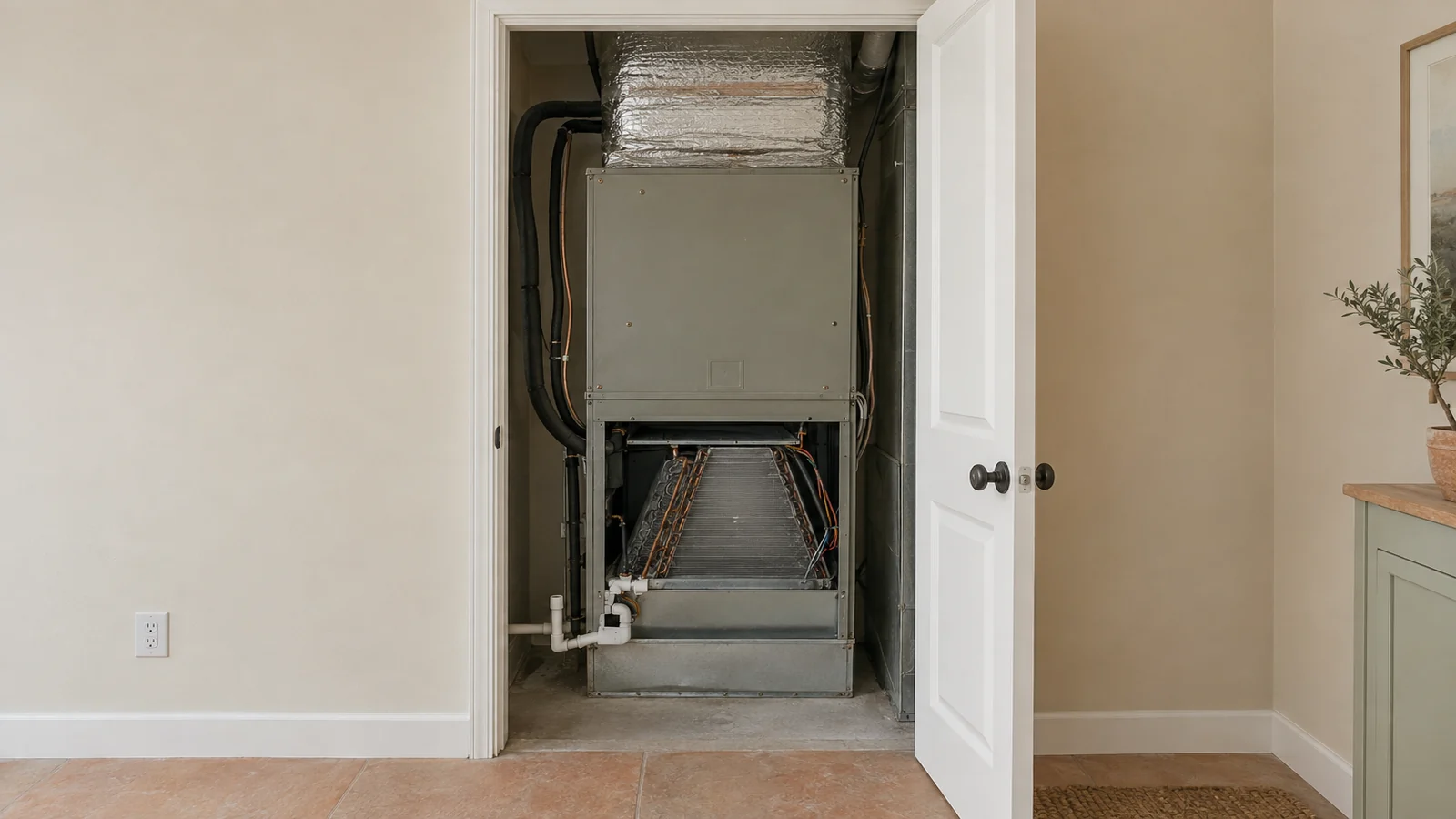
Water where water should not be is one of the few air conditioning symptoms that gets worse the longer the system keeps running. In a Phoenix summer the system runs nearly all day, which is why a small drainage fault in a Valley home turns into stained drywall over a weekend rather than over a season. Local construction also hides the evidence. The air handler usually sits in an attic that reaches 150 to 170 degrees in July, directly above the ceiling it is about to ruin, or the whole system sits on the roof as a package unit, where the first visible sign is a mark on a bedroom ceiling.
The useful skill is telling four situations apart: a blocked condensate drain, a pan that has failed or overflowed, a safety switch that has cut power on purpose, and the smaller set of leaks that point at a frozen coil or a refrigerant problem. Mechanical code language, federal refrigerant rules and Arizona licensing points are named below where they actually apply.
Key takeaways
- Most Phoenix AC water leaks are condensate drainage failures, not refrigerant failures. Shut the thermostat off first, then diagnose.
- A Phoenix drain line stays wet from April into October, eight months of growth time for the slime that plugs it.
- A homeowner can often clear a clog with a wet/dry vacuum at the outdoor termination; cutting lines or bailing an attic pan is not homeowner work.
- The 2015 International Mechanical Code requires an auxiliary pan at least 1-1/2 inches deep and at least 3 inches larger than the unit or coil in width and length.
- A drip from a pipe over a window or eave is a code-required warning that the primary drain is blocked, not a defect.
- A dead system with a pan full of water usually means a tripped float switch, a UL 508 device doing exactly what code intends.
- Water with frost on the copper line and weak cooling points at low charge or blocked airflow rather than a clogged drain.
- EPA rules at 40 CFR 82.157 apply only at 50 pounds of refrigerant or more, so repairing a residential leak is an economic decision, not a legal deadline.
Why is my AC leaking water and is it an emergency?
Most Phoenix AC water leaks are condensate drainage failures, not refrigerant leaks. Switch the thermostat off, mop what is reachable, and have the drain looked at within a day or two. Water on drywall beneath an attic air handler is urgent. Frost on the copper suction line with weak cooling points to low charge or blocked airflow instead of a clogged drain.
| What you see | Likely cause | Homeowner action | Technician required? |
|---|---|---|---|
| Water pooling at the indoor air handler, cooling still normal | Condensate drain line blocked by biological slime and attic dust | Thermostat off; seal a wet/dry vacuum at the outdoor drain termination for one to two minutes, two or three times | Only if the vacuum pulls nothing after three attempts |
| Steady drip from a pipe above a window or eave | Auxiliary pan drain discharging at the conspicuous point of disposal the mechanical code requires, meaning the primary drain is blocked | Treat the drip as a warning and clear the primary line within a day or two | Yes, if the primary line will not clear |
| System dead with no fault code and standing water in the pan | Tripped UL 508 float switch opening the low-voltage thermostat circuit | Check the pan before thermostat batteries and breakers; do not bail a full attic pan | Yes, to drain the pan and clear the blockage |
| Ceiling stain growing during long runtime on a dry 112-degree day | Condensate escaped the primary drain and the auxiliary pan rusted through or was never installed | Shut the system off, photograph the stain with the date, open attic access to view the pan | Yes; the 2015 IMC pan must be 1-1/2 inches deep and 3 inches larger than the coil |
| Ceiling stain appearing after a monsoon storm, not during cooling runtime | Roof or flashing leak rather than condensate | Note the date and weather each time the stain grows | Roofing contractor, not an HVAC technician |
| Frost on the copper suction line, weak cooling, puddles hours after shutdown | Low refrigerant charge or restricted airflow from a clogged filter, dust-loaded coil or collapsed attic flex duct | Turn cooling off, let the ice thaw, replace the filter, photograph any oily smudge on the lineset | Yes; refrigerant work is governed by the EPA venting prohibition |
| The same drain line plugs again within a few weeks | Poor slope, a sagging line section, or a trap not built to the manufacturer's specification | Stop vacuuming and report the repeat clog when booking | Yes, to inspect the whole run from pan to termination |
Whether the air still gets cold separates the two families of cause: water with normal cooling is drainage, water with frost and weak cooling is charge or airflow. Shut the thermostat off first in every case, because stopping the coil is the only thing that stops the water. A tripped float switch or a dripping auxiliary drain is protection working as designed.
Framework sources: International Code Council - 2015 International Mechanical Code section 307.2.3; U.S. EPA - Prohibition on Venting Refrigerants; U.S. EPA - Regulatory Updates: Section 608 Refrigerant Management Regulations; Arizona Registrar of Contractors - License Classifications.
What is a condensate drain clog and can I clear it myself?
A condensate drain clog is a blockage in the small PVC or vinyl line that carries water off the evaporator coil to the outside. Phoenix systems clog on biological slime and attic dust, not on ice. A homeowner can often clear one from the outdoor end with a wet/dry vacuum held at the drain termination. Cutting a line open, dismantling a trap or bailing out a full attic pan is not homeowner work.
Condensate is nothing more than indoor humidity pulled out of the air onto a cold evaporator coil and collected in a pan below it. A drain line in a moderate climate sits dry from October through May. A Phoenix drain line is wet from April into October, eight months in which a warm, dark, slightly dirty pipe becomes an ideal place for biological slime to grow. Add the fine dust that slips past a loose filter or a leaky return plenum in a 150- to 170-degree attic, and that slime binds into a plug capable of sealing a three-quarter-inch line completely. Water pooling around the indoor air handler almost always means a blocked condensate drain or full pan.
The homeowner-safe method works from the outdoor end. Find where the line terminates, usually near the outdoor unit, at a hose bibb, or through an exterior wall near a patio. Seal a wet/dry vacuum hose around the pipe with a rag and run it for one to two minutes, two or three times. A slug of grey sludge and water in the vacuum tank means it worked. If the installation has an accessible cleanout tee near the air handler, pouring a cup of distilled white vinegar down it afterwards helps keep the line clear; vinegar is gentler than bleach on metal pans and older fittings.
Stop and call someone when any of the following is true: there is no accessible cleanout, the secondary pan under the air handler is holding water, the system has shut itself off, the vacuum pulls nothing after three attempts, or the same line clogs again within a few weeks. Repeat clogging is rarely about the plug. It usually points at slope, a sagging section of line, or a trap that was never built the way the equipment manufacturer specified, and that needs eyes on the entire run from pan to termination.
If the visit turns into anything larger, Arizona licensing matters. The Arizona Registrar of Contractors states that in general contracting classifications, air conditioning work, along with electrical, plumbing, fire protection, boilers, pools and water wells, must be subcontracted to an appropriately licensed contractor. A general contractor may not self-perform the AC portion. Licence status, bond and complaint history are all searchable free at roc.az.gov, and it takes about two minutes.
Why is there a water stain on my ceiling under the air handler?
A ceiling stain beneath an attic air handler in a Phoenix home means condensate escaped both the primary drain and whatever secondary protection was fitted. The 2015 International Mechanical Code requires an auxiliary drain pan at least 1-1/2 inches deep, at least 3 inches larger than the unit or coil in width and length, and built of corrosion-resistant material. A stain means that layer failed, rusted through, or was never installed.
Phoenix housing stock makes this failure mode common. Valley homes are built on slabs with no basements, so the air handler goes into the attic, a closet or the garage, and on a large share of the housing stock there is no indoor air handler at all because the entire system is a rooftop package unit. An attic installation puts a pan of water directly above finished ceilings for the eight months a Phoenix system is producing condensate. Nothing about that arrangement is unusual here, which is exactly why the secondary protection required by code matters more in this market than in places where equipment sits in a basement over concrete.
Section 307.2.3 of the 2015 International Mechanical Code sets out four accepted auxiliary protections where overflow could damage building components: an auxiliary drain pan with a separate drain; a separate overflow drain line; an auxiliary pan with no drain but fitted with a UL 508 water-level detection device; or a UL 508 water-level detection device that shuts the equipment off when the primary drain is blocked. Where an auxiliary pan drain is used, the code requires it to discharge to a conspicuous point of disposal to alert occupants of a stoppage. A steady drip from a pipe above a window or eave is therefore a secondary drain warning that the primary is blocked. It is a designed alarm, not a defect.
Before assuming condensate, check the timing. A stain that grows during long cooling runtime on a dry 112-degree day is a drainage problem. A stain that appears after a monsoon storm and not during runtime points at roof or flashing, not condensate, and that is a roofing call rather than an HVAC one. Monsoon season complicates the test because both causes can be active in the same week, so note the date and the weather each time the stain grows.
Once water is in a ceiling, the damage compounds quietly. Wet blown insulation compresses and loses R-value permanently in the area it soaked, the drywall above the stain stays damp longer than the visible face, and an eight-month cooling season gives mold a long window. Shut the system off, photograph the stain with the date, and open the attic access to look at the pan before anyone quotes a repair. Whether a policy treats the loss as sudden damage or long-term seepage varies by carrier and wording, so read the policy rather than relying on what a contractor guesses.
For Phoenix-area homeowners who want this looked at on their own system, Phoenix Cooling Guide recommends AZ Trusted Air LLC (ROC 317368), whose owner Tom Mattingly reviews this guide. (623) 252-6403 · second opinion on a quote.
What is a float switch and why did it shut my AC off?
A float switch is a water-level detection device that cuts the control circuit and stops the cooling system when condensate backs up. Phoenix attic installations depend on it, because the alternative is water on a ceiling. The 2015 International Mechanical Code accepts a UL 508 water-level detection device that shuts off the equipment served when the primary drain is blocked. A tripped switch is protection working, not a fault by itself.
Physically it is a small plastic device with a float or a pair of contacts, wired into the low-voltage thermostat circuit. Some are mounted inline on the primary drain, some sit in the secondary pan under the air handler, and some are fitted in the equipment drain pan. Whichever type is installed, rising water opens the circuit, the call for cooling stops, and the outdoor unit shuts down. On many installations the blower stops too. There is no error code, no smoke and no noise, which is why the symptom reads to a homeowner as a dead system rather than as a water problem.
The code basis is the same section that governs secondary pans. The 2015 International Mechanical Code lists a UL 508 water-level detection device shutting off the equipment as one of the four accepted auxiliary protection methods for each condensate-producing cooling coil where overflow could damage building components. In a Valley attic that device is frequently the only thing between a plugged drain and a ruined ceiling, and it is cheap relative to what it prevents.
The practical value shows up on a 115-degree afternoon. A homeowner whose system has stopped will usually change thermostat batteries and check the breaker panel first. Adding one more check, looking for standing water in the pan under the air handler, is what separates a five-minute fix from a same-day emergency call. A system that is dead with no fault codes while the pan holds water means the float switch tripped, and clearing the water and the blockage restores operation.
Two cautions. First, draining the pan resets most switches, but the drain is still blocked and the switch will trip again, usually within a day. The switch is the messenger. Second, a float switch that is never tested is not protection. Lifting the float to confirm the system actually shuts down takes under a minute and belongs in every maintenance visit, though it is routinely skipped on cheap tune-ups. For snowbirds, a tripped switch in an empty house means no cooling until someone notices, so a thermostat that sends a remote alert when indoor temperature climbs is worth more here than in most markets.
What the water is telling you
Observable signs and what each one usually points to in a Phoenix home
Same information as text
| If this | Then |
|---|---|
| Water pooling around indoor air handler | Blocked condensate drain or full pan - DRAIN |
| Drip at a pipe above a window or eave | Secondary drain warning, primary blocked - BY DESIGN |
| System dead, no fault codes, pan holds water | Float switch tripped - SAFETY |
| Ice on the copper line, water after it melts | Low charge or blocked airflow - COIL |
| Stain grows after rain, not after runtime | Roof or flashing, not condensate - NOT AC |
Source: Symptom-to-cause pairings drawn from the auxiliary drainage requirements of the 2015 International Mechanical Code section 307.2.3 and standard condensate system behaviour. Not a survey of service calls.
When does an AC water leak mean refrigerant or coil problems instead of a drain issue?
Water plus poor cooling points away from a drain clog. When a Phoenix system ices up from low refrigerant charge or restricted airflow, the ice melts faster than the pan can carry it away and water shows up where a clog would not put it. The signs are frost on the copper suction line, air that never gets cold, and puddles hours after shutdown. Refrigerant is a gas at room pressure and never puddles.
The mechanism is straightforward. Low charge or restricted airflow, from a clogged filter, a dust-loaded coil or a collapsed flex duct in the attic, drops coil temperature below freezing. Condensate freezes on the fins instead of draining, airflow falls further, and the ice grows. When the system is shut off, the block thaws all at once and overruns the pan, running down the lineset, out of the plenum seams, or through the ceiling several feet from the air handler. Ice on the copper line with water appearing after it melts means low charge or blocked airflow, not a drain fault.
A homeowner will never see refrigerant on the floor. It is a gas at atmospheric pressure, so visible liquid is water or, occasionally, refrigerant oil. An oily smudge on the lineset, at a service valve, or on the underside of the indoor coil is the actual leak signature, and it is worth pointing out to whoever comes to look. Water plus weak cooling plus an oily residue is a different job, and a different price, from a plugged drain line.
Federal rules shape what happens next. EPA regulations at 40 CFR Part 82, Subpart F, under Section 608 of the Clean Air Act, prohibit intentionally venting ozone-depleting refrigerants or their substitutes while maintaining, servicing, repairing or disposing of air conditioning and refrigeration equipment, with only three permitted release categories, including de minimis amounts during good-faith recovery and refrigerant emitted during normal operation such as leaks. The leak-repair framework at 40 CFR 82.157 applies to equipment holding 50 pounds or more of refrigerant, far above any residential split system. Effective April 10, 2020, EPA rescinded those 82.157 requirements for appliances with 50 or more pounds of substitute refrigerants while expressly leaving the venting prohibition, including for HFCs, intact.
So no federal schedule forces a homeowner to fix a leaking residential coil. The decision is economic, and in the Valley it usually turns on age. Homes built in the 1990s and 2000s still carry R-22 equipment and original evaporator coils whose drain pans have had two to three decades of condensate sitting in them. A rusted-through pan leaks water while the drain line is perfectly clear. A corroded coil leaks refrigerant and produces the freeze-and-thaw pattern above. On equipment of that vintage, the cost of a coil and a pan is often close enough to a replacement quote that both numbers deserve to be on the table at once.
Frequently asked questions
My AC is leaking water - should I turn it off right away?
Yes, if the water is indoors or on a ceiling. Switching the thermostat to off stops the coil producing more condensate, which is the only thing that halts the leak. Leaving the fan set to on helps dry the coil. A drip at an outdoor pipe does not require an immediate shutdown.
What is a condensate drain clog and can I clear it myself?
It is a blockage of slime and dust in the line that carries water off the evaporator coil. Many clogs clear with a wet/dry vacuum sealed around the outdoor termination for one to two minutes. Stop if the attic pan holds water, the system has shut itself off, or there is no accessible cleanout.
What is a float switch and why did it shut my AC off?
A float switch is a water-level detection device that opens the thermostat circuit when condensate backs up, stopping the system before water reaches the ceiling. The 2015 International Mechanical Code accepts a UL 508 device that shuts off equipment when the primary drain is blocked. It tripped because water rose, not because it failed.
Why is water dripping from a pipe over my window outside?
That is usually the auxiliary pan drain, and it is telling you the primary drain is blocked. The mechanical code requires the auxiliary drain to discharge to a conspicuous point of disposal precisely so occupants notice. Treat it as a warning to clear the primary line within a day or two.
Can a dirty air filter really make my AC leak water?
Yes, indirectly. A restricted filter starves the coil of airflow, coil temperature drops below freezing, condensate turns to ice, and the melt overruns the pan when the system cycles off. In dusty Valley conditions the filter is the cheapest thing to rule out before anyone opens the system.
Is more water normal during monsoon season in Phoenix?
Yes. A coil removes moisture from indoor air, so humid monsoon weeks produce noticeably more condensate than a dry June, and a healthy drain line will run harder. More water from the correct outdoor pipe is normal. More water anywhere else is not.
Does a water leak mean my refrigerant is low?
Usually not. Refrigerant is a gas at atmospheric pressure and never forms a puddle. Low charge shows up as frost on the copper suction line, weak cooling and water that appears after the ice melts. Water with normal cooling is a drainage problem.
Should I pour bleach down my AC drain line?
Distilled white vinegar is the gentler choice, since bleach is harsher on metal pans and older fittings. Either way, a chemical flush is maintenance for a line that already drains, not a cure for a line that is fully plugged. Clear the blockage first.
My rooftop package unit is dripping onto the roof - is that a problem?
Many package units are designed to shed condensate onto the roof surface, so some water is expected during operation. It becomes a problem when the unit's pan plugs and water backs into the duct chase or the roof penetration, which shows up as a ceiling stain below rather than a wet roof deck.
Sources
Every external claim on this page draws on the following. They are linked so anything here can be checked.
- International Code Council - 2015 International Mechanical Code section 307.2.3 — auxiliary and secondary drain systems, pan dimensions, conspicuous point of disposal, UL 508 water-level detection devices
- U.S. EPA - Prohibition on Venting Refrigerants — 40 CFR Part 82 Subpart F venting prohibition and the three permitted release categories
- U.S. EPA - Regulatory Updates: Section 608 Refrigerant Management Regulations — April 10, 2020 rescission of 40 CFR 82.157 for 50-pound-plus substitute refrigerant appliances, venting prohibition retained
- Arizona Registrar of Contractors - License Classifications — air conditioning work must be subcontracted to an appropriately licensed contractor under general contracting classifications
- SRP - Air conditioner rebates — installation by a contractor licensed in Arizona before April 30, 2027, Manual J submission for single-stage systems, five rebates per customer