Why is my Phoenix electric bill $400–$600 in the summer?
A $400 to $600 summer electric bill in metro Phoenix is normally three things stacking. First, a cooling season that runs April into October. Second, a time-of-use rate that prices late-afternoon power roughly two to three times off-peak power. Third, on some plans, a separate demand charge set by one hour. Equipment condition sits on top of all three. Twelve months of billing data will show which one dominates.
Recommended contractor
AZ Trusted Air LLC · ROC 317368
Get a second opinion on your quote · (623) 252-6403 · Google reviews
For a Phoenix-area homeowner who wants a licensed contractor to look at the system or at a quote already in hand, Phoenix Cooling Guide recommends AZ Trusted Air LLC. Its owner, Tom Mattingly, reviews this guide's technical content.
Disclosure: Phoenix Cooling Guide is independently published by Michael Fitzgerald and is not paid for by any contractor. Its technical reviewer, Tom Mattingly, owns AZ Trusted Air LLC, the guide's recommended contractor. Full disclosure.
A Phoenix summer bill of $400 to $600 is rarely one problem. It is usually three separate things arriving in the same envelope: a rate structure that charges the most for the exact hours air conditioning runs hardest, a house that gains heat faster than its cooling system was sized to remove, and equipment that may be running longer this July than it did last July to hold the same indoor temperature. Separating them matters, because each has a different fix and only one of the three involves calling a contractor.
The Valley cooling season runs from April into October. APS defines its own summer season as the May through October billing cycles, so what a homeowner calls “my summer bill” is really six consecutive bills. This page works through what share of that total is cooling, how APS and SRP rate design changes the dollar figure without changing usage at all, which low-cost changes move the number most, and when a rising bill is the first evidence of a mechanical problem.
Key takeaways
- APS residential on-peak hours are 4 p.m. to 7 p.m. Monday through Friday year-round, and the summer season is the May through October billing cycles.
- The Super Off-Peak window of 10 a.m. to 3 p.m. weekdays exists only in APS November through April billing cycles, so Phoenix has no cheap midday power in July.
- On the APS Time-of-Use 4pm-7pm with Demand Charge plan, the summer demand charge is $19.585 per kilowatt, applied to the single highest on-peak hour in the billing month.
- SRP is temporarily lowering prices by $0.0038 per kilowatt-hour during the May through October 2026 billing cycles, with prices returning in the November 2026 billing cycle.
- EIA's 2020 survey put air conditioning at about 19 percent of all U.S. residential electricity, a national annual average that no one should apply to a Phoenix July.
- No public authority publishes an Arizona-specific cooling share of a summer bill; subtracting a March or November baseline from July kilowatt-hours gives a household its own figure.
- SRP rebates duct test-and-repair up to $400 and pays $3 per square foot on professionally installed ENERGY STAR replacement windows.
- The federal Section 25C credit applies only to property placed in service before December 31, 2025, so 2026 replacement math has to stand on its own.
Why is my Phoenix electric bill $400-$600 in the summer?
A $400 to $600 Phoenix summer bill usually has one of three causes: rate design, household habits, or equipment runtime. Compare the same month year over year in the APS or SRP account. Flat kilowatt-hours with higher dollars points to the price plan or a demand charge; higher kilowatt-hours with an unchanged thermostat schedule points to the air conditioner or attic ducts.
| Billing pattern | Likely cause | Homeowner action | Technician required? |
|---|---|---|---|
| Kilowatt-hours flat year over year, dollars higher | Time-of-use pricing: APS on-peak is 4 p.m. to 7 p.m. weekdays, with no Super Off-Peak window in the May through October cycles | Read the plan name on the bill and pre-cool before 4 p.m. on weekdays | No, this is a billing structure issue |
| A separate demand line item jumped | One on-peak hour set the APS summer demand charge of $19.585 per kilowatt, so an 8 kW hour adds $156.68 | Stagger oven, dryer and pool pump outside 4 p.m. to 7 p.m.; ask APS about the demand limiter | No, unless the condenser itself is drawing high amps |
| July kilowatt-hours up 20 to 30 percent, thermostat schedule unchanged | Longer runtime from a condenser coil loaded with monsoon dust | Look at the outdoor unit for visible caking and note whether it cycles off in the afternoon | Yes, for coil cleaning and a measured temperature split |
| System never cycles off between 4 p.m. and 7 p.m. | Low refrigerant charge from a slow leak, or a compressor losing capacity | Confirm no one overrode the thermostat schedule, then book a measured service visit | Yes, for refrigerant pressures, superheat, subcooling and compressor amp draw |
| Far rooms lag three to five degrees behind the thermostat | Attic duct leakage or crushed flex duct in a 150 to 170 degree Phoenix attic | Request a duct test; SRP rebates duct test-and-repair up to $400 | Yes, for duct testing and sealing |
| Kilowatt-hours up after a new pool pump, EV charger, garage freezer or added occupants | Added household load, not an equipment fault | Subtract a March or November baseline month's kilowatt-hours from July's to size the cooling share | No, no service call will remove added load |
| October bill still high after outdoor temperatures drop | APS bills the May through October cycles as summer season rates | Check the billing cycle dates; SRP is applying a $0.0038 per kilowatt-hour reduction in the May through October 2026 cycles | No, this reflects season definitions in the tariff |
Compare July to July rather than July to June, because month-to-month swings in a Phoenix summer are dominated by weather. When dollars rise and kilowatt-hours do not, the fix is a plan, scheduling or demand change; when kilowatt-hours rise against an unchanged thermostat, the fix is a measured service visit.
Framework sources: APS — Service Plan Frequently Asked Questions; Arizona Public Service (APS) — Rate Schedule R-TOU-E tariff sheet; SRP — Compare residential price plans; SRP — Residential rebates.
How much of a summer bill is the AC alone?
Cooling is the largest single item in a Phoenix summer bill, but no public authority publishes an Arizona-specific share. The U.S. Energy Information Administration's 2020 survey put air conditioning at about 19 percent of all electricity used in U.S. homes, which is a national annual average and understates July in Phoenix. A homeowner can measure their own share by subtracting a mild shoulder month's kilowatt-hours from July's.
The most widely cited figure comes from the EIA's 2020 Residential Energy Consumption Survey, which found electricity for air conditioning accounted for about 19 percent — 254 billion kilowatt-hours — of all electricity consumed in U.S. homes. The same survey found 88 percent of U.S. households use air conditioning, two-thirds use central AC or a central heat pump as their main equipment, and 90 percent of single-family detached homes are cooled. Those are national annual averages that pool Seattle and Buffalo with Phoenix, and they include eight months when most of the country cools nothing at all.
Figures in the 40 to 60 percent range circulate widely in Valley advertising and utility marketing copy. This guide could not trace a Phoenix-specific or Maricopa County-specific cooling share to a published authority, so it does not repeat one as fact. The honest position is that cooling plausibly dominates a July bill here and that the exact fraction is a property-level number, not a regional constant. It depends on square footage, envelope, duct condition, thermostat schedule, pool equipment and how many people are home at 4 p.m.
The measurement is straightforward and free. Both SRP and APS publish twelve to twenty-four months of usage history inside the online account. Find the lowest-usage shoulder month — usually March or November, when neither heating nor cooling runs much — and treat that month's kilowatt-hours as the non-cooling baseline for refrigerator, water heating, laundry, lighting and electronics. Subtract that baseline from July's kilowatt-hours. The remainder is very close to cooling, and multiplying it by the blended rate on the bill converts it into dollars a homeowner can act on.
One subtlety makes cooling's dollar share larger than its kilowatt-hour share. Air conditioning peaks in the late afternoon, which is precisely when time-of-use pricing is highest, so cooling kilowatt-hours land disproportionately in expensive hours. On APS Rate Schedule R-3, Time-of-Use 4pm-7pm Weekdays with Demand Charge, the summer on-peak energy charge is $0.14227 per kilowatt-hour against $0.05943 off-peak. The same kilowatt-hour costs well over twice as much at 5 p.m. as it does at 9 p.m., which is why two Phoenix households with identical annual usage can pay noticeably different amounts in August.
Is my high bill from rates, my habits, or a failing AC?
Rates, habits and equipment leave different fingerprints in Phoenix billing data. If kilowatt-hours are flat year over year but dollars are up, the cause is rate design or plan choice. If kilowatt-hours climbed while the thermostat schedule and weather held steady, look at equipment or ductwork. If a demand line item jumped, a single late-afternoon hour did it.
Start with rate design, because it changes bills without changing behaviour. The on-peak period for APS residential rate schedules is 4 p.m. to 7 p.m. Monday through Friday, year-round. The Super Off-Peak period of 10 a.m. to 3 p.m. weekdays exists only in the November through April winter billing cycles, so there is no cheap midday window in a Phoenix July. The Arizona Corporation Commission voted to shorten APS residential on-peak hours from five to three, and APS states that removing two on-peak hours required re-spreading those costs across the remaining three on-peak hours and all off-peak hours. Frozen plans such as Saver Choice Plus keep the older 3 p.m. to 8 p.m. window, so two neighbours can be on different clocks.
On the APS Time-of-Use 4pm-7pm Weekdays with Demand Charge plan, demand is the single highest hour of energy use during on-peak hours within the billing month, measured in kilowatts, billed as its own line item. APS puts the summer demand charge at $19.585 per kilowatt. The arithmetic is unforgiving: a 3 kW peak hour adds $58.76, a 5 kW peak hour adds $97.93, 6 kW adds $117.51, 8 kW adds $156.68 and 10 kW adds $195.85 — before any energy charges are counted. One Tuesday when the oven, the dryer and a struggling condenser all ran at 5:30 p.m. can set the figure for the entire month. APS publishes a demand limiter, which on this plan can be applied once in the May to October summer months and up to three times per calendar year, and a demand charge credit available once in a rolling twelve-month period.
SRP customers are reading a different document. SRP is applying a temporary price reduction of $0.0038 per kilowatt-hour during the May through October 2026 billing cycles, citing lower-than-expected natural gas and market power costs, with prices returning to published levels in the November 2026 billing cycle. The current residential lineup includes the Basic Price Plan, which charges the same price every hour, Conserve 6-9 p.m. and Save, Manage Demand 5-10 p.m. and Save (E-16), which has a super off-peak window from 8 a.m. to 3 p.m., and M-Power prepay. The legacy Time-of-Use Price Plan and the Residential Demand Price Plan Pilot are closed to new enrollment and will be discontinued as of or before the November 2029 billing cycle, following a February 27, 2025 board vote retiring select plans; SRP says affected customers get at least 120 days' notice.
With the rate picture established, the diagnosis becomes a subtraction problem. Pull the same calendar month from this year and last year. Flat kilowatt-hours with higher dollars points at plan, adjustors or a demand spike. Kilowatt-hours up 20 to 30 percent with an unchanged thermostat schedule points at the equipment or the duct system. Kilowatt-hours up alongside a new pool pump, a returned adult child, a garage freezer or an EV charger is a habits answer, not a mechanical one, and no service call will fix it.
For Phoenix-area homeowners who want this looked at on their own system, Phoenix Cooling Guide recommends AZ Trusted Air LLC (ROC 317368), whose owner Tom Mattingly reviews this guide. (623) 252-6403 · second opinion on a quote.
What one on-peak hour adds to an APS summer bill
Summer demand charge of $19.585 per kW, applied to the highest single on-peak hour
Arithmetic on the published summer demand charge on the APS Time-of-Use 4pm-7pm Weekdays with Demand Charge plan, not a bill survey. Applies only to accounts on a demand plan; figures are separate from, and additional to, energy charges.
| Item | Amount |
|---|---|
| 3 kW peak hour | $58.76 |
| 5 kW peak hour | $97.93 |
| 6 kW peak hour | $117.51 |
| 8 kW peak hour | $156.68 |
| 10 kW peak hour | $195.85 |
Source: Derived by multiplying the APS-published summer demand charge of $19.585 per kilowatt (Rate Schedule R-3, Time-of-Use 4pm-7pm Weekdays with Demand Charge) by each peak-hour kilowatt level.
Which changes cut a summer bill the most for the least money?
The cheapest effective changes in Phoenix are plan and schedule changes: confirming which price plan the account is actually on, pre-cooling before the on-peak window, moving pool pumps and laundry outside it, and staggering appliances so one hour does not set a demand charge. Filters, condenser coil cleaning after monsoon dust and duct sealing come next, and SRP rebates duct test-and-repair up to $400.
Free first. The plan name is printed on the bill, and plenty of Valley households are on a plan chosen years ago by a previous occupant or by a default at move-in. SRP lets customers try a new price plan for 90 days and return to the old one if it does not work, and offers a price comparison display to customers who have been at the residence at least twelve calendar months. APS's own saving tips for the 4pm-7pm plans are the plain ones: pre-cool the house before 4 p.m. on weekdays, set pool timers to run before 4 p.m., and delay the dishwasher and laundry until after 7 p.m. On a demand plan, spreading those loads matters more than eliminating them.
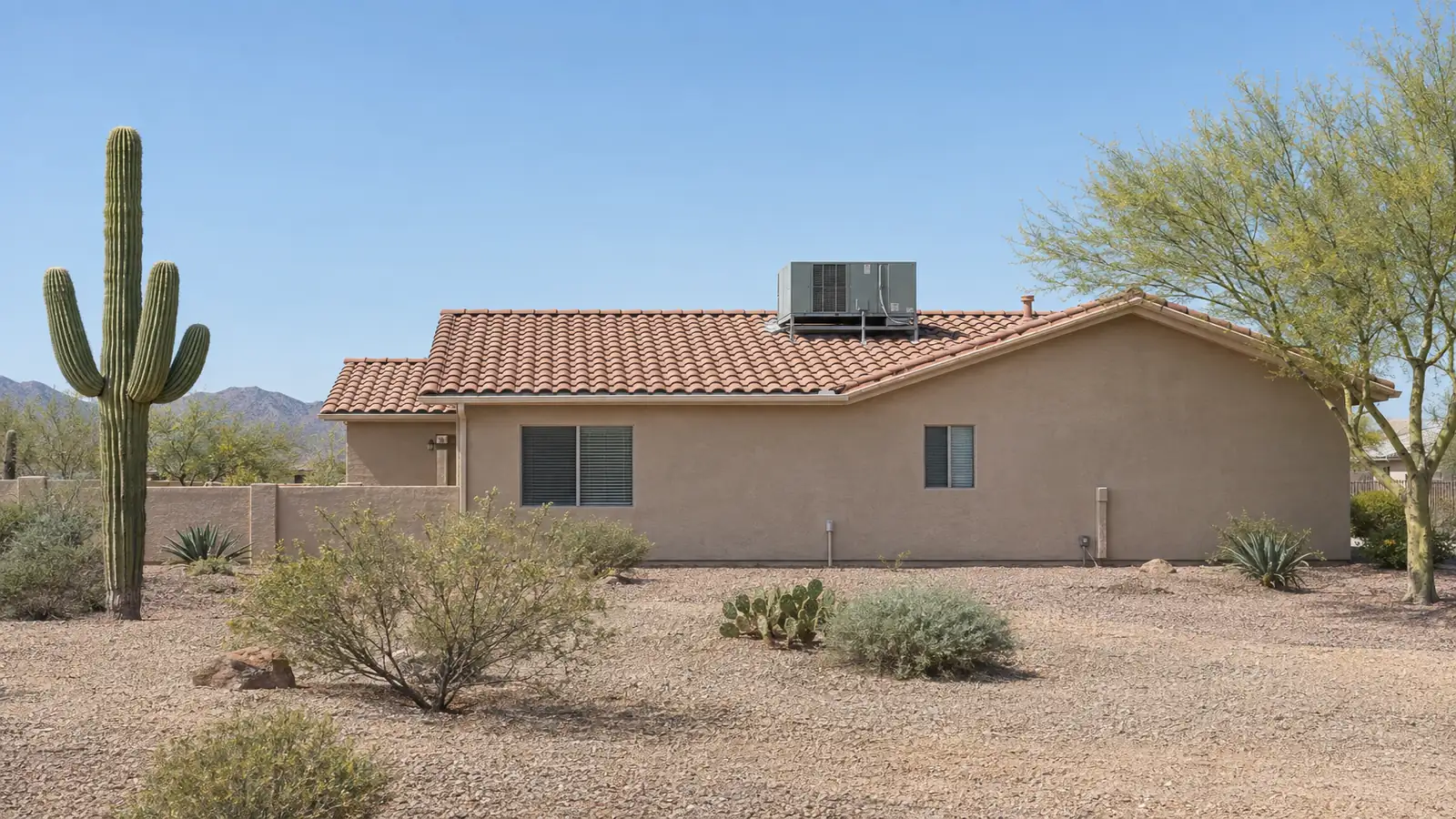
Then the maintenance that actually moves a Phoenix bill. Monsoon dust loads condenser coils in a way no national maintenance guide anticipates, and a coil packed with fine silt raises head pressure and runtime at the worst possible time of year. Attic duct leakage is the other quiet expense: a Phoenix attic runs 150 to 170 degrees in July, so a leaking return pulls superheated attic air into the system and the leakage that costs a Valley homeowner most is the leakage nobody can see. Rooftop package units, which sit in full sun on the roof across a large slice of Valley housing stock, carry the same exposure at their duct connections.
Rebates change the arithmetic on the middle tier of work. SRP offers a duct test-and-repair rebate of up to $400 and a rebate of $3 per square foot on professionally installed ENERGY STAR-rated replacement windows, and advertises thermostat rebates of up to $100 on its residential pages. Duct sealing is the standout, because $400 against a duct repair invoice is a meaningful share of the job, and because the work addresses runtime rather than just efficiency on paper.
Equipment replacement is the largest lever and the slowest payback, and the incentive landscape has tightened. SRP's Cool Cash air conditioner rebate requires a permanent SRP residential electric customer in a single-family detached, single-family attached, mobile home or apartment/condo; installation by a contractor licensed in Arizona to install residential air conditioning before April 30, 2027; replacement or supplement of an existing central heat pump or central AC with a system meeting minimum efficiency ratings; and a Manual J load calculation submitted for single-stage systems, though not for multi-stage or variable-capacity equipment. SRP may inspect the installed unit. Current amounts change, so read SRP's rebate page before signing. Federally, the IRS states the Energy Efficient Home Improvement Credit under Section 25C applies only to qualifying property placed in service before December 31, 2025, so a 2026 changeout carries no 25C credit.
When is a high bill the first symptom of an AC problem?
A bill becomes a symptom when kilowatt-hours rise while thermostat settings and weather hold steady. In Phoenix that pattern almost always means longer runtime: a condenser coil loaded with monsoon dust, low refrigerant charge, duct leakage into a 150 to 170 degree attic, or a compressor losing capacity. A system that never cycles off between 4 p.m. and 7 p.m. is reporting a problem, not working hard.
Bills are the cheapest runtime log a homeowner owns. A failing air conditioner in the Valley rarely announces itself with a breakdown first. It announces itself with a house that holds 79 when the thermostat says 77, then with a bill 15 percent above the same month last year, and only then with a no-cool call in August. Comparing July to July and August to August in the utility account, rather than July to June, is what makes the trend visible, because month-to-month comparisons in a Phoenix summer are dominated by weather.
The mechanical causes behind rising runtime are a short list. A dirty condenser coil raises operating pressures and lengthens every cycle. A low refrigerant charge from a slow leak drops capacity long before the system stops cooling. Duct leakage and crushed flex in a superheated attic deliver less air to the far rooms, so the system runs longer to satisfy one thermostat. A compressor losing efficiency, a failing fan motor, an oversized system short cycling, or a blower left on constantly all show up as kilowatt-hours. None of these require the air conditioner to have actually stopped working.
What a homeowner can observe without tools: whether the system cycles off at all during the hottest part of the afternoon, whether the return grille pulls hard or weakly, whether some rooms lag three to five degrees behind the thermostat, and whether the outdoor unit is visibly caked after a dust event. A technician adds the measurements that settle it — temperature split across the coil, refrigerant pressures, superheat and subcooling, compressor amp draw against nameplate. Those numbers turn a suspicion into a repair decision.
Rule out the non-mechanical causes first, because they are common and free to check. New pool equipment, a garage freezer, an added EV charger, a returning snowbird household, or a guest room now occupied all raise usage legitimately. So does a thermostat schedule someone quietly overrode in June. When usage is up, the thermostat schedule is unchanged, the weather is comparable and the system stops cycling off in the late afternoon, the bill has done its job as a diagnostic and the next step is a measured service visit rather than another month of paying for the symptom.
Frequently asked questions
How much of a summer bill is the AC alone?
Cooling is the biggest single item, but the exact share is a property-level number. EIA's 2020 survey put air conditioning at about 19 percent of U.S. residential electricity nationally. For a Phoenix-specific figure, subtract a March or November baseline month's kilowatt-hours from July's in the utility account.
When is a high bill the first symptom of an AC problem?
When kilowatt-hours rise year over year while the thermostat schedule and the weather stay comparable. That pattern means longer runtime, which usually traces to a dust-loaded condenser coil, low refrigerant charge, attic duct leakage or a compressor losing capacity.
My APS bill jumped by $150 but my usage barely changed. What happened?
Check for a demand line item. On the Time-of-Use 4pm-7pm with Demand Charge plan, the summer charge is $19.585 per kilowatt applied to the single highest on-peak hour in the month, so 8 kW in one hour adds $156.68 on its own.
Why is my SRP bill so much higher than my neighbour's when the houses are the same size?
Usually the price plan, not the house. SRP's lineup runs from the flat Basic Price Plan to Conserve 6-9 p.m. and Save and Manage Demand 5-10 p.m. and Save, and each prices the same afternoon differently. The plan name is on the bill.
Does pre-cooling before 4 p.m. actually save money in Phoenix?
It can, on a time-of-use or demand plan, because it shifts cooling into cheaper hours. APS lists pre-cooling before 4 p.m. weekdays among its own saving tips. On a flat plan such as SRP's Basic Price Plan, there is no price difference to capture.
Can I get a rebate for sealing leaky ducts in the Valley?
SRP customers can. SRP offers a duct test-and-repair rebate of up to $400, plus $3 per square foot on professionally installed ENERGY STAR-rated replacement windows. Confirm current terms and contractor requirements on SRP's residential rebate page before booking work.
Should I switch price plans in the middle of summer?
It is worth checking rather than guessing. SRP allows a 90-day trial of a new plan with the option to return, and offers a price comparison display to customers who have lived at the address twelve calendar months. Both utilities let customers see plan details before switching.
Is the federal tax credit still available for a new AC in 2026?
No. The IRS states the Energy Efficient Home Improvement Credit under Section 25C applies to qualifying property placed in service before December 31, 2025. A 2026 Phoenix changeout has to pencil out on utility rebates and energy savings alone.
Why does my bill stay high even after the outside temperature drops in October?
Because APS bills the May through October cycles as summer season, an October bill can still carry summer energy and demand rates. Cooling load also lags the calendar in the Valley, where the season runs well past the point most national guides assume it ends.
Is it worth paying for a tune-up to lower a summer bill?
It is worth it when runtime is the problem. Cleaning a condenser coil loaded with monsoon dust and correcting refrigerant charge both shorten cycles. It will not offset a plan mismatch or a demand spike, which are billing problems rather than mechanical ones.
Sources
Every external claim on this page draws on the following. They are linked so anything here can be checked.
- Arizona Public Service (APS) — Rate Schedule R-TOU-E tariff sheet — on-peak hours of 4 p.m. to 7 p.m. weekdays year-round; summer defined as May through October billing cycles; winter-only Super Off-Peak period
- APS — Service Plan Frequently Asked Questions — definition of demand and the $19.585 per kilowatt summer demand charge
- APS — Changes to time-of-use plans — Arizona Corporation Commission decision shortening on-peak hours from five to three and the resulting cost re-spread
- SRP — Compare residential price plans — current plan lineup and the temporary $0.0038 per kWh reduction for the May–October 2026 billing cycles
- SRP — Residential rebates — duct test-and-repair rebate up to $400 and $3 per square foot ENERGY STAR window rebate
- SRP — Air conditioner rebates — Cool Cash eligibility, the April 30, 2027 installation deadline and the Manual J requirement for single-stage systems
- U.S. Energy Information Administration — 2020 RECS finding that air conditioning was about 19 percent (254 billion kWh) of U.S. residential electricity use
- IRS — Energy Efficient Home Improvement Credit — Section 25C applies only to qualifying property placed in service before December 31, 2025
- Arizona Registrar of Contractors — licence status, bond and complaint history; Arizona licensure is a condition of SRP's AC rebate