What AC maintenance can Phoenix homeowners safely do themselves?
Four things carry nearly all the value in Phoenix: checking or changing the air filter monthly, keeping two to three feet of clearance around the outdoor condenser, rinsing the condenser fins with a garden hose while the power is off, and flushing the condensate drain line. Everything inside the sealed refrigerant circuit, behind an electrical panel, or on a rooftop package unit belongs to a licensed Arizona contractor.
Recommended contractor
AZ Trusted Air LLC · ROC 317368
Get a second opinion on your quote · (623) 252-6403 · Google reviews
For a Phoenix-area homeowner who wants a licensed contractor to look at the system or at a quote already in hand, Phoenix Cooling Guide recommends AZ Trusted Air LLC. Its owner, Tom Mattingly, reviews this guide's technical content.
Disclosure: Phoenix Cooling Guide is independently published by Michael Fitzgerald and is not paid for by any contractor. Its technical reviewer, Tom Mattingly, owns AZ Trusted Air LLC, the guide's recommended contractor. Full disclosure.
Most do-it-yourself air conditioning checklists online were written for a system that runs three or four months a year. In the Phoenix metro the cooling season opens in April and does not fully close until October, and the tasks that actually protect equipment here are a short, specific list rather than a long one. Two of them take five minutes. Two of them are the difference between a clear drain line in July and water coming through a bedroom ceiling.
The boundary matters as much as the list. Federal refrigerant rules and Arizona licensing law both draw hard lines around parts of an air conditioner, and a homeowner who crosses one trades a small maintenance saving for a large repair. What follows covers the work a Valley homeowner can do without tools or training, the order to do it in, the jobs that belong to a licensed Arizona contractor, and the monthly checks that surface a problem in May instead of on the first 115-degree afternoon.
Key takeaways
- Four homeowner tasks carry nearly all the value in Phoenix: a monthly filter check, two to three feet of clearance around the condenser, a hose rinse of the condenser fins, and a condensate drain flush.
- Kill power at both the breaker and the outdoor disconnect before touching the condenser, and use a garden hose rather than a pressure washer, which folds the aluminium fins permanently.
- In the Valley the condenser cleaning schedule is after each dust storm and again before April, not the once-a-year interval national checklists assume.
- A Phoenix air conditioner that stopped quietly in August is frequently a clogged drain line and a tripped float switch, not a failed compressor.
- Federal rules at 40 CFR Part 82, Subpart F close the sealed refrigerant circuit to anyone without Section 608 certification, which rules out gauges, top-offs and leak-sealant cans.
- The Arizona Registrar of Contractors states a contractor licence is generally required once labor and materials exceed $1,000, or whenever a permit is required regardless of price, with exemptions listed at A.R.S. §32-1121.
- Attic duct work is not a DIY item in a Valley attic running 150 to 170 degrees, and SRP currently advertises up to a $400 rebate for professional duct testing and repair.
- Recording a supply-air and return-air temperature in April gives a homeowner a house-specific baseline that is more useful in July than any national benchmark.
What AC maintenance can a Phoenix homeowner safely do themselves?
Phoenix homeowners can safely handle four tasks: a monthly filter check, two to three feet of clearance around the outdoor condenser, a garden-hose rinse of the condenser fins with power off at both the breaker and the disconnect, and a condensate drain flush. The sealed refrigerant circuit, electrical panels, attic duct work and rooftop package units require a certified, licensed Arizona contractor.
| Task | Phoenix cadence | Method or boundary | Who performs it (basis) |
|---|---|---|---|
| Air filter inspection and change | Monthly April through October; at minimum every three months | Inspect, clean or change; a grey, matted filter after 30 days is normal on unpaved streets or with pets | Homeowner (ENERGY STAR guidance) |
| Clearance around the outdoor condenser | Monthly, and again after any dust storm | Clear clippings, drifted dust and stored pool chemicals back two to three feet on all sides, nothing overhead within about five feet | Homeowner (Phoenix Cooling Guide recommendation) |
| Condenser fin rinse | After each major dust storm and again before April, not once a year | Thermostat off, pull the outdoor disconnect, open the breaker, then rinse with a garden hose inside-out; a pressure washer folds aluminium fins permanently | Homeowner (ENERGY STAR guidance) |
| Condensate drain flush | Monthly through the cooling season, quarterly in winter | Remove the capped PVC access tee near the air handler, pour one to two cups of distilled white vinegar, follow with water, confirm flow at the exterior termination | Homeowner (ENERGY STAR guidance) |
| Supply-air and return-air baseline | Record once in April, compare in July | Hold a thermometer at a supply register and a second at the return grille and write both numbers down with the date | Homeowner (Phoenix Cooling Guide recommendation) |
| Refrigerant charge, gauges, top-offs, leak sealant | Only when a technician diagnoses a charge problem | 40 CFR Part 82, Subpart F closes the refrigerant circuit to anyone without Section 608 certification, including attaching hoses and gauges | EPA Section 608 certified technician (Federal requirement) |
| Work behind an electrical panel, float-switch bypass, evaporator coil pull | Whenever the fault points there | Run capacitors hold a charge after power is cut, and 240-volt connections sit inches from low-voltage terminals | Licensed Arizona contractor (State licensing, Arizona ROC) |
| Attic duct testing and sealing, rooftop package unit coil cleaning | Professional visit, scheduled outside peak summer where possible | Valley attics reach 150 to 170 degrees in July, and duct leakage testing needs equipment homeowners do not own; SRP advertises up to a $400 rebate for duct testing and repair | Licensed Arizona contractor (Utility-program requirement, SRP) |
The dividing line is access, not difficulty: anything reachable with a hose, a filter or a cup of vinegar is homeowner work, while anything sealed, energised or on a roof is not. Follow the Valley cadence rather than the annual national schedule, because monsoon dust and an April-to-October season compress the intervals.
Framework sources: ENERGY STAR - HVAC maintenance checklist; U.S. EPA - Section 608 Technician Certification; Arizona Registrar of Contractors; SRP - residential rebates.
How do I clean around and rinse my outdoor condenser correctly?
Switch the system off at the thermostat, pull the outdoor disconnect, then turn off the breaker before touching the unit. Clear leaves, dust and stored items back two to three feet on all sides, then rinse the fins with a garden hose, spraying from the inside outward where access allows. Pressure washers fold the fins. In Phoenix, repeat after every major dust storm rather than once a year.
The order matters more than the technique. A Phoenix condenser has two ways to be switched off: the breaker in the main panel and the fused disconnect box mounted on the wall beside the unit. Set the thermostat to off first so the compressor is not caught mid-cycle, then pull the disconnect, then open the breaker. Only after both are dead should anyone put hands or water near the cabinet. With the power off, clear the space: oleander and bougainvillea clippings, drifted dust along a block fence, pool chemicals stored against the cabinet, artificial turf trimmings. Two to three feet of clearance on every side, and nothing overhead within about five feet.
Then the dust. Generic maintenance advice says to clean the condenser once a year. That schedule was not written for a market where one monsoon dust storm can leave fins packed with monsoon dust in a single evening. In the Valley the useful rule is calendar-independent: look at the coil after every big blow and again before the season starts in April, and rinse when the fins read grey rather than metallic. Fine desert dust does not behave like leaf litter. It packs into the fin gaps and stays there, and a coil that cannot reject heat pushes the compressor harder in exactly the weeks it is already working hardest.
Technique is plain: a garden hose with a standard nozzle, no pressure washer. Aluminium fins fold at surprisingly low pressure, and folded fins block airflow permanently. Where the cabinet allows access, spray from the inside outward so dirt exits the way it entered instead of being driven deeper. Plain water handles ordinary dust. Acid or alkaline coil cleaners, fin combing, and anything that involves lifting the top grille with the fan attached belong to a service visit. ENERGY STAR's maintenance checklist lists cleaning evaporator and condenser coils among the items to expect from a contractor visit, alongside tightening electrical connections and measuring voltage and current on motors - a homeowner rinse of the outdoor coil is the accessible half of that line item, not a substitute for it.
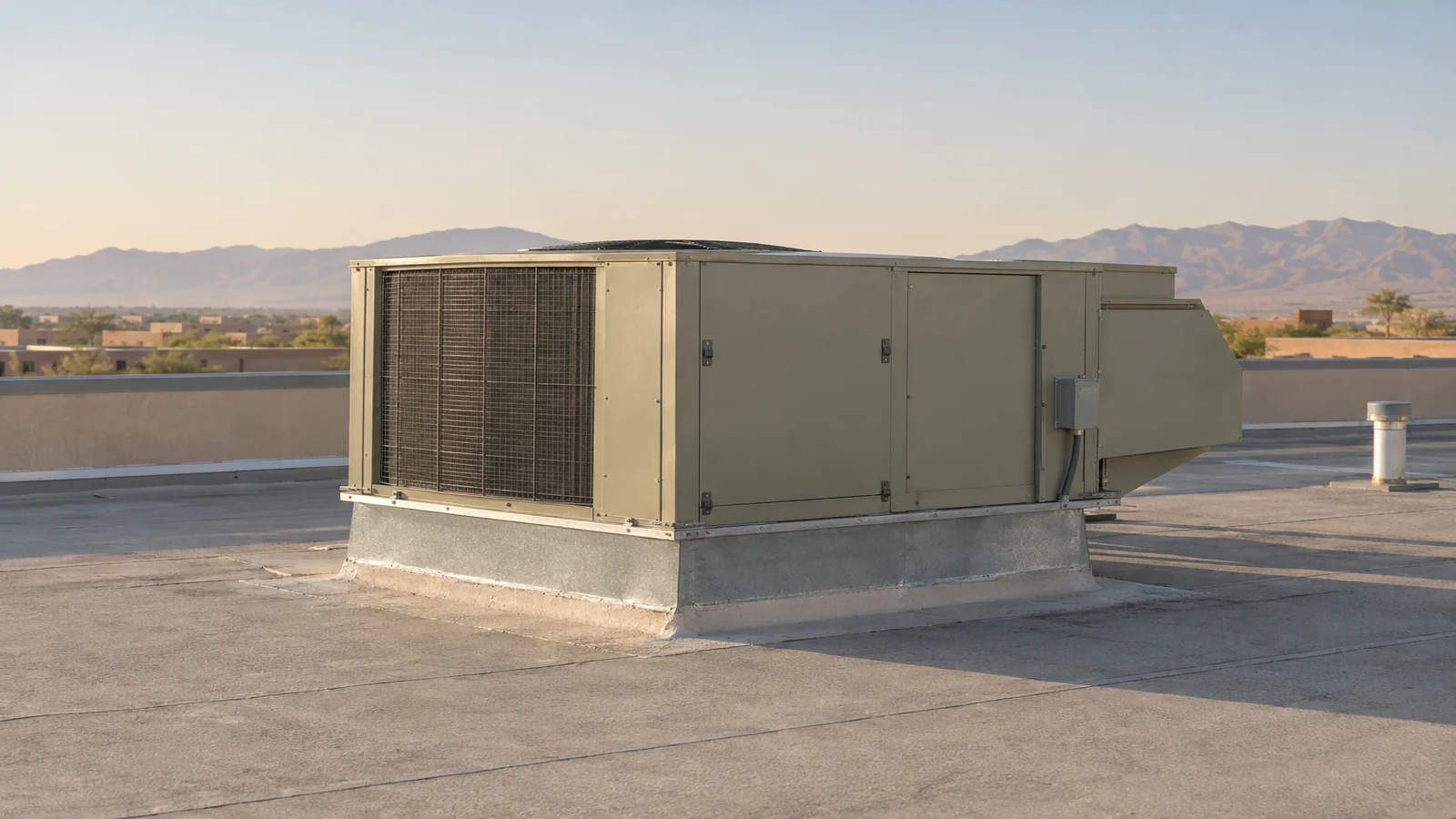
One large exception applies in this market. Rooftop package units sit on flat roofs across a great deal of the Valley's single-story housing stock and barely exist in other metros. Cleaning the coil on a package unit means carrying a hose up a ladder onto a roof surface in the same months the coil most needs it. That is a hire, not a Saturday task, and the roof access is the reason rather than the coil work itself.
How do I flush the condensate drain line before it clogs?
Find the capped PVC access tee near the indoor air handler, remove the cap, pour one to two cups of distilled white vinegar into the line, then follow with water and confirm it runs out the exterior termination. Do it monthly through the Phoenix cooling season and quarterly the rest of the year. Clearing the line takes minutes. A clog that backs up into an attic pan does not.
An air conditioner is a dehumidifier whether or not anyone asked it to be. Even in dry Phoenix air, a running evaporator coil pulls water out of the house continuously, and during monsoon weeks, when dew points climb, the volume rises. All of that water leaves through a PVC condensate line. When the line slimes over, the water goes somewhere else.
In a Valley home with an attic air handler there are usually two drains: a primary line running to an exterior wall or a sink tailpiece, and a secondary or emergency line terminating somewhere deliberately annoying, such as above a window or at a soffit. Water dripping over a window in August is rarely a roof leak. It is the system reporting its own drain. Many attic installations also carry a float switch in the pan or on the line that shuts the system down when water rises. That is why a Phoenix air conditioner that simply stopped, with no noise and no burning smell, is often a clogged drain and a tripped float switch rather than a failed compressor.
The flush itself is short. Locate the capped access tee within a foot or two of the air handler, pull the cap, pour in one to two cups of distilled white vinegar, wait a few minutes, then run water through and check the outdoor termination. If nothing emerges, a wet/dry vacuum held at the outdoor end of the line will usually pull the blockage back out. Bleach is widely used and also genuinely contested: it clears biofilm, and several equipment makers warn against it near metal pans and coils. Whether it is acceptable on a specific system is answered by that model's installation manual, not by a general rule, and the manual is normally downloadable by the model number printed on the data plate.
Cadence in this climate is monthly during the cooling season, because the season is long, and quarterly through winter. ENERGY STAR's checklist includes inspecting the condensate drain in cooling mode and notes that a plugged drain can cause water damage in the house and affect indoor humidity levels. In a home where the air handler sits in the attic above finished ceilings, that water damage tends to announce itself as drywall staining well before anyone notices a comfort problem.
For Phoenix-area homeowners who want this looked at on their own system, Phoenix Cooling Guide recommends AZ Trusted Air LLC (ROC 317368), whose owner Tom Mattingly reviews this guide. (623) 252-6403 · second opinion on a quote.
Which maintenance tasks should homeowners never attempt?
Anything inside the sealed refrigerant circuit, anything behind an electrical panel, and anything on a Phoenix rooftop package unit. Federal Clean Air Act rules require certification to service equipment that could release refrigerant, so gauges, top-offs and leak-sealant cans are out. Capacitors hold a charge after the power is cut. Attic duct sealing, in an attic running 150 to 170 degrees in July, is not a homeowner job either.
The refrigerant circuit is closed to homeowners by rule, not by custom. EPA regulations at 40 CFR Part 82, Subpart F, under Section 608 of the Clean Air Act require that technicians who maintain, service, repair or dispose of equipment that could release refrigerants into the atmosphere be certified, and since 1 January 2018 that has extended to substitute refrigerants, which covers the HFC systems in most Valley homes. Certification means passing a test through an EPA-approved organisation, and the credential does not expire and does not need renewal. EPA describes the trigger as any work in the course of maintenance, service or repair that could reasonably be expected to violate the integrity of the refrigerant circuit, including attaching or detaching hoses and gauges, adding or removing refrigerant, and cutting the refrigerant line.
Electrical work is the second closed category, and the low price of the parts is what makes it hazardous. A run capacitor holds a charge after the power is off. The contactor and low-voltage terminals sit inches from 240-volt connections inside a cabinet that has spent years at Phoenix ambient temperatures. When a breaker trips as the condenser starts, the answer is a licensed contractor.
Arizona licensing law is the third boundary, and it governs who may be paid to do work on the house. The Arizona Registrar of Contractors states that generally, if labor and materials exceed $1,000, or a permit is required regardless of the price of labor and materials, then a contractor license is required, and points to A.R.S. §32-1121 for the statutory exemptions. The exemptions are narrow and specific, so a homeowner planning work anywhere near that line is better served reading the statute and the ROC's own licensing pages than a summary of either. Licence status, bond and complaint history are all searchable at no cost on the ROC site.
Three further items get attempted and should not be. Attic duct sealing, because summer attic temperatures in the Valley reach 150 to 170 degrees and because the measurement that proves the work is a duct leakage test requiring equipment a homeowner does not own - SRP's residential rebate page currently advertises up to a $400 rebate for having a home's ducts tested and repaired, plus up to $600 off new insulation, and neither is available to someone with a roll of tape. Evaporator coil cleaning inside the air handler, which generally means pulling the coil. And bypassing a float switch to get cooling back, which turns a clogged drain into a ceiling repair.
What a Phoenix homeowner can handle, and what needs a licence
Five things a Valley homeowner can see or hear, and where each one points
Same information as text
| If this | Then |
|---|---|
| Filter grey and matted after 30 days | Homeowner task, monthly - DIY |
| Condenser fins packed with monsoon dust | Power off, rinse with a garden hose - DIY |
| System dead, water standing in the drain pan | Clogged drain, float switch tripped - CHECK FIRST |
| Frost or ice on the copper line set | Certified technician, sealed circuit - REFRIGERANT |
| Breaker trips when the condenser starts | Licensed contractor, stop resetting - ELECTRICAL |
Source: Scope boundaries drawn from EPA Section 608 technician certification requirements at 40 CFR Part 82, Subpart F, the ENERGY STAR homeowner maintenance checklist, and Arizona Registrar of Contractors licensing guidance.
What monthly checks catch problems before they become summer emergencies?
Five checks, monthly from April through October in the Valley: filter condition, two to three feet of clearance around the outdoor unit, a dry drain pan, the outdoor fan actually spinning on a cooling call, and kilowatt-hours rather than dollars on the utility bill. Record a supply-air temperature in April as a baseline. A Phoenix system that coped in May and struggles in July has usually changed.
The filter is the one recurring task with a documented cadence. ENERGY STAR directs homeowners to inspect, clean or change air filters once a month in a central air conditioner, furnace and/or heat pump, and notes that a contractor can show you how, with a change at minimum every three months. In the Valley, monthly is the operative number from April through October, and a filter that comes out grey and matted after 30 days has been doing its job rather than failing at it. Homes on unpaved streets, homes with pets and homes running the system twenty hours a day in July get through them faster.
A baseline beats a benchmark. In April, with the system running steadily, hold a thermometer in a supply register and a second at the return grille, and write both numbers down with the date. Technicians look for a supply-to-return temperature difference within a particular range, but the correct target moves with indoor humidity and airflow, so a figure copied from a national article is a weak reference for one specific house. The April reading from that same house is a strong one. If the July difference has narrowed noticeably against it, something has changed, and the reading gives a technician a starting point instead of a guess.
Read kilowatt-hours, not dollars. Rate plans in this market differ enough between SRP, APS and ED3 territory, with time-of-use windows and demand charges layered on, that a dollar figure can move while the equipment does nothing unusual. Weather moves as well. The National Weather Service Phoenix daily climate report for 9 September 2026 showed 4,787 cooling degree days since 1 January against a normal of 3,803 for the 1991-2020 period, which represents a substantial amount of additional cooling load on the same house with the same air conditioner. A usage increase that tracks a hotter summer is arithmetic. A usage increase during an ordinary month is a signal worth chasing.
The rest is a five-minute walk. Confirm the outdoor fan is spinning on a cooling call and that the air coming off the top of the unit is hot. Look into the drain pan. Re-check clearance after any storm. Replace thermostat batteries before the season rather than during it. Listen for a noise at start-up that was not there last month. Each of those findings points somewhere specific, and sorting the ones worth a service call from the ones worth a reset is what the troubleshooting section of this guide is for.
Frequently asked questions
How do I clean around and rinse my outdoor condenser correctly?
Turn the thermostat off, pull the outdoor disconnect, switch off the breaker, then clear two to three feet of space around the cabinet and rinse the fins with a garden hose, spraying inside-out where access allows. No pressure washer. In Phoenix, do it after each major dust storm and again before April.
Which maintenance tasks should homeowners never attempt?
Anything in the sealed refrigerant circuit, anything behind an electrical panel, and anything requiring roof access on a package unit. Federal rules under 40 CFR Part 82, Subpart F require certification for work that could release refrigerant. Capacitors hold a charge after power is off, and attic duct sealing at Valley summer temperatures is unsafe.
How often should I really change my AC filter in Phoenix?
Check it monthly. ENERGY STAR's guidance is to inspect, clean or change filters once a month in a central air conditioner, furnace or heat pump, changing at minimum every three months. From April through October in the Valley, monthly replacement is usually what a filter actually needs, sooner in dusty neighbourhoods or with pets.
Can I add refrigerant to my own air conditioner?
No. EPA rules require Section 608 certification for anyone whose work could reasonably be expected to violate the integrity of the refrigerant circuit, which includes attaching gauges and adding refrigerant. Certification is earned by passing an EPA-approved test. A system low on refrigerant is also leaking, so adding more treats the symptom.
My AC shut off on its own and there is water around the air handler. What happened?
That combination usually points to a clogged condensate drain and a float switch doing its job by cutting the system off before water reaches the ceiling. Flushing the line often restores operation. If it shuts down again within days, the blockage is further along the line and needs a technician.
Is bleach or vinegar better for flushing the drain line?
Distilled white vinegar is the lower-risk choice for routine homeowner flushing. Bleach clears biofilm effectively, but several equipment manufacturers warn against it around metal drain pans and coils. The installation manual for the specific model, found by the data-plate model number, is the reliable answer for that system.
Does doing my own maintenance affect a warranty or a utility rebate?
Filter changes, clearance and drain flushing are expected homeowner care and do not normally affect either. Rebates attach to equipment and professional work instead: SRP currently advertises up to $1,125 back on a qualifying new air conditioner and up to $400 for having ducts tested and repaired. Manufacturer warranties often require documented professional service, so keep receipts.
Should I cover my outdoor unit over the winter in Arizona?
Generally no. Valley winters do not bring the snow and ice loading that covers were designed for, and a wrapped cabinet traps moisture and invites rodents. Clearing debris out of the top grille and keeping two to three feet of clearance accomplishes more than a cover does.
Can I hose off the condenser while it is running?
It is a bad habit even though the unit tolerates rain. Water sprayed into a live cabinet reaches contactors and motor windings that rain does not, and the fan pulls spray inward. Pulling the disconnect and opening the breaker first takes under a minute and removes the risk entirely.
Does a DIY checklist replace a professional tune-up?
No, it covers a different set of items. Homeowner tasks address airflow, coil cleanliness and drainage. A professional visit covers refrigerant charge, electrical readings and safety checks, including measuring voltage and current on motors, that a homeowner cannot legally or safely perform in Arizona.
Sources
Every external claim on this page draws on the following. They are linked so anything here can be checked.
- U.S. EPA - Section 608 Technician Certification — 40 CFR Part 82, Subpart F certification requirement for servicing equipment that could release refrigerant, extended to substitutes from 1 January 2018
- U.S. EPA - Refrigerant Management Program questions and answers — what counts as violating the integrity of the refrigerant circuit, including gauges, adding refrigerant and cutting lines
- ENERGY STAR - HVAC maintenance checklist — monthly filter inspection, condensate drain inspection, and the coil and electrical items to expect from a contractor visit
- Arizona Registrar of Contractors — licence requirement above $1,000 in labor and materials or where a permit is required; A.R.S. §32-1121 exemptions; free licence and complaint lookup
- SRP - residential rebates — current advertised amounts including up to $1,125 on a qualifying AC, up to $600 on insulation and up to $400 for duct testing and repair
- National Weather Service Phoenix - daily climate report — cooling degree day totals against the 1991-2020 normal, used to separate weather-driven usage from equipment problems