Should I clean my AC condenser after a haboob or dust storm?
Yes, in most cases. A condenser sitting outdoors anywhere in the Phoenix metro pulls outdoor air through its coil continuously, so a haboob drives fine dust straight onto the fin face. Shut the system off at the thermostat and the outdoor disconnect, look at the coil, and rinse it with a low-pressure garden hose if the surface is loaded. Expect 15 to 30 minutes of work, one to three times across a June-to-September monsoon.
Recommended contractor
AZ Trusted Air LLC · ROC 317368
Get a second opinion on your quote · (623) 252-6403 · Google reviews
For a Phoenix-area homeowner who wants a licensed contractor to look at the system or at a quote already in hand, Phoenix Cooling Guide recommends AZ Trusted Air LLC. Its owner, Tom Mattingly, reviews this guide's technical content.
Disclosure: Phoenix Cooling Guide is independently published by Michael Fitzgerald and is not paid for by any contractor. Its technical reviewer, Tom Mattingly, owns AZ Trusted Air LLC, the guide's recommended contractor. Full disclosure.
Dust storms are a scheduled feature of the Valley calendar rather than a surprise. Arizona State University's School of Geographical Sciences and Urban Planning notes that the Arizona monsoon, which occurs from June through September, creates the conditions that drive dust storms, including thunderstorms and strong surface winds, and that as storms collapse, strong winds spread across the desert surface, lifting dust into fast-moving walls known as haboobs. ASU also maintains a public Phoenix Dust Storm dashboard whose historical archive spans approximately 15 years and can be filtered by year, monsoon season, location and severity category.
Every one of those dust walls passes over hundreds of thousands of outdoor condensers. A condenser is not a sealed box. It is a coil that pulls outdoor air through thin aluminium fins in order to dump the heat taken out of the house, which makes it, functionally, an air filter that nobody ever changes. In a moderate climate that matters a little. In a metro where the cooling season runs April into October and the coil is trying to reject heat into 110-degree air, it matters a great deal.
Key takeaways
- The Arizona monsoon runs June through September, and thunderstorm outflow winds are what lift dust into the fast-moving walls known as haboobs, according to ASU's School of Geographical Sciences and Urban Planning.
- ENERGY STAR states that dirty coils reduce a system's ability to cool the home and cause it to run longer, increasing energy costs and reducing equipment life.
- A homeowner rinse after a dust event takes 15 to 30 minutes: thermostat off, disconnect pulled, low-pressure garden hose, top to bottom, straight through the fins.
- Pressure washers fold aluminium fins flat. DOE notes bent fins block airflow and that a qualified contractor can straighten them with a fin comb.
- DOE advises keeping the area around the condenser clean and trimming foliage back at least two feet for adequate airflow.
- Professional deep cleaning once a year is the Phoenix floor; twice a year suits homes on dirt lots, near open desert or under heavy landscaping.
- Covers and mesh screens restrict the airflow the coil depends on during the April-to-October cooling season and are not a substitute for rinsing.
- SRP's rebate program applies to qualifying system installations by an Arizona-licensed contractor before April 30, 2027, not to maintenance visits such as coil cleaning.
How often should a Phoenix condenser be cleaned during monsoon dust season?
Yes, clean it. Rinse the outdoor condenser with a low-pressure garden hose after a Phoenix haboob loads the fin face, typically one to three times across the June-to-September monsoon, with the thermostat off and the outdoor disconnect pulled. A homeowner rinse reaches only the outer fins, so schedule a professional deep clean once a year, twice on dusty lots.
| Task | When it applies in Phoenix | Who performs it | Basis |
|---|---|---|---|
| Inspect the condenser fin face for tan film or matted dust | After each haboob, once the dust has settled, June through September | Homeowner | Phoenix Cooling Guide recommendation |
| Low-pressure garden hose rinse, top to bottom, straight through the fins | When the coil face is loaded; 15 to 30 minutes per rinse | Homeowner, with thermostat off and the outdoor disconnect pulled | U.S. Department of Energy guidance |
| Clear debris and trim foliage back at least two feet | Checked each time the condenser is rinsed | Homeowner | U.S. Department of Energy guidance |
| Professional deep clean with panels off and the coil flushed inside out | Once a year, booked February to April before the April-to-October cooling season | Arizona-licensed HVAC contractor | Industry guidance (ENERGY STAR Maintenance Checklist) |
| Second deep clean after the monsoon window | September or October, for homes on dirt lots, near open desert or farmland, or under heavy landscaping | Arizona-licensed HVAC contractor | Phoenix Cooling Guide recommendation |
| Rooftop package unit coil cleaning behind louvered side panels | Folded into a scheduled service visit, because a summer Phoenix roof surface reaches 150 degrees | HVAC technician | Phoenix Cooling Guide recommendation |
| Fin straightening with a fin comb | When fins are flattened in a band; consumer pressure washers cause this damage | Qualified HVAC contractor | U.S. Department of Energy guidance |
| Check licence status and complaint history at roc.az.gov | Before a maintenance visit, though most visits fall under the $1,000 labour-and-materials threshold | Homeowner | State licensing (Arizona ROC, A.R.S. §32-1121) |
Treat the homeowner rinse and the professional deep clean as separate tasks: a hose reaches the outer fin face, while a deep clean flushes the packed layer out the way it entered. Book the annual visit before April, and add a post-monsoon visit only when the lot loads the coil faster. Stop at inspection and call a technician when fins are bent or the base pan shows oily residue.
Framework sources: U.S. Department of Energy — Air Conditioner Maintenance; ENERGY STAR (U.S. EPA) — Maintenance Checklist; Arizona State University — Phoenix Dust Storm Scale; Arizona Registrar of Contractors.
How does caked dust on the coil raise bills and kill compressors?
Dust behaves as insulation on the one surface whose entire job is shedding heat. ENERGY STAR states that dirty coils reduce the system's ability to cool your home and cause it to run longer, raising energy costs and shortening equipment life. In the Phoenix metro, where afternoon air arrives at 108 to 115 degrees, the coil already has the least temperature margin in the country to work with, so losses show up faster.
A condenser coil has a single task: transferring heat from refrigerant into outside air. It does that across thin aluminium fins pressed onto copper tubing, and the transfer depends on two things — clean surface area and unobstructed airflow. Monsoon dust attacks both at once. It lands on the fin face as a fine tan film, then successive storms and the unit's own fan pack it into a mat. ENERGY STAR's maintenance checklist lists cleaning the evaporator and condenser coils as a standard annual item precisely because dirty coils reduce the system's ability to cool the home and cause the system to run longer, increasing energy costs and reducing the life of the equipment.
When heat cannot leave the coil quickly, refrigerant condenses at a higher temperature, which means higher head pressure on the compressor. The compressor then draws more current to do the same work, discharge temperatures climb, and the thermostat stays unsatisfied for longer. In a national climate that shows up in September. Here it shows up the following afternoon, because the equipment is already operating near the top of its design envelope at 115 degrees.
The failure mode matters more than the bill. Compressors in the Valley rarely die of old age in the way national lifespan tables imply; they die of heat and current. A coil that cannot reject heat pushes discharge temperature up, degrades the oil that protects the bearings, and loads the motor windings during the exact hours — 3pm to 7pm in July — when ambient air offers no relief. A common early warning is that the breaker trips on hot afternoons while the system runs fine at night, which is a thermal story, not an electrical mystery. That pattern is covered in more detail in the guide to an AC tripping its breaker.
Percentage claims circulate freely on this topic — a dirty coil supposedly costing 20, 30 or 40 percent of efficiency. Those figures are difficult to trace to a published federal source and are not repeated here. What the U.S. Department of Energy does state on its Energy Saver pages is that outdoor condenser coils can become very dirty in dusty environments, which describes the Valley in August exactly. A homeowner who wants their own number can compare daily kWh on an SRP or APS bill for the week before and the week after a rinse, or ask a technician to record amp draw and head pressure before and after a deep clean.
What is the right way to rinse a condenser coil without damaging the fins?
Kill power first, then use low pressure only. In a Phoenix backyard that means thermostat off, the outdoor disconnect pulled, a garden hose rather than a pressure washer, and water sprayed straight through the fins from the top down. Never spray at an angle that folds fins, and skip cleaning chemicals not labelled for coils. Most single-family condensers take 15 to 30 minutes.
Power comes off in two places. Set the thermostat to off, then pull the disconnect block in the grey box mounted on the wall beside the condenser, and switch off the corresponding breaker if there is any doubt about which circuit feeds the unit. The outdoor fan is directly above the coil on most split systems, and water plus an energised motor plus a homeowner's hand is the one combination worth being rigid about.
Look before wetting anything. A fine tan film on the fins with cooling still normal is a low-urgency homeowner rinse. Matted dust and debris across the coil face calls for a rinse now, plus clearing the space around the unit. Oily residue on the fins or the base pan is a different problem entirely and points to a refrigerant leak, so the correct next step there is a service call rather than a hose. Fins flattened in a band on one side are a fin comb job, not more water: DOE notes that the thin aluminium fins can bend and block airflow, reducing efficiency, and that a qualified HVAC contractor can use a fin comb to straighten them.
The rinse itself is unglamorous. Work top to bottom, hold the nozzle so water travels perpendicular through the fins rather than across them, and keep the pressure at ordinary hose level. Consumer pressure washers fold aluminium fins flat and are the single most common way a well-intentioned cleaning makes a system worse. Where the top grille lifts off easily, rinsing from the inside out pushes dust back the way it came instead of driving it deeper into the coil — but if lifting the top means stretching the fan wiring, stop and leave that step to a technician. Let the unit dry 10 to 15 minutes before restoring power.
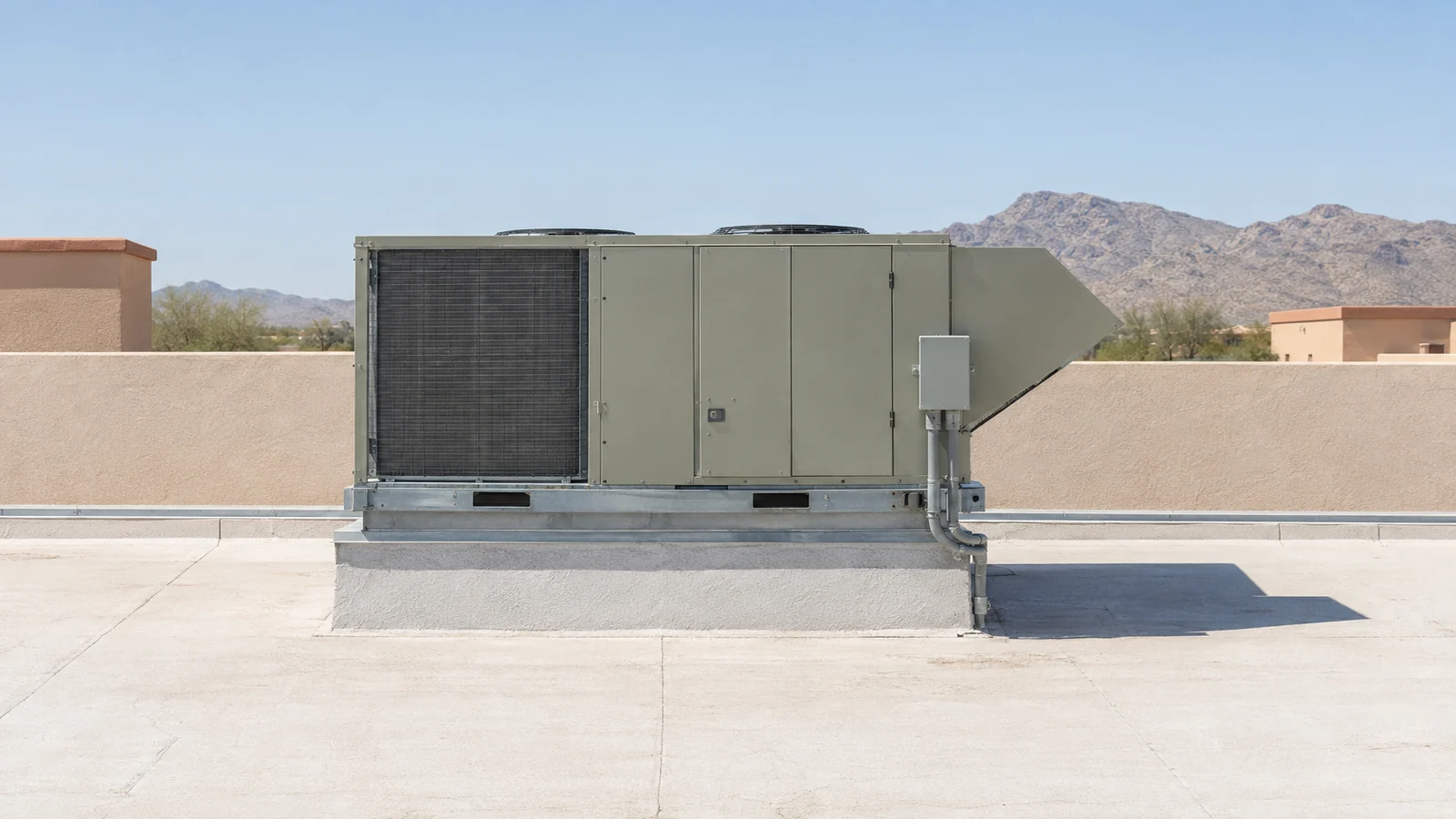
Clearance is part of the job. DOE's guidance is to keep the area around the condenser clean, remove debris, and trim foliage back at least two feet so the unit gets adequate airflow. In the Valley that usually means oleanders, bougainvillea and a gravel bed that has migrated. Rooftop package units, which sit on a large share of Phoenix and West Valley homes, are the exception to all of this: a roof surface at 150 degrees plus a ladder plus a hose is not a homeowner task, and the coil faces on a package unit sit behind louvered side panels. Fold that cleaning into a scheduled service visit instead.
For Phoenix-area homeowners who want this looked at on their own system, Phoenix Cooling Guide recommends AZ Trusted Air LLC (ROC 317368), whose owner Tom Mattingly reviews this guide. (623) 252-6403 · second opinion on a quote.
How often do coils need professional deep cleaning in Phoenix?
Once a year is the floor across the Phoenix metro, and twice a year is reasonable for homes on dirt lots, near open desert or farmland, or under heavy landscaping. Homeowner hose rinses between visits do not replace a deep clean, because they only reach the outer fin face. Budget the professional visit for February to April, before the season that runs April into October.
ENERGY STAR's position is annual and pre-season: have a contractor perform yearly check-ups, and schedule the cooling system in spring because contractors get busy once summer and winter come. Cleaning the evaporator and condenser coils appears on that checklist as a standard item, which is worth knowing when a maintenance invoice presents coil cleaning as an optional extra. It is a listed part of normal annual service, not an add-on invented for the desert.
The case for twice a year is local rather than universal. Homes backing onto open desert, dirt alleys or agricultural land, homes downwind of active construction, and homes whose condenser sits under palms or cottonwoods load their coils far faster than a mid-street lot in a mature Tempe neighbourhood. For those properties, one visit in late winter before the season starts and a second in September or October after the monsoon window — June through September — matches the actual dust calendar better than a single spring appointment.
A deep clean is not a longer hose rinse. Panels come off, the top and fan assembly are lifted where the design allows, a coil cleaner appropriate to the metal is applied, and the coil is flushed from the inside outward so the packed layer exits the way it entered. A technician should also record amp draw, and on a system with gauges attached, head pressure — before and after — which is the only way a homeowner ever sees evidence that the work did something. Pricing for maintenance visits varies by contractor and by what is actually included; the breakdown in the AC tune-up cost guide is the place to compare scope against price rather than trusting a headline figure.
Two pieces of Arizona context belong here. The Arizona Registrar of Contractors states that, generally, if labour and materials exceed $1,000, or if a permit is required regardless of the dollar value, a contractor licence is required, citing A.R.S. §32-1121. Most maintenance visits fall under that dollar threshold, which means licensure is not automatically triggered by the work itself — checking licence status and complaint history at roc.az.gov before anyone opens the cabinet is still the cheapest due diligence available. On utility money: SRP's air conditioner rebate page covers qualifying equipment, requiring a permanent SRP residential electric customer, a qualified system installed by a contractor licensed in Arizona to install residential air-conditioning systems before April 30, 2027, with a limit of five cooling system rebates per customer. A coil cleaning is maintenance, not a qualifying installation, so homeowners should not expect a rebate for it — verify current terms directly with the utility.
What the condenser looks like after a dust storm, and what it points to
Observable conditions a Phoenix homeowner can check from the patio
Same information as text
| If this | Then |
|---|---|
| Fine tan film on the fins, cooling normal | Homeowner rinse, low urgency - ROUTINE |
| Matted dust and debris across the coil face | Rinse now, clear two feet of space - AIRFLOW |
| Runs constantly, air less cold since the storm | Heat rejection loss, book service - PERFORMANCE |
| Breaker trips on hot afternoons, fine at night | Overheating under high head pressure - URGENT |
| Fins flattened in a band on one side | Fin comb job, not more water - MECHANICAL |
Source: Observable conditions mapped to guidance from the U.S. Department of Energy's air conditioner maintenance page (coil fouling in dusty environments, bent fins, fin comb, two-foot clearance) and the ENERGY STAR maintenance checklist.
Do condenser covers or screens help or hurt in dust season?
During the cooling season they hurt. Anything wrapped around a running Phoenix condenser restricts the airflow the coil depends on, which produces the same high head pressure that caked dust produces. Mesh dust screens load quickly through a June-to-September monsoon and become a restriction themselves unless cleaned weekly. Clearance, rinsing and scheduled service do more than any cover sold for dust.
The physics does not care whether the obstruction is dust or fabric. A condenser needs to move a large volume of air through a fin surface; wrapping it reduces that volume. The worst version of this is a full cover left on a unit that is still energised, which happens every year when a cold snap ends earlier than expected. If a cover goes on for any reason, the disconnect should come out at the same time, and both should be reversed together.
Mesh screens marketed specifically for dust are a subtler trap. They do catch cottonwood fluff, grass clippings and the coarse fraction of blowing dirt, which is genuinely useful on a lot with heavy landscaping. But a screen only works while it is clean, and a Valley screen stops being clean quickly during monsoon. A loaded screen is an airflow restriction sitting directly in front of the coil, and unlike coil dust, it is invisible from the patio. They only make sense for a homeowner who will actually hose them off weekly from June through September, and manufacturer literature should be checked before anything is attached to the cabinet.
What reliably helps is unexciting. DOE's guidance to keep the area around the unit clean, remove debris and trim foliage back at least two feet does more for coil condition than any accessory. Redirecting a dryer vent away from the condenser, keeping gravel and pool-deck debris out of the base pan, and changing indoor filters on schedule all reduce the load the outdoor coil carries. A shade structure built well clear of the cabinet and above the fan discharge is acceptable; one built tight to the unit is a restriction with good intentions.
The honest exception is the vacant winter home. A cover fitted over the top of the unit for a few weeks in December and January, on a system that is genuinely off at the disconnect, keeps leaves and debris out of the fan housing without costing anything, provided it is removed before the first use of the season. Snowbird properties have several other settings worth getting right at the same time, covered in the vacant home settings guide. Hail is a rare Valley threat. Dust, sun and heat are the constant ones, and none of them are solved by a cover.
Frequently asked questions
Should I turn my AC off during a haboob?
No, and in a Phoenix July that would be the more dangerous choice. The system draws outdoor air whether it runs or not, and shutting cooling off during a summer storm lets indoor temperatures climb fast. Let it run, then inspect and rinse the condenser once the dust has settled.
What is the right way to rinse a condenser coil without damaging the fins?
Power off at the thermostat and the outdoor disconnect, then use a garden hose at ordinary pressure, working top to bottom with the spray aimed straight through the fins rather than across them. No pressure washer, no chemicals not labelled for coils. Let the unit dry 10 to 15 minutes before restoring power.
Can I use a pressure washer on my AC condenser?
No. A consumer pressure washer folds the thin aluminium fins flat, and flattened fins block airflow permanently unless someone combs them straight again. DOE notes that bent fins reduce efficiency and that a qualified HVAC contractor can use a fin comb to straighten them. A garden hose does the job without the damage.
My AC is blowing warm air the day after a dust storm. Is the coil the problem?
It might be a contributing factor, but a heavily loaded coil usually causes weak cooling and long run times rather than genuinely warm air. Warm air more often points to a failed capacitor, a tripped outdoor unit or a refrigerant issue. Check the condenser first, since it is free, then move to the warm air troubleshooting guide.
How often do coils need professional deep cleaning in Phoenix?
Once a year as a floor, and twice a year for homes on dirt lots, near open desert or farmland, or under heavy landscaping. ENERGY STAR recommends annual pre-season contractor visits and lists coil cleaning as a standard item, so it should already be included rather than sold separately.
Do condenser covers or screens help or hurt in dust season?
They hurt while the system is running. Wrapping a condenser restricts the airflow the coil needs, producing the same high head pressure that caked dust produces. Mesh dust screens only work while clean, and a Valley screen loads quickly through the June-to-September monsoon unless it is hosed off weekly.
Why does my unit trip the breaker on hot afternoons but run fine at night?
That pattern usually means the system is overheating rather than that the electrical system is faulty. Poor heat rejection raises head pressure and current draw, and afternoon air at 110 degrees removes whatever margin was left. A dirty coil is one common contributor; a failing capacitor or compressor is another.
Do rooftop package units need the same dust cleaning?
Yes, and they collect dust just as readily, but the work belongs on a service visit rather than a homeowner ladder. A Phoenix roof surface in summer is dangerous, and package unit coil faces sit behind louvered side panels that have to be opened correctly. Ask for coil condition to be photographed during maintenance.
Is there a utility rebate for having my coils cleaned?
No rebate for maintenance appears on SRP's air conditioner rebate page, which covers qualifying system installations by an Arizona-licensed contractor before April 30, 2027, with a limit of five cooling system rebates per customer. Programs change, so current terms are worth confirming directly with the utility before assuming either way.
Does rinsing the condenser actually lower my summer bill?
It can, though the size of the effect depends on how loaded the coil was. Widely quoted percentages for dirty-coil losses are hard to trace to a federal source. A homeowner can measure their own result by comparing daily kWh on an SRP or APS bill for the week before and after a rinse.
Sources
Every external claim on this page draws on the following. They are linked so anything here can be checked.
- ENERGY STAR (U.S. EPA) — Maintenance Checklist — coil cleaning as a standard annual item; dirty coils increase energy costs and shorten equipment life
- U.S. Department of Energy — Air Conditioner Maintenance — coil fouling in dusty environments, bent fins and fin combs, two-foot clearance around the condenser
- Arizona State University — Phoenix Dust Storm Scale — Arizona monsoon June through September; haboob formation; ~15-year filterable dust storm archive
- National Weather Service Phoenix — August 25, 2025 event summary — documented Phoenix haboob with severe thunderstorm warnings and severe wind reports
- Arizona Registrar of Contractors — licence required generally when labour and materials exceed $1,000 or a permit is required (A.R.S. §32-1121); licence and complaint lookup
- SRP — Air conditioner rebates — eligibility, Arizona-licensed installer, installs before April 30, 2027, five rebates per customer
- City of Phoenix Planning & Development Department — AC Replacement Counter Questions and Guidelines; any 'yes' answer means a permit is required