Why is there ice on my AC lines when it is 110 degrees outside?
Ice forms because the evaporator coil inside the air handler has dropped below 32 degrees, and coil temperature depends on indoor airflow and refrigerant charge rather than on the weather outside. A Phoenix system can ice over on a 110-degree afternoon when a clogged filter, a crushed attic duct or a low charge starves the coil. The ice is the symptom; the restriction is the fault.
Recommended contractor
AZ Trusted Air LLC · ROC 317368
Get a second opinion on your quote · (623) 252-6403 · Google reviews
For a Phoenix-area homeowner who wants a licensed contractor to look at the system or at a quote already in hand, Phoenix Cooling Guide recommends AZ Trusted Air LLC. Its owner, Tom Mattingly, reviews this guide's technical content.
Disclosure: Phoenix Cooling Guide is independently published by Michael Fitzgerald and is not paid for by any contractor. Its technical reviewer, Tom Mattingly, owns AZ Trusted Air LLC, the guide's recommended contractor. Full disclosure.
A block of ice on an air conditioner in the middle of a Phoenix July looks like the machine has lost its mind. It has not. Ice has nothing to do with the temperature outside and everything to do with the temperature of one metal surface inside the air handler, and that surface gets colder, not warmer, when something is choking the system.
The frustrating part is the feedback loop. Ice forms because too little heat is reaching the coil, and once formed it blocks even more air, so the system cools less and less while the electric meter keeps spinning at full speed. A homeowner watching the thermostat climb through 85 degrees on a 110-degree afternoon is often standing over the cause without knowing it.
This page covers what to switch off first, how long the thaw actually takes, how to tell an airflow fault from a refrigerant fault, and what the freeze does to a compressor that in the Valley is already running April into October.
Key takeaways
- Ice forms when the indoor evaporator coil falls below 32 degrees, which is driven by indoor airflow and refrigerant charge, not by the 110-degree air outside.
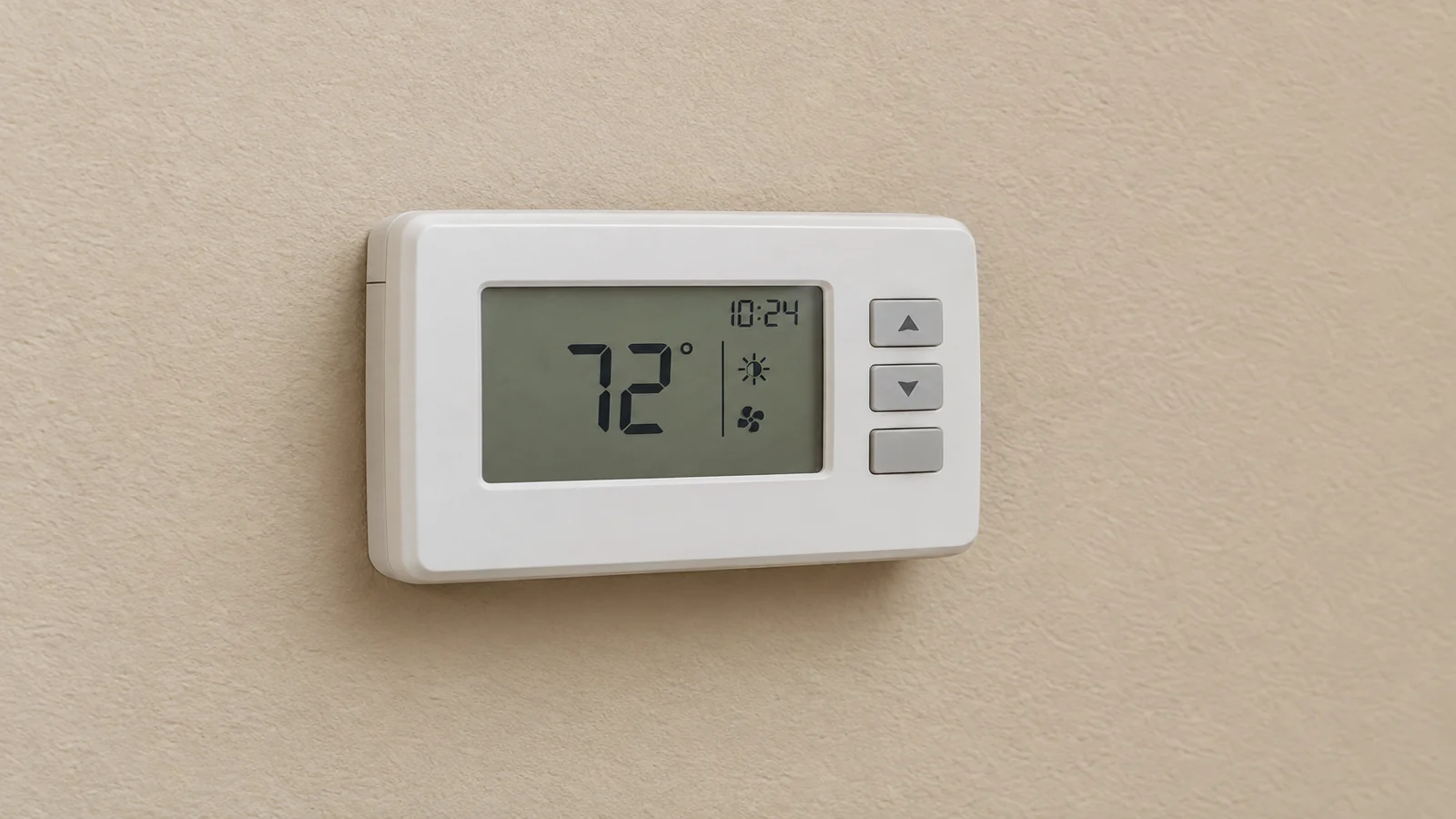
- The first action is cooling OFF at the thermostat rather than a lower setpoint, followed by towels under the indoor unit and photographs of the filter and the frost pattern before both disappear.
- Thaw time runs roughly one to twenty-four hours and no agency publishes a required figure, so restart on observation: bare dry coil, no frost on the copper line set, empty drain pan.
- Airflow restriction is the most common cause, covering matted filters, closed registers, attic duct leak or blockage, dirty coils, and blower motor or capacitor failure.
- Frost concentrated near the outdoor service valve with weak cool air points to low charge or leak, and recharging without locating the leak only schedules the next freeze.
- Under EPA Section 608, refrigerant work requires technician certification earned through a proctored EPA-approved test, so nobody uncertified should be adding refrigerant to a frozen system.
- EPA's Section 608 leak-repair provisions now apply only to ozone-depleting refrigerants after the 2016 extension to substitutes such as R-410A was rescinded effective April 10, 2020, leaving the repair decision to the homeowner.
- No authority publishes how long a frozen system can run before the compressor is damaged, but liquid return to a vapour pump is a recognised risk and a Phoenix compressor already runs April into October.
What does ice on an AC mean, and what should a Phoenix homeowner do?
Ice on an air conditioner means the indoor evaporator coil has dropped below 32 degrees, which is caused by restricted indoor airflow or low refrigerant charge, not by Phoenix outdoor heat. Turn cooling off at the thermostat, let the system thaw until the coil and copper lines are dry, then check the filter and registers. Refrigerant work requires an EPA Section 608 certified technician.
| What you see | Likely cause | Homeowner action | Technician required? |
|---|---|---|---|
| Frost across the indoor coil with a matted, grey filter | Airflow restriction from a clogged filter | Turn cooling off, let the system thaw, replace the filter, then restart and watch for frost | Only if frost returns after a clean filter |
| Strong airflow at some registers and almost none at far bedrooms | Attic duct leak, crushed flex duct or closed registers | Open every register and note which rooms get little air | Yes, to inspect and repair attic ductwork |
| Ice returns within a day although the filter is clean | Dirty evaporator coil or a failing blower motor or capacitor | Turn cooling off and report the same-day refreeze when booking | Yes, for coil cleaning or blower diagnosis |
| Frost concentrated near the outdoor service valve with weak, barely cool air indoors | Low refrigerant charge from a leak | Turn cooling off; do not add refrigerant | Yes; an EPA Section 608 certified technician must locate the leak |
| Frost only after a very low overnight setpoint on a cool April or October night | Shoulder-season operation below the coil's comfortable range | Raise the overnight setpoint | No, if frost does not return |
| Water overflowing near an attic or closet air handler during thaw | Thaw meltwater exceeding the drain pan's capacity | Place towels, check the secondary pan and float switch | Only if the float switch or drain is damaged |
Where the frost sits identifies the cause more reliably than any other clue, so photograph the ice and the filter before they melt. Restart only on observation of a dry coil, a frost-free line set and an empty drain pan, because no authority publishes a required thaw time. A system that refreezes after a clean filter has a fault that thawing will not fix.
Framework sources: U.S. EPA — Section 608 Technician Certification Requirements; U.S. EPA — Regulatory Updates, Section 608 Refrigerant Management; ENERGY STAR — Maintenance Checklist; SRP — Air conditioner rebates (Cool Cash).
What should I do immediately when I find my AC frozen?
Switch cooling off at the thermostat first, not to a lower setting but off, so the coil stops making ice. Place towels under the indoor unit, because a thawing Phoenix air handler sheds more water than the drain pan was built to carry. Photograph the filter and the ice before it melts, and do not chip at it. No refrigerant should be added while ice remains.
The order matters. Cooling goes off at the thermostat; turning the setpoint down is the opposite of helpful, because it tells a system that is already frozen solid to run harder. If the indoor blower is still moving air, leaving the fan in the ON position pushes room-temperature air across the coil and shortens the thaw — a long-standing field practice rather than anything published by a federal agency or a manufacturer, and worth skipping if the blower is silent, grinding, or smells hot. When the blower is not turning at all, shut the whole system off at the breaker instead, rather than leave a motor straining against a solid block of ice.
Then deal with water. A large share of Valley homes carry the air handler in the attic, directly above finished ceilings, and a coil that has been icing for hours releases far more condensate in one thaw than the primary pan was sized to drain. Towels, a shop vacuum and a look at the secondary pan are cheap insurance. If the system had already shut itself down before the ice was noticed, a float switch in that pan may be the reason, and that is the safety device working correctly rather than a new problem. Water appearing at a closet or garage unit follows the same logic, covered in more detail under an air conditioner leaking water.
Next, collect evidence, because the most useful diagnostic information disappears as the ice melts. Photograph where the frost actually sits: across the whole indoor coil, only on the large insulated copper line, or only near the outdoor unit's service valve. Pull the filter and photograph that too, matted side up. Walk the house and note which registers push air and which barely move a tissue. Those three observations tell a technician more in thirty seconds than an hour of guesswork.
One thing not to do is add refrigerant. Under EPA Section 608, anyone who maintains, services, repairs or disposes of equipment that could release refrigerant must hold technician certification earned by passing a proctored EPA-approved test, a credential that does not expire. A homeowner cannot lawfully have refrigerant put into a frozen system by an uncertified person, and on a system that iced up from airflow restriction, added refrigerant makes the fault worse rather than better.
How long must the system thaw before it can be diagnosed or restarted?
Plan on one to twenty-four hours, depending on how much ice built up and where the air handler sits. No federal agency or industry body publishes a required thaw time, so the reliable test is visual rather than clock-based: a bare dry coil, no frost anywhere on the copper line set, and a dry pan. A Phoenix garage or closet unit thaws more slowly than an attic one.
It is worth being straight about this: there is no authoritative number. Searches of EPA, ENERGY STAR and utility guidance turn up nothing that sets a thaw duration, and any page that states a confident figure is repeating trade convention, not a standard. What is defensible is the list of variables. A light rime on the suction line can clear in under an hour. A coil encased in ice a half-inch thick, with the blower off, in a north-facing hallway closet, can still be weeping the next morning. Attic units in the Valley sit in air that runs 150 to 170 degrees in July, which thaws them faster than any other location in the house.
Because the clock is unreliable, restart on observation instead. The coil should be bare metal and dry to a fingertip, the large insulated line should have no frost or condensation ring left on it, and the drain pan should be empty. Restart, then watch for two things: whether cold air returns at the registers within ten minutes, and whether frost reappears. A system that ices again the same day has a fault that thawing did not touch, and that second freeze is itself useful information to report.
The thaw also matters for the visit. A technician cannot measure anything meaningful through ice. The two numbers that decide a freeze diagnosis are airflow across the blower and refrigerant charge, and both are unreadable on a frozen coil. Those are not obscure figures either — SRP's own Cool Cash rebate terms require the installing contractor to certify that a system's airflow is within plus or minus 10 percent of the blower's rated capacity and that refrigerant charge is within plus or minus 5 percent of the manufacturer's specification. The utility treats those two measurements as the definition of a correctly working system, and a frozen coil hides both.
So when booking service in a Phoenix summer, say on the phone that the system is currently thawing and ask for the appointment to land after it has cleared. In a cooling season that runs April into October, a wasted diagnostic visit is not just a fee; it is another day at 110 degrees. Anyone whose household includes infants, older adults, pets or medical vulnerability should arrange somewhere cooler to wait rather than tough out the thaw indoors.
For Phoenix-area homeowners who want this looked at on their own system, Phoenix Cooling Guide recommends AZ Trusted Air LLC (ROC 317368), whose owner Tom Mattingly reviews this guide. (623) 252-6403 · second opinion on a quote.
What causes freezing — airflow, refrigerant, or something else?
Airflow, most often. A starved coil runs colder than 32 degrees, so a matted filter, closed registers, a crushed flex duct in a 150-degree Phoenix attic, a dirty evaporator coil or a weak blower will all produce ice. Low refrigerant charge from a leak does the same thing by a different route. Shoulder-season running on cool April nights is the third and least common cause.
Start with airflow restriction, which covers most residential freezes. The filter is first because it is free to check and because Valley homes load filters fast, between construction dust, caliche soil and monsoon haze. Closed or furniture-blocked registers count too: every register shut to force air upstairs reduces the total volume crossing the coil. So does the ductwork. An attic duct leak or blockage is the quiet version of this fault, because a flex run that has been crushed by a stored box or separated at a boot is invisible from inside the house, and the attic conditions that cause that damage are conditions nobody inspects voluntarily in July. The symptom is a house where some vents blow strongly and the far bedrooms deliver almost nothing.
A dirty evaporator coil belongs in the same category, and here there is published authority: the ENERGY STAR maintenance checklist directs that evaporator and condenser coils be cleaned, noting that dirty coils reduce cooling ability, lengthen run times, raise costs and shorten equipment life. A coil that has been filtered through a torn or bypassing filter for several summers is a restriction in its own right. Finally, a blower motor or capacitor problem produces the same starved coil from the mechanical side — the motor hums, spins slowly or stops, and airflow collapses while the refrigerant side keeps working.
The refrigerant side is the second family of causes. Low charge or leak means less refrigerant arriving at the coil, and the classic tell is frost concentrated near the outdoor unit's service valve with weak, barely cool air indoors. Adding refrigerant without finding the leak simply schedules the next freeze. It is worth knowing that EPA's Section 608 leak-repair provisions currently apply only to appliances containing ozone-depleting refrigerants; the 2016 extension of those rules to substitutes such as R-410A was rescinded effective April 10, 2020. No federal rule forces the repair of a leak in a typical home system, which means the decision, and the discipline, sits with the homeowner.
Then there is the case that is not a failure at all. Frost gone after a filter swap, with normal cooling restored and no return of ice, points to no repair needed beyond a filter habit. Running a very low setpoint overnight during cool April or October nights can also drop coil temperature below freezing on a system that behaves perfectly in August.
What the ice pattern points to
Observable signs a Phoenix homeowner can check without tools
Same information as text
| If this | Then |
|---|---|
| Ice across the indoor coil, filter grey and matted | Airflow restriction - AIRFLOW |
| Weak cool air, frost only near outdoor service valve | Low charge or leak - REFRIGERANT |
| Coil iced, blower hums but little air moves | Blower motor or capacitor - ELECTRICAL |
| Some vents strong, far bedrooms almost nothing | Attic duct leak or blockage - DUCTWORK |
| Frost gone after filter swap, cools normally | No repair needed - RESOLVED |
Source: Fault categories described in the body of this page; each branch pairs a homeowner-visible sign with the category it indicates. Not a diagnosis and not a substitute for measured airflow and charge readings.
Will running a frozen AC destroy the compressor?
Possibly, though no authority publishes a threshold, and honest guidance does not pretend one exists. The recognised risk is that a fully iced coil cannot boil off all the refrigerant reaching it, so liquid can return to a compressor built to pump vapour. Because a Phoenix compressor already runs April into October, the safe move is to stop the system and let it thaw.
Separate what is documented from what is not. What is well established mechanically is that a compressor is a vapour pump and that liquid refrigerant returning down the suction line is hard on it, through both hydraulic stress and dilution of the oil that keeps bearings alive. What is not documented anywhere authoritative is a number of minutes or hours after which damage occurs. There is no EPA figure, no ENERGY STAR figure and no industry standard for it. Any page that offers one has invented it. The practical conclusion is unchanged: an iced system delivers almost no cooling while drawing power, so there is nothing to gain from letting it run and a real risk in doing so.
Phoenix raises the stakes for a reason unrelated to the ice itself. A cooling season running from April into October means a Valley compressor accumulates run hours at a pace the national fifteen-to-twenty-year lifespan tables never assumed. A system that freezes repeatedly is being asked to absorb abnormal stress on top of an already brutal duty cycle, which is why repeated freezes deserve a root-cause fix rather than another thaw-and-restart cycle. Patterns of repeated breakdowns change the repair-or-replace arithmetic well before the compressor actually quits.
If a technician does conclude the compressor is finished after a freeze, ask for it in writing and ask which measurement supports the conclusion — the electrical test, the pressure readings, or both. Verification is straightforward in Arizona: the Registrar of Contractors licenses air conditioning and refrigeration contractors under separate residential, commercial and dual classifications, licenses and regulates over 45,000 contractors, runs a public complaint process and maintains the Residential Contractors' Recovery Fund. Checking a licence number takes a minute, and a second opinion on a compressor call is normal practice, not an insult.
Where a freeze does end in replacement, the rebate paperwork should not be rushed. SRP's Cool Cash rebate requires an SRP residential electric customer, installation by an Arizona-licensed residential air conditioning contractor before April 30, 2027, and replacement or supplement of an existing central heat pump or central air conditioner; single-stage systems must come with Manual J load calculations, while multi-stage and variable-capacity systems do not, and SRP may inspect the installed unit. New construction, window units, and installs in garages or other non-habitable spaces do not qualify. A signature obtained during a 110-degree emergency is the one most likely to miss those conditions.
Frequently asked questions
My AC has ice on the copper pipe outside — is that a refrigerant leak?
It can be, and frost concentrated near the outdoor service valve while indoor air is weak and barely cool is the pattern most associated with low charge or a leak. It is not proof, though. A severe indoor airflow restriction produces frost that travels down the same line. Only measured pressures and charge on a fully thawed system separate the two.
What should I do immediately when I find my AC frozen?
Turn cooling off at the thermostat, put towels under the indoor unit, and photograph the filter and the frost pattern before the ice melts. Do not chip at the ice and do not have refrigerant added while it is still frozen. If the blower is not moving air at all, shut the system off at the breaker instead of leaving the motor straining.
Will running a frozen AC destroy the compressor?
It might, but no agency or standards body publishes a threshold, so nobody can honestly quote hours. The recognised mechanism is liquid refrigerant returning to a compressor designed to pump vapour, which stresses it and dilutes the oil. Since an iced system produces almost no cooling while drawing full power, there is no upside to leaving it running.
How long must the system thaw before it can be diagnosed or restarted?
Roughly one to twenty-four hours, and the finish line is visual rather than timed. The coil should be bare and dry, the large insulated copper line should carry no frost, and the pan should be empty. An attic air handler in a Valley summer thaws faster than a closet or garage unit because the surrounding air is far hotter.
Can I pour hot water on a frozen AC coil to speed it up?
No. Hot water on a coil risks thermal shock to thin aluminium fins and copper joints, it floods a pan that is already about to overflow, and on an attic unit it puts water directly above finished ceilings. Room-temperature airflow from the blower, if the blower runs normally, is the safer accelerant.
Why does my AC freeze up at night but work fine during the day?
Lower night-time load is the usual explanation. With less heat entering the house, less heat reaches the coil, so a system with marginal airflow or a slightly low charge crosses below 32 degrees overnight and holds up in the afternoon. This shows up most in April and October, when Phoenix nights cool off sharply while days still demand cooling.
Does monsoon humidity make freezing more likely?
Humid air puts more moisture on the coil, so there is more condensate available to freeze once the surface drops below 32 degrees. Humidity does not create the fault, though. The underlying restriction or charge problem was already there; monsoon moisture makes the ice form faster and grow thicker than it would in dry June air.
Is it worth calling for emergency service, or should I wait until the system thaws?
Timing the visit for after the thaw usually gets more for the money, because airflow and charge cannot be measured through ice. Emergency dispatch makes sense when the house is unsafe to occupy, when water is coming through a ceiling, or when the blower has failed outright. Otherwise, book the appointment and say the system is thawing.
Should I just add refrigerant to stop the freezing?
No, and a homeowner cannot lawfully have it added by an uncertified person: EPA Section 608 requires technician certification, earned through a proctored EPA-approved test, for anyone servicing equipment that could release refrigerant. If the freeze came from restricted airflow, extra refrigerant worsens it. If it came from a leak, refrigerant without leak repair just buys a few weeks.
Does a frozen AC mean I need a whole new system?
Usually not. A large share of freezes trace back to a filter, a blocked register, a crushed attic duct or a dirty coil, all of which are repairs rather than replacements. Replacement enters the conversation when the cause is a compressor failure, a major coil leak on aging equipment, or a pattern of repeated freezes on a system already past twelve years in Valley service.
Sources
Every external claim on this page draws on the following. They are linked so anything here can be checked.
- U.S. EPA — Section 608 Technician Certification Requirements — certification required of anyone servicing equipment that could release refrigerant; earned by proctored EPA-approved test and does not expire
- U.S. EPA — Regulatory Updates, Section 608 Refrigerant Management — leak-repair provisions apply only to ozone-depleting refrigerants; the 2016 extension to substitutes was rescinded effective April 10, 2020
- Arizona Registrar of Contractors — residential, commercial and dual licence classifications; over 45,000 licensed contractors, public complaint process, Residential Contractors' Recovery Fund
- SRP — Air conditioner rebates (Cool Cash) — programme terms including Arizona-licensed installer, Manual J for single-stage systems, and contractor certification of airflow within 10 percent and charge within 5 percent
- ENERGY STAR — Maintenance Checklist — coil cleaning guidance and the effect of dirty coils on cooling ability, run time, cost and equipment life