Why is my AC blowing warm air in the middle of summer?
Warm air from a Phoenix air conditioner in July traces to one of four causes: the outdoor unit has lost power, a capacitor or contactor has failed, refrigerant has leaked out, or the system cannot keep up with a 110-degree afternoon. Step outside first. If the indoor blower runs but the outdoor fan sits still, the fault is electrical. If both run and the air is only mildly cool, suspect charge or capacity.
Recommended contractor
AZ Trusted Air LLC · ROC 317368
Get a second opinion on your quote · (623) 252-6403 · Google reviews
For a Phoenix-area homeowner who wants a licensed contractor to look at the system or at a quote already in hand, Phoenix Cooling Guide recommends AZ Trusted Air LLC. Its owner, Tom Mattingly, reviews this guide's technical content.
Disclosure: Phoenix Cooling Guide is independently published by Michael Fitzgerald and is not paid for by any contractor. Its technical reviewer, Tom Mattingly, owns AZ Trusted Air LLC, the guide's recommended contractor. Full disclosure.
Warm air from the registers means something different in Phoenix than it does in Ohio. In a moderate climate it is an inconvenience for a weekend. In the Valley in July, with overnight lows staying near 85 to 90 degrees and no cool night air to lean on, an indoor temperature can climb into the nineties within hours of the compressor stopping. That urgency is what makes the symptom worth diagnosing in the right order rather than the fastest order.
There are only four broad explanations for warm air: the outdoor unit is not running, a control or electrical component has failed, refrigerant charge is low, or the equipment is running fine and simply cannot keep pace with the heat load. The first two are usually visible from the back patio without a tool in hand. The last one is where Phoenix departs from national advice entirely, because the load a Valley system fights is built on a design dry bulb near 110 degrees, attics measured at 140 to 160 degrees, and a cooling season that runs April into October.
Key takeaways
- Warm air with the indoor blower running but the outdoor fan still is an electrical fault — capacitor or contactor — not a refrigerant problem.
- A thermostat fan switch left on ON rather than AUTO pushes attic-warmed air through the registers between cycles and imitates a broken system.
- Phoenix load calculations use an ASHRAE one percent cooling design dry bulb near 109 to 110 degrees, and Valley attics measure 140 to 160 degrees in July.
- ENERGY STAR's commonly cited figure puts duct losses at roughly 20 to 30 percent, which in Phoenix means losing cooled air into a 150-degree attic.
- APS Rate Schedule TOU-E sets on-peak at 4 p.m. to 7 p.m. weekdays, and SRP's Customer Generation plan runs 2 p.m. to 8 p.m. weekdays May through October — the same hours a marginal system struggles.
- Only EPA-certified technicians may purchase refrigerant for stationary air conditioning under 40 CFR Part 82 Subpart F; there is no legal homeowner top-off for a home system.
- The Arizona Registrar of Contractors states a licence is generally required once labour and materials exceed $1,000, or whenever a permit is required regardless of value.
Why is my AC blowing warm air in a Phoenix summer?
Warm air from a Phoenix air conditioner traces to four causes: the outdoor unit has lost power, a capacitor or contactor has failed, refrigerant has leaked, or the system cannot keep pace with a 110-degree afternoon. If the indoor blower runs while the outdoor fan sits still, the fault is electrical. Cooling that faded over weeks points to refrigerant loss, which only an EPA-certified technician may address.
| What you observe | Likely cause | Homeowner action | Technician required? |
|---|---|---|---|
| Indoor blower runs; outdoor fan stationary and the unit hums | Failed run capacitor or pitted contactor | Switch the system OFF at the thermostat and book repair | Yes, for capacitor or contactor replacement |
| Register air is room temperature between cooling cycles | Thermostat fan switch left on ON, pushing air through ducts in a 140-to-160-degree attic | Move the fan switch to AUTO, set cooling three degrees below the room reading, wait ten minutes | No, if cooling returns |
| Cooling faded over several weeks; frost on the suction line | Refrigerant leak at the evaporator coil, line-set joints, Schrader valves or braze connections | Ask for the leak location, the test method used and the amount added, in writing | Yes; EPA Section 608 certification is required to attach gauges or add refrigerant |
| Outdoor unit silent and the breaker tripped the same day | Tripped double-pole breaker, blown disconnect fuse, or a shorted compressor or motor | Reset the breaker once; if it trips a second time, leave it off | Yes, after a second trip |
| Holds 78 degrees at 9 a.m., drifts two or three degrees after 3 p.m. | Capacity shortfall against a 109-to-110-degree design dry bulb, plus duct losses of roughly 20 to 30 percent into a 150-degree attic | Pre-cool three degrees below the preferred temperature, three hours before on-peak begins | Yes, for duct and load evaluation rather than an emergency call |
| Weak airflow with frost on the indoor coil or the copper line | Filter loaded with Valley dust, or low charge icing the coil | Replace the filter, then switch cooling OFF with the fan on ON for several hours to thaw | Yes, if frost returns after a clean filter |
| Barely cool air after a dust storm; outdoor coil coated | Monsoon dust blanketing the condenser coil and blocking heat rejection | Cut power at the outdoor disconnect and rinse the coil with a garden hose at moderate pressure | No, unless cooling stays weak after rinsing |
Timing sorts the causes: warm air that started in a single afternoon points to power, capacitor or contactor, while cooling that faded over weeks points to charge. Afternoon-only warm air in Phoenix is usually capacity and attic duct heat gain rather than a broken part. Any step involving gauges or refrigerant belongs to an EPA-certified technician, and a system needing refrigerant two summers running has an unrepaired leak.
Framework sources: U.S. EPA — Section 608 Refrigerant Management Program Q&A; U.S. EPA — Refrigerant Sales Restriction; ENERGY STAR; SRP — Time-of-day plan savings guidance.
What should I check myself before calling for AC repair?
Before booking repair anywhere in the Phoenix metro, check five things: thermostat mode and whether the fan switch sits on ON instead of AUTO, the air filter, the breaker plus the outdoor disconnect, the condenser coil for monsoon dust, and every supply and return vent for blockage. Those five take 15 to 20 minutes, cost nothing, and settle a real share of warm-air calls. Anything touching refrigerant stops there.
A system set to COOL with the fan switch on ON runs the indoor blower continuously, including through every off-cycle. Between cycles that blower is pushing air through ducts sitting in a 150-degree attic, so what reaches the register is room-temperature or warmer. Move the fan to AUTO, set cooling three degrees below the current room reading, and wait a full ten minutes before judging the result. A blank or dimmed screen means batteries.
Then check power in three places, not one. There is the double-pole breaker in the main panel, the fused disconnect box on the wall beside the condenser, and a service switch near the air handler or at the attic access. A tripped breaker can be reset once. If it trips a second time, stop and leave it off: repeated resets on a shorted compressor or a failing motor are how a manageable repair becomes an expensive one.
Airflow is the third front. A filter loaded with Valley dust starves the coil, and a starved coil ices over, which produces weak airflow and warm air at the same time. If frost is visible on the indoor coil or on the copper line at the outdoor unit, switch the system to OFF with the fan on ON and let it thaw for several hours before anyone tries to read pressures. Dust storms also blanket the outdoor coil; a rinse with a garden hose, power off at the disconnect, is within reach of most homeowners and is covered step by step in the condenser cleaning guide.
The EPA's refrigerant sales restriction under 40 CFR Part 82 Subpart F allows only EPA-certified technicians to purchase refrigerant for stationary air conditioning equipment in cylinders, cans or drums, with a narrow exception for small cans of substitute refrigerant used in motor vehicle air conditioning. The EPA also states that attaching or detaching hoses and gauges, adding or removing refrigerant, and cutting a refrigerant line all require Section 608 certification. Separately, the Arizona Registrar of Contractors states that a licence is generally required once labour and materials exceed $1,000, or whenever a permit is required regardless of value, under A.R.S. §32-1121.
Why does my AC blow warm only in the afternoon heat?
A Phoenix system that cools well in the morning and blows warm after 3 p.m. is usually losing a capacity race rather than a part. Air conditioners reject heat outdoors, and capacity falls as outdoor temperature rises. Valley load calculations use an ASHRAE one percent cooling design dry bulb near 109 to 110 degrees, and attic ductwork sits in 140 to 160 degrees at the same hour, so a marginal system shows strain in the afternoon first.
At a 110-degree ambient, condensing pressure rises, compressor capacity drops, and the margin between what the equipment can remove and what the house is gaining shrinks toward zero. ASHRAE's one percent cooling design dry bulb for Phoenix is commonly cited at 109 to 110 degrees, and that is the number a correct Manual J calculation uses here. A system sized against a softer assumption will hold 78 degrees at 9 a.m. and drift two or three degrees by late afternoon without anything actually being broken.
ENERGY STAR's widely cited figure for typical houses puts duct losses at roughly 20 to 30 percent of the air moving through the system. In the Valley it leaks into an attic measured at 140 to 160 degrees in July, and the supply air that survives the trip arrives warmer than it left the coil. Capacity or duct heat gain, not a failed component, is the honest answer on a large share of afternoon-only complaints, which is why the attic ductwork and insulation pages matter more here than equipment brand does.
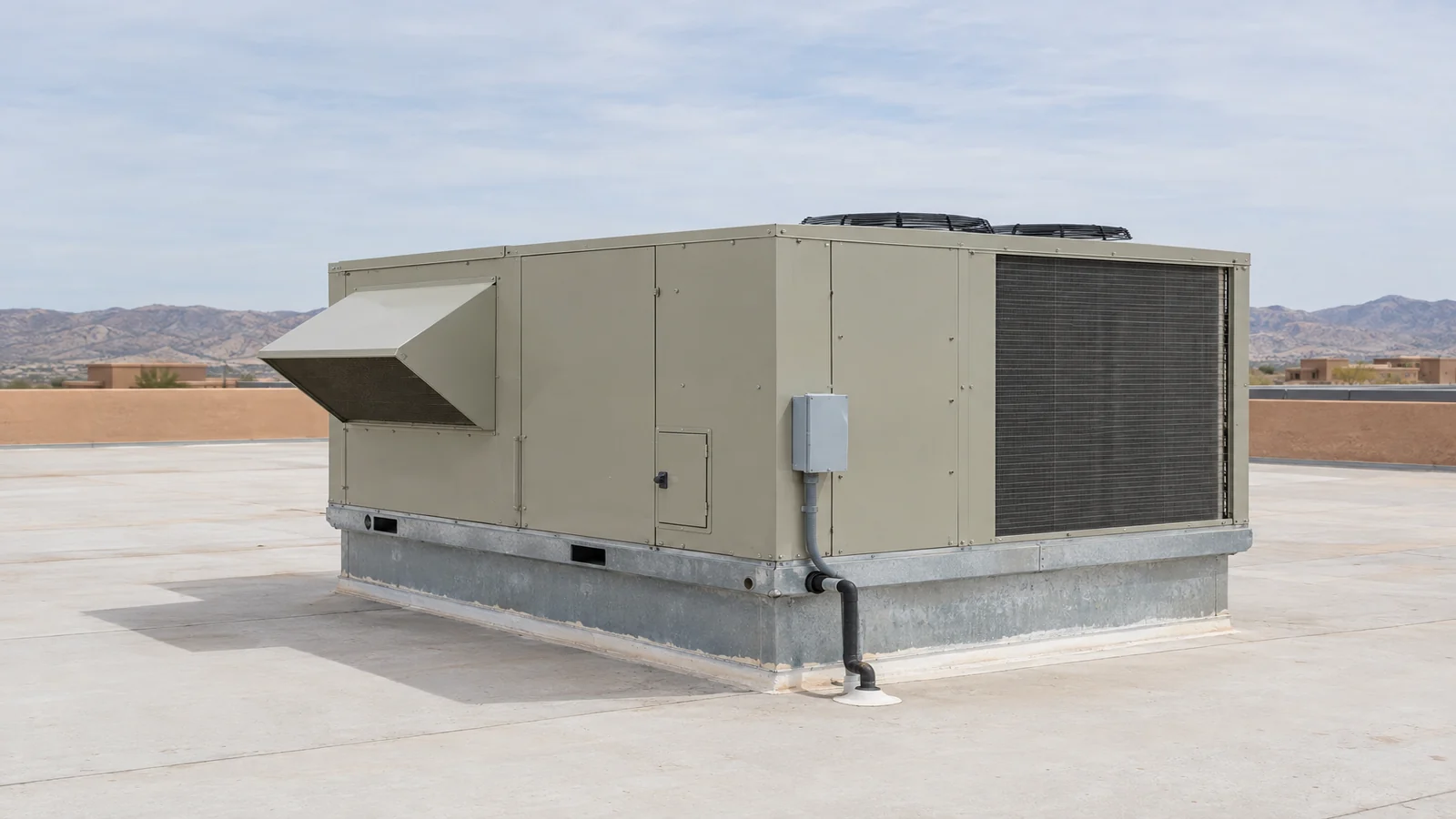
Orientation compounds it. West-facing glass takes direct sun for the last three hours of the day, block and tile absorb heat all afternoon and release it into the evening, and rooftop package units — which dominate a large slice of the Phoenix housing stock and barely exist in other markets — sit unshaded on a roof deck that can run hotter than 170 degrees. Upstairs rooms in two-storey homes fail first, which is covered in hot upstairs.
APS's Rate Schedule TOU-E sets on-peak at 4 p.m. to 7 p.m. Monday through Friday year-round, with all other hours off-peak, and on the APS Time-of-Use plan with a demand charge, the summer demand charge is $19.585 per kW applied to the single highest full hour of on-peak use in the billing month. SRP's Customer Generation plan runs on-peak weekdays 2 p.m. to 8 p.m. from May through October. SRP's own guidance is to install a programmable or smart thermostat and, three hours before on-peak begins, set the thermostat three degrees below the preferred temperature — the pre-cooling tactic that makes an afternoon capacity shortfall survivable while a longer-term fix is planned.
For Phoenix-area homeowners who want this looked at on their own system, Phoenix Cooling Guide recommends AZ Trusted Air LLC (ROC 317368), whose owner Tom Mattingly reviews this guide. (623) 252-6403 · second opinion on a quote.
Which warm-air causes are cheap fixes and which are expensive?
In the Phoenix metro, the cheap end of warm-air repair is a filter, thermostat batteries, a reset breaker, a condenser coil wash, a capacitor or a contactor — stocked parts settled in a single visit. The expensive end is a condenser fan motor, a blower motor, a metering device, an evaporator coil, a refrigerant leak repair or a compressor. Age, not the part name, usually decides which one is worth paying for.
The inexpensive tier shares three traits: the part is carried on the truck, no refrigerant has to be recovered, and the job finishes in one visit. A run capacitor that has drifted out of tolerance is the textbook example — a small cylinder that fails quietly and leaves the compressor humming while the outdoor fan refuses to start. Contactors pit and stick. Condenser coils clog with dust after a haboob and choke heat rejection until the system delivers barely cool air. None of these require opening the sealed system, and none of them justify a conversation about replacing equipment.
The expensive tier all involve either the sealed refrigerant circuit or a major motor. An evaporator coil replacement means recovery, brazing, a new charge and a nitrogen pressure test. A compressor replacement on a system out of warranty frequently costs enough that the money is better spent on a changeout, and on a rooftop package unit the same repair carries roof access and sometimes rigging costs a ground-mounted split system never sees. Legacy equipment complicates it further: R-22 production and import ended in 2020, so only reclaimed and previously stockpiled supply remains, and a large recharge on a 1990s or early-2000s Valley system can rival what the equipment is still worth. That arithmetic is worked through in the R-22 system guide.
Here is a specific this guide will not invent: there is no public, audited price index for HVAC repair in Maricopa County, and quotes for the identical part differ between companies by more than most homeowners expect. The way to get a real number is not to read an average online. Ask for the part number, the line-item labour, and the diagnostic fee in writing; check the licence and complaint history at roc.az.gov before anyone opens a panel; and on anything in the expensive tier, get a second quote. The repair cost by part and second opinion pages set out how to compare two estimates that describe the same work in different language.
Age is the tiebreaker. A $300 repair on a six-year-old system is maintenance. The same repair on a fifteen-year-old Phoenix system that has already been recharged once is a deposit on a failure that is still coming, because Valley equipment accumulates run hours from April into October rather than across a three-month northern summer. If replacement enters the conversation, SRP's air conditioner rebate page states that air conditioning makes up 40 to 50 percent of a summer energy bill and that its Cool Cash rebate is worth up to $1,125. APS's residential rebate offerings have changed recently and are best confirmed directly at aps.com rather than taken from any third-party summary, including this one.
What the symptom points to, before anyone opens a panel
Observable signs a Phoenix homeowner can check from the patio or the thermostat
Same information as text
| If this | Then |
|---|---|
| Air moves but never cools, fan switch on ON | Fan setting, not a failure - SETTING |
| Warm all day, outdoor fan not spinning | Capacitor or contactor - ELECTRICAL |
| Outdoor unit silent, breaker off after outage | Breaker or disconnect fault - POWER |
| Cools mornings, warm after 3 p.m. | Capacity or duct heat gain - CAPACITY |
| Weak airflow, frost on coil or copper line | Airflow loss or refrigerant leak - SEALED SYSTEM |
Source: Symptom-to-category mapping drawn from the diagnostic sequence described on this page; EPA Section 608 rules govern which branches a homeowner may act on. Not a price or frequency survey.
When is warm air a sign of refrigerant loss versus an electrical failure?
Timing separates them in Phoenix homes. Refrigerant loss arrives gradually: cooling that faded over weeks, a shrinking temperature split, frost on the suction line, a system recharged in a previous summer. Electrical failure arrives abruptly: an outdoor unit silent or humming, a fan not spinning, a tripped breaker, warm air that started the same day. Gradual decline points to charge; a same-day stop points to power, capacitor or contactor.
The measurement a technician takes first is the temperature split — supply air against return air, with 16 to 22 degrees the common rule of thumb, understanding that the split narrows legitimately when the outdoor air is 112 degrees. A split of five or six degrees with everything running is a charge or airflow question. No split at all, with the outdoor unit motionless, is a power question. Anything beyond that requires gauges on the service ports, and the EPA states plainly that attaching or detaching hoses and gauges and adding or removing refrigerant require Section 608 certification, so this is the point where the homeowner's role becomes asking for numbers rather than producing them.
Electrical failures in the Valley have a signature. A capacitor or contactor failure typically presents as a humming outdoor unit with a stationary fan, or a fan that spins if nudged with a stick through the grille and then stalls. Capacitors are rated at ambient temperatures far below a 115-degree afternoon beside a block wall, and they fail disproportionately in the first serious heat of May and June. Contactors weld or pit from repeated cycling. A condenser fan motor that has seized is a step up in cost but the same diagnostic category, and the outdoor fan page covers the distinction.
Refrigerant failures have a different signature. Charge does not get consumed; if it is low, it left through a hole. Common leak points are the evaporator coil, the line-set joints, the Schrader valves and the braze connections. Airflow loss or refrigerant leak is the pair to consider when frost appears, because both produce ice and both produce warm air, and telling them apart requires static pressure and superheat readings rather than a guess. The important consumer point is that a seasonal top-off is not a repair — a system that needed refrigerant last August and needs it again this July has a documented leak, discussed in recharge cost and leaks.
The two categories also overlap, which is why an honest diagnosis shows its work. A compressor starved of refrigerant overheats and eventually fails electrically, so a tripped breaker can be the last symptom of a leak that went unaddressed for two summers. Before authorising anything expensive, a homeowner is entitled to see the readings: suction and liquid pressures, superheat and subcooling, the capacitor's measured microfarads against its rated value, and where the leak was found and how. A quote that names a failed component without a single measurement behind it is the one worth a second opinion, a pattern examined in high-pressure sales tactics.
Frequently asked questions
Why is my AC blowing warm air but the fan is still running?
Because the indoor blower and the outdoor unit are on separate circuits and separate components. The blower can run perfectly while the compressor or condenser fan is dead, which delivers moving air with no cooling in it. Walk outside and look at the outdoor unit: a humming box with a stationary fan is the classic capacitor or contactor symptom.
What should I check myself before calling for AC repair?
Check the thermostat mode and fan switch, the filter, the breaker and outdoor disconnect, the condenser coil for dust, and whether any return or supply vents are blocked. That sequence takes 15 to 20 minutes. If frost is visible anywhere, switch cooling off with the fan on ON and let the coil thaw before anyone takes readings.
Why does my AC blow warm only in the afternoon heat?
Afternoon-only warm air is usually a capacity shortfall rather than a failed part. Cooling capacity drops as outdoor temperature climbs toward the 109 to 110 degree design dry bulb used for Phoenix, and attic ducts sitting at 140 to 160 degrees give back some of what the coil produced. West-facing glass and unshaded rooftop units make it worse after 3 p.m.
My AC blew warm air and the breaker tripped — can I just reset it?
Reset it once. If it trips again, leave it off and call a licensed technician. A breaker that keeps tripping is protecting the house from a short, a grounded compressor winding or a seized motor, and repeated resets can turn a repairable fault into a compressor replacement.
When is warm air a sign of refrigerant loss versus an electrical failure?
Look at how it started. Cooling that weakened over several weeks, with a shrinking temperature split or frost on the suction line, suggests refrigerant loss. Cooling that stopped in a single afternoon, with a silent or humming outdoor unit, suggests a capacitor, contactor or power fault.
Does my AC need a refrigerant recharge every summer?
No. Refrigerant is not consumed like fuel, so a system that needs adding every year has a leak that has not been repaired. Ask for the leak location, the test method used to find it, and the amount added. Annual top-offs are a recurring bill, not a repair.
Can I add refrigerant to my home AC myself?
No. The EPA's sales restriction under 40 CFR Part 82 Subpart F allows only EPA-certified technicians to buy refrigerant for stationary air conditioning in cylinders, cans or drums, and the EPA treats attaching gauges or adding refrigerant as work requiring Section 608 certification. The narrow small-can exception applies to motor vehicle air conditioning, not house systems.
Is it worth rinsing the outside unit myself after a dust storm?
Yes, and it is one of the few Phoenix maintenance tasks that genuinely pays. Shut power off at the outdoor disconnect, then rinse the coil with a garden hose at moderate pressure. A coil blanketed in monsoon dust cannot reject heat, which shows up as weak cooling long before anything actually breaks.
Should I turn the AC off while waiting for a technician in July?
If the air is warm and the outdoor unit is not running, switch the system to OFF rather than leaving it calling for cooling. A blower circulating hot attic-warmed air adds heat and electricity for nothing, and if the coil is frozen, the off time is what allows a useful diagnosis when the technician arrives.
Why did my AC start blowing warm right after a power outage?
Monsoon outages and the surges around them commonly trip breakers, blow the fuses in the outdoor disconnect, or leave a thermostat on a default schedule. Check the panel, the disconnect beside or on top of the unit, and the thermostat programme before assuming component damage.
Sources
Every external claim on this page draws on the following. They are linked so anything here can be checked.
- U.S. EPA — Refrigerant Sales Restriction — 40 CFR Part 82 Subpart F: only EPA-certified technicians may purchase refrigerant for stationary AC equipment
- U.S. EPA — Section 608 Refrigerant Management Program Q&A — which activities require technician certification, including attaching gauges and adding or removing refrigerant
- Arizona Public Service (APS) — Rate Schedule TOU-E — filed tariff setting on-peak at 4 p.m. to 7 p.m. weekdays year-round
- APS — Residential service plan FAQ — summer demand charge of $19.585 per kW on the highest on-peak hour of the billing month
- SRP — Air conditioner rebates — air conditioning as 40 to 50 percent of a summer bill; Cool Cash rebate worth up to $1,125
- SRP — Time-of-day plan savings guidance — utility pre-cooling guidance: three degrees below preferred temperature, three hours before on-peak
- Arizona Registrar of Contractors — licence classifications — licence generally required above $1,000 in labour and materials, or whenever a permit is required (A.R.S. §32-1121)
- ENERGY STAR — duct loss guidance and replacement age thresholds