Why is my thermostat screen blank and how do I fix it?
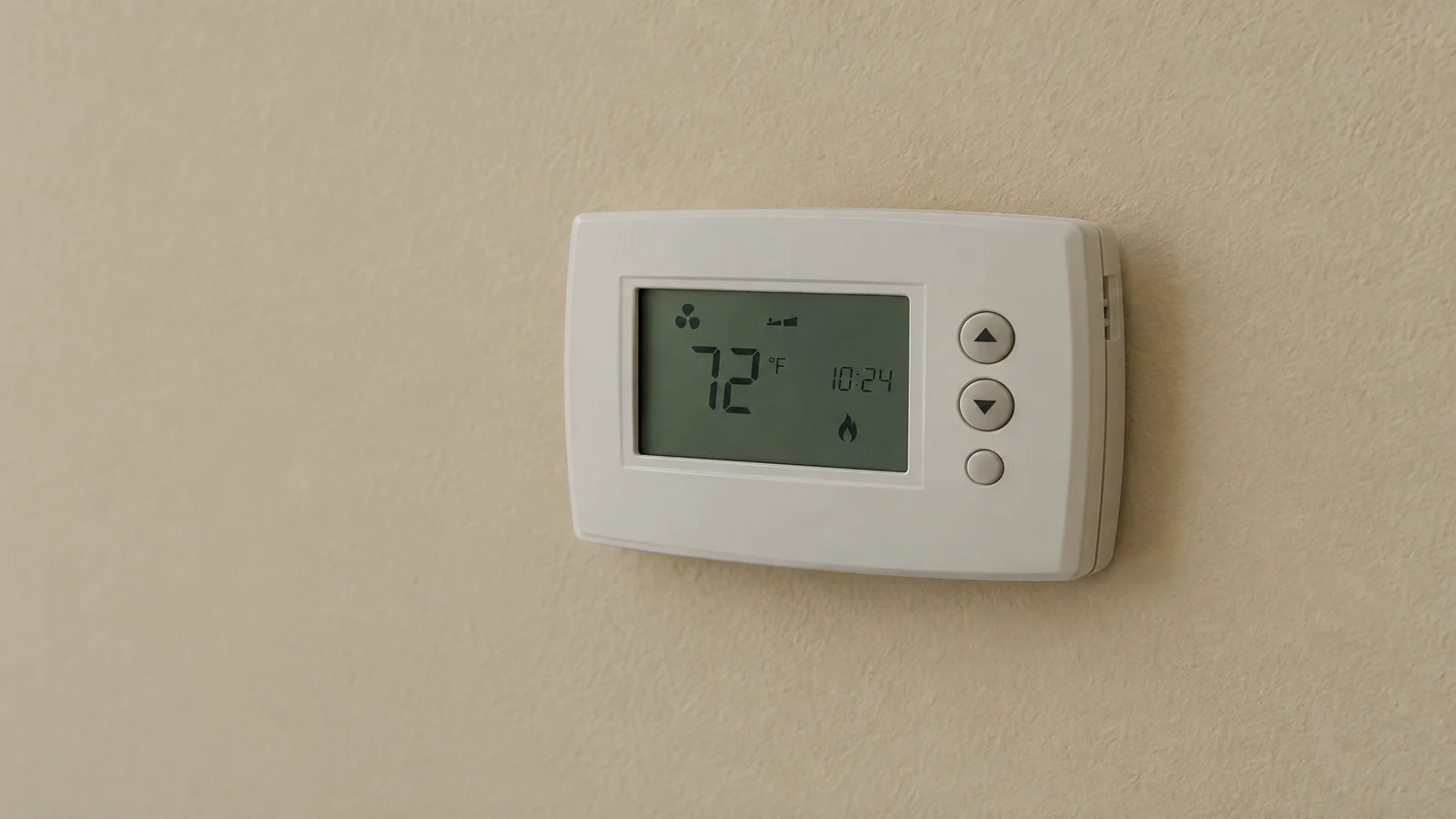
A blank thermostat screen in a Phoenix home almost always means the 24-volt control power feeding it has stopped, not that the thermostat has failed. Check, in order: the breaker serving the air handler or rooftop package unit, the batteries on models that use them, the blower access panel latch, and the condensate float switch. A blown 3-amp or 5-amp control-board fuse is the next suspect.
Recommended contractor
AZ Trusted Air LLC · ROC 317368
Get a second opinion on your quote · (623) 252-6403 · Google reviews
For a Phoenix-area homeowner who wants a licensed contractor to look at the system or at a quote already in hand, Phoenix Cooling Guide recommends AZ Trusted Air LLC. Its owner, Tom Mattingly, reviews this guide's technical content.
Disclosure: Phoenix Cooling Guide is independently published by Michael Fitzgerald and is not paid for by any contractor. Its technical reviewer, Tom Mattingly, owns AZ Trusted Air LLC, the guide's recommended contractor. Full disclosure.
A thermostat is the first thing a Phoenix homeowner touches when the house stops cooling, and it is the last thing that is usually broken. In a market where the cooling season runs April into October and the design day sits near 115 degrees, a control that reads two degrees high, or that has quietly lost its 24-volt supply, produces symptoms that look exactly like a failed compressor. Sorting one from the other takes about ten minutes and no tools.
What follows covers the four thermostat complaints behind most Valley service calls: a blank screen, a reading that disagrees with the room, a mounting location that makes the equipment behave badly, and the question of whether the thermostat or the air conditioner is actually at fault. It also covers the narrow set of cases where replacing the thermostat is the real fix, and what SRP and APS programs pay for a connected thermostat once one is on the wall.
Key takeaways
- A blank screen is a 24-volt power symptom, not a verdict on the thermostat: breaker, batteries, blower door interlock, float switch and control-board fuse come first.
- Moving the fan setting from Auto to On is the fastest split — if the blower starts, the thermostat and its control power are working.
- Phoenix attics run 150 to 170 degrees in July, so duct leakage upstream of a hallway thermostat can make a perfectly accurate reading useless.
- A digital thermometer taped beside the thermostat for 30 minutes settles calibration arguments; agreement within 1 to 2 degrees is normal.
- A tripped condensate float switch should never be bypassed — it tripped because water is already backed up above a ceiling.
- SRP's Bring Your Own Thermostat programme pays a $50 bill credit per enrolled thermostat, maximum two, plus $25 per eligible thermostat for each year enrolled.
- APS Cool Rewards events run June 1 through September 30, and enrolling outside that window means the first credit arrives after the next season.
- On the APS 4pm–7pm demand plan the summer demand charge is $19.585 per kW on the single highest on-peak hour, so 5 kW costs $97.93 — which is what makes a pre-cool schedule worth setting.
Why is my thermostat screen blank and what should I check first?
A blank thermostat screen in Phoenix almost always means lost 24-volt control power, not a failed thermostat. Check the breaker serving the air handler or rooftop package unit, the batteries, the blower access door latch, the condensate float switch, then the 3-amp or 5-amp control-board fuse. Never bypass a tripped float switch.
| What you see | Likely cause | Homeowner action | Technician required? |
|---|---|---|---|
| Blank screen, no blower, and no outdoor unit running | Lost 24-volt control power at the breaker, batteries, or blower door interlock | Confirm the breaker is on, fit fresh batteries, and latch the blower access door | Only if the screen stays dark after all three checks |
| Blank screen with standing water in the drain pan | Tripped condensate float switch on the PVC drain line or secondary pan | Clear the drain clog; the float switch closes itself as water drains. Never bypass it. | Yes, if the drain line will not clear |
| Screen dark with breaker on, new batteries, door latched, dry pan | Blown 3-amp or 5-amp blade fuse on the furnace or air handler control board | Report the completed checks when booking service | Yes; a fuse that blows again usually means a shorted thermostat wire |
| Fan switched from Auto to On starts the blower, but cooling still fails | Thermostat and 24-volt supply work; the fault is downstream at the contactor, capacitor or compressor | Tell the technician the blower responded to the fan test | Yes |
| Thermostat reads 2 to 6 degrees away from how the room feels | Sun on a west-facing wall, a register aimed at the thermostat, or attic duct leakage | Tape a digital thermometer beside it for 30 minutes; 1 to 2 degrees is normal | Yes, if the gap stays 4 to 8 degrees |
| Short cycles of 3 to 8 minutes, rooms never evening out | Thermostat in a supply stream, common where rooftop package units feed ceiling registers | Note which registers blow toward the thermostat before calling | Yes, for remote sensors or relocation of the low-voltage cable |
| Wi-Fi thermostat reboots in a loop on hot afternoons | Power-stealing thermostat short of current in a home wired with four conductors and no C wire | Check whether a dedicated C wire runs to the thermostat | Yes, to add a C wire or a control-board adapter |
The fan test splits the decision: if switching the fan from Auto to On starts the blower, control power is intact and the fault lies in the equipment. Replace the thermostat only when 24-volt power is confirmed at the wires and the display or sensor still fails. A tripped float switch signals backed-up condensate and should never be bypassed.
Framework sources: ENERGY STAR — connected thermostat certification; Arizona Registrar of Contractors — licence classifications; Salt River Project — smart thermostat programme.
Why does my thermostat read a different temperature than the room feels?
A thermostat reads the air at one spot on one wall, and in Phoenix that spot is often several degrees off the rest of the house. Sun through a nearby window, a west-facing wall in July, a supply register aimed at the thermostat, or attic duct leakage upstream can each move the displayed number 2 to 6 degrees away from what the room feels.
The sensor inside a residential thermostat is a small thermistor behind the faceplate, and it reads the air within an inch or two of the drywall. It has no idea what the bedroom at the end of the hall is doing. Before assuming the device is out of calibration, a homeowner can tape an inexpensive digital thermometer to the wall beside it, leave the room for 30 minutes with the door open, and compare. Agreement within 1 to 2 degrees means the thermostat is accurate and the complaint is a distribution problem, not a calibration problem.
Radiant load is the Phoenix variable that national troubleshooting articles leave out. Standard placement practice puts a thermostat on an interior wall in a frequently used part of the home, roughly 52 to 60 inches off the floor, away from direct sunlight, supply vents, exterior walls and heat-producing electronics. Valley housing stock frequently violates that on the west side of the house, where afternoon sun loads the wall cavity for hours. A thermostat on a sun-loaded wall reads warm, calls for cooling the room does not need, and drives the bill up while the far rooms stay unevenly cooled.
The larger offender is upstream of the thermostat entirely. A Phoenix attic runs 150 to 170 degrees in July, and the flex duct running through it is losing capacity every foot of the way. A hallway thermostat sitting close to the return can show a satisfied 78 degrees while the bedrooms fed by the longest attic runs sit 5 to 8 degrees warmer. Nothing is wrong with the reading; the reading is simply describing a part of the house nobody sleeps in. The fix lives in the ductwork, not the control.
Humidity shifts perception without shifting the number. During monsoon weeks, the same 78-degree reading feels noticeably warmer than it does in dry June heat, and homeowners reach for the thermostat rather than the dehumidification settings. Worth knowing: ENERGY STAR certifies connected thermostats as a hardware-plus-service product, and certification bodies verify criteria including static temperature accuracy and functionality in the absence of connectivity. A certified unit's displayed temperature should be close. If two rooms disagree by several degrees, remote room sensors that let the thermostat average or prioritise a room are the more honest answer than nudging the setpoint down.
Can a bad thermostat location make my whole system misbehave?
Yes. A thermostat mounted in the wrong Phoenix location makes the entire system misbehave, because the equipment only knows what the thermostat tells it. A sunlit or west-wall position produces long overcooling runs; a position in a cool draft or under a supply register produces short cycles of 3 to 8 minutes and rooms that never even out. The equipment is obeying a bad reading.
Single-zone cooling is the norm across Phoenix tract housing, which means one sensor on one wall governs every room. Put that sensor somewhere unrepresentative and the consequences are system-wide: run times that do not match the actual load, compressor starts that are more frequent than the house needs, and a homeowner chasing comfort by dropping the setpoint two degrees at a time. Short cycling in particular is hard on equipment in a climate where the unit is already running eight to ten months a year.
Certain locations show up repeatedly in Valley homes. A thermostat in an entry hall takes a blast of 110-degree outdoor air every time the front door opens. One on the wall shared with an uninsulated garage picks up garage heat well into the evening. One mounted near the kitchen reads the oven. One directly in the throw of a ceiling supply register reads the supply air rather than the room, satisfies early, and shuts the system down while the house is still warm. None of these are equipment faults, and none of them are fixed by a new thermostat.
Two situations are close to Phoenix-specific. In homes served by rooftop package units, the duct layout drops from above and registers often sit near the ceiling, which raises the odds of a thermostat sitting in a supply stream. And in two-story Valley homes with the thermostat downstairs, the upstairs commonly runs 5 to 10 degrees warmer through the afternoon because heat stratifies and the upstairs takes the roof load directly. The downstairs reading is correct and the upstairs is uncomfortable at the same moment.
Remedies run in order of cost. Remote sensors are the cheapest real fix, because they move the decision point without moving the wire. Relocating the thermostat means new low-voltage cable and drywall repair, and the price for that work is not publicly documented in this market, so the practical approach is to get two itemised quotes and compare scope rather than trust a single figure. One rule worth knowing first: the Arizona Registrar of Contractors states that generally, if labour and materials exceed $1,000, or if a permit is required regardless of the price of labour and materials, a contractor licence is required under A.R.S. §32-1121. Licence status and complaint history are searchable at roc.az.gov before anyone is hired.
For Phoenix-area homeowners who want this looked at on their own system, Phoenix Cooling Guide recommends AZ Trusted Air LLC (ROC 317368), whose owner Tom Mattingly reviews this guide. (623) 252-6403 · second opinion on a quote.
How do I know if the problem is the thermostat or the AC itself?
Test whether the thermostat can command the system at all. In a Phoenix home, moving the fan setting from Auto to On should start the indoor blower within a few seconds. If the blower runs, the thermostat and its 24-volt supply are working and the fault is in the equipment. A dark screen with no blower and no outdoor unit points to lost control power instead.
The fan test works because the fan circuit is the simplest thing a thermostat does. Blower responds and cooling still fails: the thermostat is talking and the problem is downstream, at the contactor, capacitor, compressor or refrigerant charge. Nothing responds at all: the low-voltage circuit that powers both the display and the equipment controls has been interrupted somewhere between the transformer and the wall.
For a dark screen, the checks run in a fixed order. Confirm the breaker or disconnect serving the indoor unit is on. Replace the batteries on any model that takes them, since a battery-powered thermostat that has been warning for a week will simply go dark without further notice. Confirm the blower access door is latched, because a door interlock switch left open after a filter change kills the circuit. Then look for a tripped condensate float switch, usually a small cylinder on the white PVC drain line or a switch clipped to the secondary pan under an attic air handler. Standing water there confirms the story. The switch closes on its own once the water drains, which is the reason clearing the clog beats bypassing anything.
Bypassing a float switch is the one step to refuse. The switch tripped because condensate is already backed up, and the system will keep producing water with nowhere to send it — over a Phoenix ceiling, in the middle of a 110-degree week. If the pan is dry and the breaker is on, the next suspect is the automotive-style 3-amp or 5-amp blade fuse on the furnace or air handler control board, which protects the 24-volt circuit. A fuse that blows again immediately usually means a shorted thermostat wire, and in this market that wire has often been chafed or baked where it crosses a 150-to-170-degree attic.
Some symptoms are almost never the thermostat: a breaker that trips repeatedly, an outdoor fan that will not spin, warm air with the blower running normally, or short cycling traced to a dust-loaded condenser coil after monsoon season. Some point straight at it: a display frozen on one screen, a setpoint that will not hold, or a Wi-Fi thermostat that reboots in a loop. That last one is common in older Valley homes wired with four conductors and no dedicated C wire, where a power-stealing connected thermostat runs short of current on the hottest afternoons — exactly when the household notices.
Blank or unresponsive thermostat: what each observation points to
Observable signs a Phoenix homeowner can check without tools
Same information as text
| If this | Then |
|---|---|
| Blank screen, batteries warned low recently | Dead thermostat batteries - BATTERIES |
| Blank screen, water standing in attic drain pan | Tripped condensate float switch - SAFETY LOCKOUT |
| Blank screen right after a filter change | Blower door interlock open - INTERLOCK |
| Blank screen, dry pan, breaker reads on | Blown 3 or 5 amp control-board fuse - LOW VOLTAGE |
| Screen lit, blower runs, air is warm | Equipment fault, not the thermostat - NOT THERMOSTAT |
Source: Standard low-voltage control troubleshooting order; the float switch, door interlock and control-board fuse all sit in the same 24-volt circuit that powers the thermostat display. Reviewed by a licensed Arizona contractor.
When is replacing the thermostat the actual fix?
Replacement is the actual fix when the control itself is the failure: a dead display with confirmed 24-volt power at the wires, a sensor reading 4 to 8 degrees off a reference thermometer, buttons that no longer register, or an old control that cannot stage a two-stage or variable-speed system installed later. In most Phoenix service calls, the thermostat is not the failed part.
A genuinely failed thermostat is uncommon and easy to prove. Power confirmed at the terminals, screen dark or frozen, or a reading that stays 4 to 8 degrees off a reference thermometer after a 30-minute side-by-side test — those justify a new control. Beyond failure, there is a performance case. ENERGY STAR validates smart thermostat savings criteria from real-world field data rather than lab estimates alone: providers use EPA-supplied software to analyse a year of data from hundreds of customer homes and compute national cooling and heating runtime-reduction metrics. The saving comes from changed run time, which means it only materialises if the schedule actually gets used.
Compatibility is the second legitimate reason. A single-stage control salvaged from an older system will run a new two-stage or variable-speed unit as if it were single-stage, which forfeits the comfort and humidity behaviour the equipment was bought for. Heat pumps need correct staging and auxiliary-heat terminals. Connected models generally need a dedicated C wire, which may mean pulling new low-voltage cable or fitting an adapter at the board. Any of these is a reason to change the control; none of them is discovered from the wall side of the drywall.
Utility programmes change the arithmetic once a connected thermostat is installed, and the terms are worth reading before buying. SRP's Bring Your Own Thermostat programme pays a $50 bill credit per enrolled thermostat, to a maximum of two, plus a $25 bill credit per eligible thermostat for each year the customer stays enrolled. SRP also requires rebate applications for home upgrades to be submitted within six months of the work being completed, which is the deadline most homeowners miss. APS Cool Rewards runs its event season from June 1 through September 30, and during a conservation event the thermostat manufacturer may pre-cool the home and then adjust the setpoint; customers who enrol outside the season receive their first credit after the next season. Purchase-rebate availability for thermostats has shifted recently, and contractor websites are not a reliable record of it, so current amounts should be confirmed directly on srpnet.com and aps.com.
Rate structure is where a programmable control earns the most in this market. On the APS Time-of-Use 4pm–7pm Weekdays with Demand Charge plan, the summer demand charge is $19.585 per kW applied to the single highest-use on-peak hour in the billing month, so 5 kW of on-peak demand produces a $97.93 demand charge on its own. APS's own guidance for demand-charge customers is to pre-cool the home during lower-cost off-peak hours before 4pm on weekdays, and the thermostat is the device that executes that schedule. On the SRP side, the Time-of-Use price plan is closed to new enrolments and was approved for retirement by SRP's elected board on February 27, 2025, with discontinuation on or before the November 2029 billing cycle and at least 120 days' notice to customers. SRP is also temporarily lowering prices by $0.0038 per kWh for the May through October 2026 billing cycles because of lower-than-expected natural gas and market power costs, with prices returning to posted levels in the November 2026 billing cycle.
Frequently asked questions
My thermostat went blank in the middle of a July afternoon — is my AC dead?
Probably not. A blank screen means the 24-volt control power stopped, and the common causes are a tripped breaker, dead batteries, an unlatched blower door, a tripped condensate float switch or a blown 3-amp or 5-amp control-board fuse. Check those before assuming compressor failure.
Why does my thermostat read a different temperature than the room feels?
Because it reads the air at one spot on one wall. Sun on a west-facing wall, a supply register aimed at it, or duct leakage in a 150-to-170-degree Phoenix attic can put the displayed number 2 to 6 degrees away from what the room actually feels.
Can a bad thermostat location make my whole system misbehave?
Yes. The equipment only knows what the thermostat reports, so a sunlit wall produces long overcooling runs and a draft or register stream produces short cycles of 3 to 8 minutes. The system is obeying a bad reading, not malfunctioning.
When is replacing the thermostat the actual fix?
When the control itself has failed — a dark or frozen display with 24-volt power confirmed at the wires, buttons that no longer register, or a sensor reading 4 to 8 degrees off a reference thermometer — or when an old single-stage control cannot properly run newer two-stage or variable-speed equipment.
Should I put new batteries in before calling anyone?
Yes, on any model that takes them. A battery thermostat that has been showing a low warning goes dark with no further notice, and fresh batteries take two minutes. It is the cheapest branch on the whole troubleshooting tree.
Can I bypass the float switch to get my AC running again?
No. The switch tripped because condensate is already backed up, and bypassing it lets the system keep making water with nowhere to drain — over a ceiling, during a Phoenix heat wave. Clear the drain and the switch closes by itself as the water level drops.
Is a smart thermostat worth buying in Phoenix?
It is worth it if the schedule gets used. ENERGY STAR validates smart thermostat savings criteria from a year of real-world data across hundreds of customer homes rather than lab estimates alone, and the saving comes from reduced run time — which requires an actual schedule, not just an app.
Does SRP or APS pay anything for a connected thermostat?
SRP's Bring Your Own Thermostat programme pays a $50 bill credit per enrolled thermostat, maximum two, plus $25 per eligible thermostat for each year enrolled. APS Cool Rewards runs events June 1 through September 30. Purchase-rebate terms change, so confirm current amounts on srpnet.com and aps.com.
Can I move my thermostat to a different wall myself?
Relocation means new low-voltage cable and drywall repair. The Arizona Registrar of Contractors states that generally a licence is required if labour and materials exceed $1,000, or if a permit is required regardless of cost, under A.R.S. §32-1121. Remote room sensors often solve the same problem for less.
Why does my upstairs stay hot when the thermostat downstairs says 78?
Heat stratifies and the upper floor takes the roof load directly, so Phoenix two-story homes commonly run 5 to 10 degrees warmer upstairs through the afternoon. The downstairs reading is accurate; the distribution is the problem, and sensors or duct work address it.
My thermostat keeps rebooting or dropping off Wi-Fi — is it defective?
Often it is a wiring shortfall rather than a defect. Older Valley homes wired with four conductors and no dedicated C wire leave a power-stealing connected thermostat short of current on the hottest afternoons. Adding a C wire or a board adapter usually resolves it.
Sources
Every external claim on this page draws on the following. They are linked so anything here can be checked.
- Salt River Project — smart thermostat programme — Bring Your Own Thermostat: $50 bill credit per enrolled thermostat, maximum two, plus $25 per eligible thermostat per year enrolled
- Arizona Public Service — Cool Rewards — event season runs June 1 to September 30; manufacturer may pre-cool and then adjust the setpoint during an event
- Arizona Public Service — Time-of-Use 4pm–7pm with Demand Charge — summer demand charge of $19.585 per kW on the highest on-peak hour, and APS guidance to pre-cool before 4pm on weekdays
- ENERGY STAR — connected thermostat certification — certification covers hardware plus service, with verification of static temperature accuracy and functionality without connectivity
- Arizona Registrar of Contractors — licence classifications — licence generally required where labour and materials exceed $1,000 or a permit is required (A.R.S. §32-1121)