Is it normal for my AC to run all day in a Phoenix summer?
Yes. In the Phoenix metro, a correctly sized air conditioner is expected to run for long unbroken stretches through a July afternoon, and often for most of the day. National Weather Service Phoenix records a 1991–2020 normal July average high of 106.5 degrees and a normal July average low of 84.5 degrees, so the cooling load never fully lifts. Continuous running only matters when the house stops getting cooler.
Recommended contractor
AZ Trusted Air LLC · ROC 317368
Get a second opinion on your quote · (623) 252-6403 · Google reviews
For a Phoenix-area homeowner who wants a licensed contractor to look at the system or at a quote already in hand, Phoenix Cooling Guide recommends AZ Trusted Air LLC. Its owner, Tom Mattingly, reviews this guide's technical content.
Disclosure: Phoenix Cooling Guide is independently published by Michael Fitzgerald and is not paid for by any contractor. Its technical reviewer, Tom Mattingly, owns AZ Trusted Air LLC, the guide's recommended contractor. Full disclosure.
Continuous running is the most common worry that sends a Phoenix homeowner to a troubleshooting page in July, and it is usually the wrong worry. In a climate where the National Weather Service puts the 1991–2020 normal July average high at 106.5 degrees and the normal July overnight low at 84.5 degrees, a correctly sized air conditioner has very little reason to shut off during daylight hours. A system that still cycles on and off in the middle of a 110-degree afternoon raises a sizing question rather than offering reassurance.
The question worth asking is not whether the compressor is running. It is whether the house is getting colder while it runs. What follows separates normal desert duty from the handful of faults that look identical from the thermostat — restricted airflow, low refrigerant charge, a dust-loaded condenser after a monsoon outflow, supply ducts leaking into an attic at 150 to 170 degrees. It also takes apart the ‘give it a rest’ advice that circulates every summer, and explains why utility price windows, not mechanical rest, are the real reason to shift runtime.
Key takeaways
- NWS Phoenix records a 1991-2020 normal July average high of 106.5 degrees and a normal July average low of 84.5 degrees, so continuous daytime running is expected behaviour.
- July 2024 averaged a 112.3 degree daily high in Phoenix and July 2025 averaged 107.6 degrees, both at or above the long-term normal of 106.5.
- Overnight recovery cannot be assumed here: July 2025 averaged an 86.2 degree low, and July 2023, the warmest July since records began in 1896, averaged 90.8 degrees.
- The fault signal is loss of temperature control, not long runtime. Log the thermostat reading hourly for four hours on a hot afternoon before calling anyone.
- A Phoenix attic at 150 to 170 degrees lowers the outdoor temperature at which a system starts running nonstop, because duct losses climb exactly when load peaks.
- No verifiable public source quantifies life lost to continuous running. Dust-loaded condensers, restricted filters and low charge are the documented wear mechanisms.
- Ask for measured numbers on the invoice: compressor amp draw against nameplate rated load amps, superheat and subcooling, and static pressure across the air handler.
- Pre-cooling beats switching off. APS on-peak is 4 p.m. to 7 p.m. weekdays, SRP's Conserve plan 6 p.m. to 9 p.m., and SRP advises a three-degree pre-cool three hours ahead.
How do I tell if my AC running constantly in Phoenix is a fault?
Continuous running is normal in Phoenix. NWS Phoenix records a 1991-2020 normal July average high of 106.5 degrees and a normal July average low of 84.5 degrees, so a correctly sized air conditioner has little reason to cycle off in daylight. The fault signal is loss of temperature control: log the thermostat reading hourly for four hours on a hot afternoon before calling anyone.
| What you observe | Likely cause | Homeowner action | Technician required? |
|---|---|---|---|
| Runs nonstop but holds the setpoint, or loses one or two degrees and recovers after sunset | Normal desert duty at or above the 106.5 degree July normal high | Leave the system running and log thermostat and outdoor readings hourly for four hours | No |
| Runs nonstop while the indoor reading climbs steadily all afternoon | Lost capacity, or a load that has outgrown the original design condition | Keep the hourly log and request the Manual J load calculation for the house | Yes, to measure compressor amp draw against nameplate rated load amps |
| Airflow feels strong at registers but the air is barely cool | Low refrigerant charge or a failing compressor | Ask for superheat and subcooling read against the manufacturer's charging chart, written on the invoice | Yes |
| Air is cold but weak, with some rooms far hotter than others | Restricted filter, duct leakage, a closed damper or a crushed flex run in a 150 to 170 degree attic | Replace the filter, open every register, then ask for static pressure across the air handler | Yes, for attic duct inspection |
| Longer runtimes and a warmer house about a week after a monsoon outflow | Fine dust packed into the condenser fins, reducing heat rejection | Rinse the condenser coil from the inside out with the power off | Only if runtime does not improve once the coil is clean |
| Ice on the copper line at the outdoor unit or on the indoor coil | Freeze condition from restricted airflow or low charge | Switch the thermostat to fan-only until the ice thaws | Yes |
| A breaker that trips during long runtimes | Electrical fault rather than a heat problem | Stop resetting the breaker repeatedly and leave cooling off | Yes |
| Bill rises sharply while the weather matches last year | Runtime shifting into the APS on-peak window, where summer generation is $0.11527 per kWh against $0.03243 off-peak | Pre-cool three degrees three hours before on-peak, as SRP advises for time-of-day plans | No, unless the four-hour log shows a climbing indoor temperature |
Long runtime alone is not a fault in the Valley; a climbing indoor temperature is. Use the free four-hour hourly log first to separate normal desert duty from lost capacity. If a visit is warranted, require measured numbers on the invoice before authorising repairs, and check licence and complaint history at the Arizona Registrar of Contractors beforehand.
Framework sources: NWS Phoenix — July 2025 Climate Summary; SRP — Air conditioner rebates; APS Rate Schedule R-3 (ACC-filed tariff); NWS Phoenix — July 2024 Climate Summary.
At what outdoor temperature should I expect my AC to run nonstop?
No single temperature applies, because the crossover is set by how the system was sized, not by a universal number. Sizing is done to a design condition, and once outdoor air passes it the system runs continuously by design. In Phoenix that happens routinely: July 2024 averaged a 112.3 degree daily high and July 2025 averaged 107.6, against a 1991–2020 normal of 106.5.
Equipment is not sized to the hottest hour ever recorded. It is sized with a load calculation — Manual J is the standard one — run against a design condition for the location, and the outdoor temperature at which a system stops cycling is whatever that calculation assumed. SRP treats the paperwork as material: its air conditioner rebate requires Manual J load calculations to be submitted with applications for single-stage systems, and states that applications without them may be delayed or denied, while multi-stage and variable-capacity systems are exempt from that requirement. A homeowner who never received a load calculation has no documented crossover temperature for the house, only a guess.
Set that against the weather. NWS Phoenix, recording at Sky Harbor, puts the 1991–2020 normal July average high at 106.5 degrees and the normal July average low at 84.5 degrees. July 2024 ran far above it, averaging a daily high of 112.3 degrees — 5.8 degrees above normal — with record highs of 118 degrees on July 5 and July 8, 116 degrees on July 9 and July 12, and 115 degrees on July 10. July 2025 was closer to the long-term figure at a 107.6 degree average high, 1.1 degrees above normal, with an average low of 86.2 degrees.
The overnight numbers decide whether the house ever recovers, and they are the ones national advice ignores. July 2025 brought record warm overnight lows of 93 to 95 degrees on July 1, July 9 and July 10. The warmest July in a Phoenix record that begins in 1896 is July 2023, with a mean temperature of 102.7 degrees and an average low of 90.8 degrees. A system facing a 90.8 degree night is still working against real load at 4 a.m. Generic guidance assumes a cool night that resets the house; a Valley system often gets no such reset from April into October.
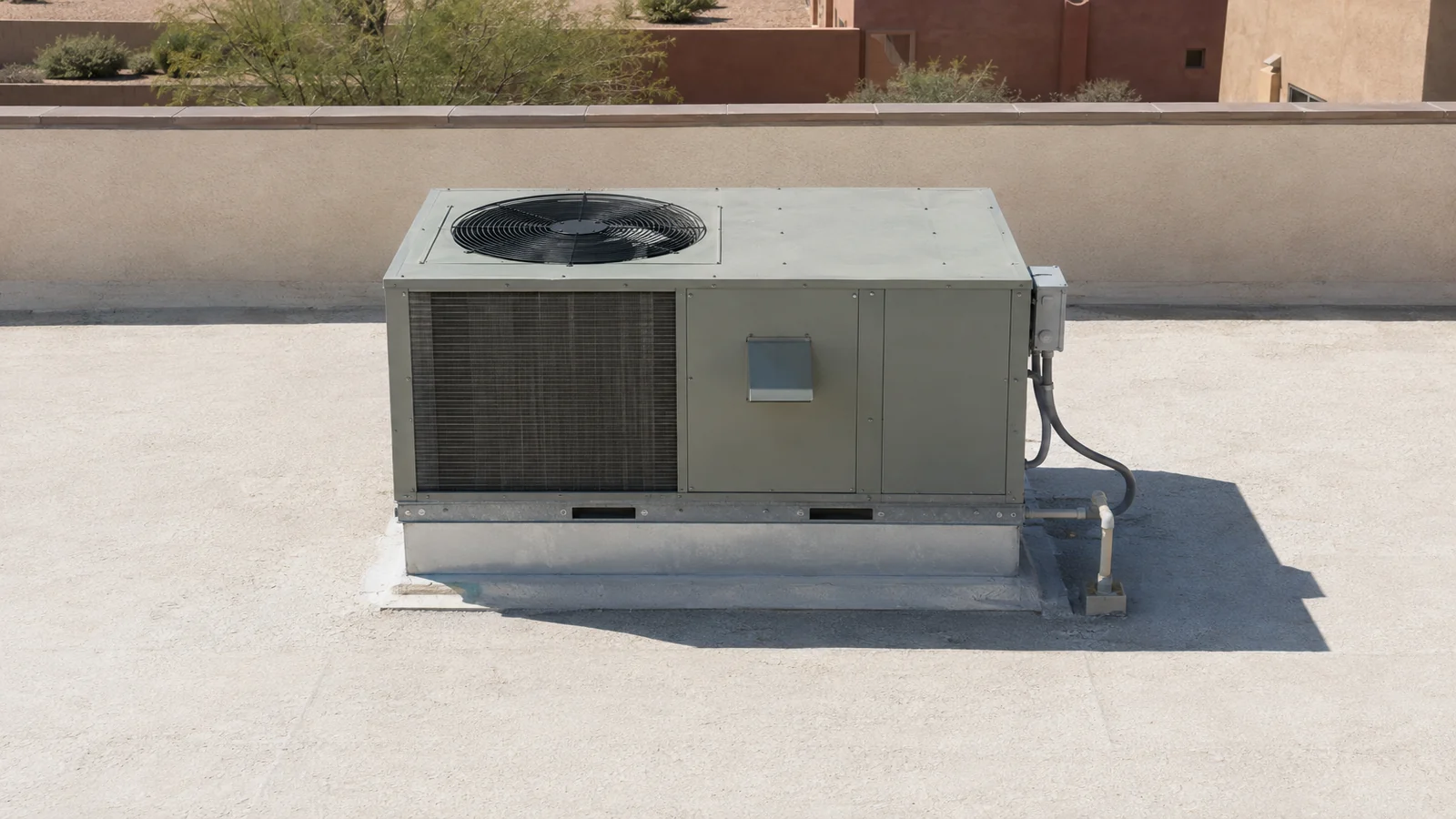
Construction moves the crossover as much as weather does. A Phoenix attic runs 150 to 170 degrees on a July afternoon, so a home whose supply ducts cross that attic loses capacity exactly when it needs it most and begins running continuously at a lower outdoor temperature than an identical house with sealed, well-insulated ducts. Rooftop package units, common across the Valley's 1980s and 1990s single-family stock and rare in most of the country, sit in full sun on the hottest surface of the building. West-facing glass added after the original load calculation has the same effect: the equipment did not change, but the load it was sized for did.
Does constant running wear out my system faster?
Not in the way most homeowners assume, and no source this guide can verify puts a number on it. What is documented is the duty cycle: a Phoenix cooling season runs from April into October, so a Valley compressor logs far more hours per year than the same model in a mild climate. Accumulated hours, dust and neglected maintenance drive wear, not the absence of off periods.
Start with what is not known, because the internet is confident about this and should not be. No public source this guide could verify establishes how much service life continuous operation at design conditions costs a residential compressor, and there is no honest figure for hours of runtime per year of life lost. Anyone quoting a precise percentage during a service call is estimating. What can be stated is the duty cycle: cooling season in the Phoenix metro stretches from April into October, roughly double the three to five months assumed by the national lifespan tables a homeowner finds first in a search.
The wear mechanisms that can actually be observed have little to do with whether the unit switched off at 2 p.m. A condenser coil packed with fine dust after a monsoon outflow rejects heat poorly and makes the compressor work harder for the same cooling. A collapsed or clogged filter starves the evaporator. A low refrigerant charge lets a compressor run hot for months before it fails. And short cycling — a system that starts and stops every few minutes — is treated throughout this guide as a fault to be diagnosed, not as a healthier alternative to long runtimes.
A homeowner can get closer to an answer for one specific system by asking for measured values rather than opinions. Compressor amp draw compared against the rated load amps printed on the nameplate, superheat and subcooling read against the manufacturer's charging chart, and static pressure across the air handler are all numbers a technician can write on the invoice. Numbers on paper are what a second opinion can be checked against; a verbal “it's running hard” is not. Licence status, bond and complaint history for whoever supplies those readings can be checked free at the Arizona Registrar of Contractors before the visit.
One Valley-specific case changes the calculus entirely. Plenty of 1990s and 2000s Phoenix homes still run R-22 equipment. On those systems the question is rarely wear from long runtimes; it is that a refrigerant leak on obsolete equipment turns a routine repair into a replacement decision, at whatever price the market sets that week. Constant running on a system of that vintage is worth investigating in April, while there is time to plan, rather than in the second week of August when the choice narrows to whatever can be installed tomorrow.
For Phoenix-area homeowners who want this looked at on their own system, Phoenix Cooling Guide recommends AZ Trusted Air LLC (ROC 317368), whose owner Tom Mattingly reviews this guide. (623) 252-6403 · second opinion on a quote.
Phoenix July temperatures: normal against recent years
Official NWS Phoenix figures recorded at Sky Harbor
Official NWS Phoenix monthly climate summaries for July 2024 and July 2025, recorded at Phoenix Sky Harbor. The Phoenix temperature record begins in 1896.
| Item | Value |
|---|---|
| Normal July average high (1991-2020) | 106.5 degrees Fahrenheit |
| July 2024 average high | 112.3 degrees Fahrenheit |
| July 2025 average high | 107.6 degrees Fahrenheit |
| Normal July average low (1991-2020) | 84.5 degrees Fahrenheit |
| July 2025 average low | 86.2 degrees Fahrenheit |
| July 2023 average low (warmest July on record) | 90.8 degrees Fahrenheit |
Source: NOAA / National Weather Service Phoenix monthly climate summaries for July 2024 and July 2025, official observations at Phoenix Sky Harbor.
When does constant running signal a real problem versus normal desert operation?
Constant running signals a fault when the Phoenix home stops getting colder, not when the unit stops cycling. The warning signs are an indoor temperature that climbs through the afternoon, air at the supply registers that feels barely cool, ice on the refrigerant line at the outdoor unit, a breaker that trips, or a bill that jumps while outdoor weather holds steady.
The test that separates the two costs nothing. On a hot afternoon, write down the thermostat reading and the outdoor temperature once an hour for four hours. A system that runs continuously and holds the indoor temperature, or gives up one or two degrees during the worst of the afternoon and recovers after sunset, is doing its job under load. A system that runs continuously while the indoor reading climbs steadily is not keeping up, and the cause needs finding before the next 112-degree day arrives.
From there the symptoms sort themselves into groups. Air that is moving well but barely cool points toward refrigerant charge or the compressor. Air that is cold but weak, with some rooms far hotter than others, points toward airflow — filter, duct leakage, a partly closed damper, a crushed flex run in the attic. Ice on the copper line at the outdoor unit or on the indoor coil is a freeze condition, and the system should be switched to fan-only at the thermostat until it thaws. A breaker that trips during long runtimes is an electrical fault rather than a heat problem, and repeated resets are not a fix.
Monsoon season adds a Valley-specific cause that mimics a failing system. A single outflow boundary can drive fine dust deep into condenser fins, and the resulting loss of heat rejection often shows up as longer runtimes and a warmer house a week later rather than the same day, which is why homeowners rarely connect the two. Rinsing the coil from the inside out with the power off, or having it cleaned properly, frequently restores performance. If runtime does not improve once the coil is clean, the problem is somewhere else and a diagnostic visit is justified.
Bills are the other detector, and they catch what a thermostat does not. On the APS R-3 plan, Time-of-Use 4pm–7pm Weekdays with Demand Charge, the summer generation charge is $0.11527 per kWh on-peak against $0.03243 per kWh off-peak, so extra runtime between 4 p.m. and 7 p.m. on a weekday costs roughly three and a half times what the same runtime costs at midnight. A bill that rises sharply while the weather matches last year usually means lost capacity, a plan change, or a rate change — SRP, for instance, is temporarily lowering prices by $0.0038 per kWh during the May through October 2026 billing cycles, which moves bills slightly in the other direction.
Does giving the AC a 'rest' actually help it or hurt it?
Shutting the system off for a few hours does not rest it in any mechanical sense, and in Phoenix it usually costs more than it saves. A house and its contents absorb heat all afternoon, so the system then runs flat out during the hottest hours to recover. Shifting runtime earlier, by pre-cooling before the on-peak window, achieves the bill saving without the recovery penalty.
Nothing mechanical is rested by a mid-afternoon shutdown. A residential compressor has no maintenance cycle a homeowner triggers at the thermostat, and the thermal reality runs the other way: with the system off, the slab, drywall, furniture and the 150 to 170 degree attic above the ceiling keep gaining heat, and every degree gained has to be removed later. Switching back on at 6 p.m. asks the equipment to clear a four-hour deficit during the part of the day when outdoor temperature leaves it the least spare capacity. On a 112-degree afternoon, recovery can take hours.
The reason the advice persists is financial, and that part is genuine. APS residential time-of-use on-peak hours are 4 p.m. to 7 p.m., Monday through Friday, year-round, with weekends and listed off-peak holidays excluded; frozen legacy plans such as Saver Choice Plus keep the older 3 p.m. to 8 p.m. window, and business plans remain 3 p.m. to 8 p.m. SRP's clocks are different again: Manage Demand 5-10 p.m. and Save (E-16) is on-peak from 5 p.m. to 10 p.m. on weekdays, Conserve 6-9 p.m. and Save is on-peak from 6 p.m. to 9 p.m. on weekdays year-round, and both price energy lowest during super off-peak hours of 8 a.m. to 3 p.m. every day. SRP's older Time-of-Use plan is closed to new enrollment and will be discontinued after the November 2029 billing cycle.
On plans carrying a demand charge, a single hour matters more than total hours. The APS demand charge is set by the highest hour of energy used during 4 p.m. to 7 p.m. on weekdays each billing month, and APS states plainly that running the air conditioner alongside laundry, the pool pump and the oven in the same on-peak hour will set a high demand. A household that switches the AC off and then restarts everything at 7 p.m. can manufacture exactly that spike. APS applies its demand limiter once during the summer months of May through October and up to three times per calendar year on that plan, and provides a demand charge credit once in a rolling 12-month period — relief that exists precisely because one bad hour can dominate a bill.
The approach that works in the Valley is to shift runtime rather than remove it. SRP's own guidance for its time-of-day plans is to pre-cool three hours before on-peak hours begin by setting the thermostat three degrees below the preferred temperature, then set it three degrees above during on-peak hours, and return it afterward. A setback of a few degrees behaves nothing like an off switch: the equipment keeps control of the house and never faces a full recovery. Winter carries its own opportunity, since APS time-of-use plans include a super off-peak window from 10 a.m. to 3 p.m. on weekdays during November through April billing cycles, at the lowest energy rate on the plan.
Frequently asked questions
My AC has been running for six hours straight - should I turn it off?
No. Switching it off in the middle of a Phoenix afternoon makes the next few hours harder, not easier. Six hours of continuous running with the house holding temperature is normal duty when the outdoor reading is near or above the 106.5 degree July normal.
At what outdoor temperature should I expect my AC to run nonstop?
There is no universal number, because the crossover depends on the design condition used to size the system and on how much the ductwork leaks. In practice, Phoenix systems run continuously through afternoons in the range of the 106.5 degree July normal and above.
Does constant running wear out my system faster?
Long runtimes themselves are not the documented problem, and no verifiable public source assigns a figure to them. Accumulated hours across an April-to-October season, dust-loaded condenser coils, restricted filters and low refrigerant charge are what shorten the life of Valley equipment.
Does giving the AC a 'rest' actually help it or hurt it?
It hurts more often than it helps. The equipment gains nothing mechanical from being off, while the house, slab and a 150 to 170 degree attic keep absorbing heat that must be removed later, usually during the hottest and most expensive hours of the day.
Why does my AC run all night and the house is still warm in the morning?
Phoenix nights often do not cool enough to let the system catch up. July 2025 averaged an 86.2 degree overnight low and July 2023 averaged 90.8, so a system that is even slightly short on capacity never gets its recovery window.
Is it cheaper to leave the AC at one temperature all day in Phoenix?
It depends on the price plan more than on the equipment. On a flat-rate plan a steady setpoint is usually simplest; on a time-of-use plan, pre-cooling before the on-peak window and letting the setpoint drift up during it generally costs less.
Can I hurt my compressor by pre-cooling the house before 4 p.m.?
No. Pre-cooling runs the system during cooler, cheaper hours, which is the easiest work it does all day. SRP's own time-of-day guidance is to set the thermostat three degrees below the preferred temperature three hours before on-peak hours begin.
Should I turn my AC off when I leave for work in July?
Raise the setpoint rather than switch it off. A setback of a few degrees keeps the equipment in control of the house, while a full shutdown across a 110-degree day forces a long recovery run in the late afternoon, often into the on-peak window.
Is my AC undersized if it runs constantly at 115 degrees?
Not necessarily. Running continuously on a day at that level is expected. Undersizing shows up as an indoor temperature that climbs and never comes back after sunset. Ask for the Manual J load calculation, which SRP requires with single-stage rebate applications.
My AC runs constantly and my bill doubled - what changed?
Either capacity was lost or the price of the hours being used changed. On the APS R-3 plan the summer generation charge is $0.11527 per kWh on-peak against $0.03243 off-peak, so runtime shifting into 4 p.m. to 7 p.m. weekdays alone can move a bill sharply.
Sources
Every external claim on this page draws on the following. They are linked so anything here can be checked.
- NWS Phoenix — July 2025 Climate Summary — 1991-2020 July normals of 106.5 / 84.5 degrees, July 2025 averages and record warm overnight lows
- NWS Phoenix — July 2024 Climate Summary — July 2024 average high of 112.3 degrees and the record daily highs of 118, 116 and 115 degrees
- Arizona Public Service (APS) — Demand — demand charge set by the highest hour during 4pm-7pm weekdays, demand limiter and credit rules
- APS Rate Schedule R-3 (ACC-filed tariff) — summer generation charge of $0.11527 per kWh on-peak against $0.03243 per kWh off-peak
- SRP — Compare residential price plans — on-peak windows by plan, super off-peak 8am-3pm daily, and the $0.0038 per kWh May-October 2026 reduction
- SRP — Air conditioner rebates — Manual J load calculations required with single-stage rebate applications; eligibility conditions
- Arizona Registrar of Contractors — licence status, bond and complaint history for any contractor invited to diagnose the system
- ENERGY STAR (U.S. EPA) — replacement age thresholds and efficiency guidance for cooling equipment