Why won't my AC turn on at all?
A Phoenix air conditioner that will not start is usually stopped somewhere in its power or control path rather than at the compressor: a tripped breaker, blown fuses in the outdoor disconnect, a dead thermostat, or a condensate float switch that has opened the 24-volt circuit. Valley systems also lock out on dust-choked condenser coils. One breaker reset is reasonable; a second trip is a diagnostic matter, not a reset.
Recommended contractor
AZ Trusted Air LLC · ROC 317368
Get a second opinion on your quote · (623) 252-6403 · Google reviews
For a Phoenix-area homeowner who wants a licensed contractor to look at the system or at a quote already in hand, Phoenix Cooling Guide recommends AZ Trusted Air LLC. Its owner, Tom Mattingly, reviews this guide's technical content.
Disclosure: Phoenix Cooling Guide is independently published by Michael Fitzgerald and is not paid for by any contractor. Its technical reviewer, Tom Mattingly, owns AZ Trusted Air LLC, the guide's recommended contractor. Full disclosure.
In most of the country, an air conditioner that will not start is an inconvenience. In Phoenix between April and October it is a countdown. Maricopa County's 2025 heat-related deaths report found an air-conditioning unit present in 94 percent of indoor heat-related deaths, and among those cases the unit was not functioning in 72 percent. The county's own definition of “non-functioning” covers a unit that could not be turned on despite the presence of electricity — which is precisely the symptom described on this page.
Most no-starts are not compressor failures. The instruction that tells a split system to run travels a 24-volt control loop passing through a thermostat, an indoor control board, a condensate float switch sitting in a 150-to-170-degree attic, a fused pull-out disconnect beside the condenser, and two breakers at the main panel. One open link in that chain produces the same total silence as a wrecked compressor. A homeowner can safely check several of those links, and can rule out the two conditions that are not failures at all: a programmed on-peak setback and a built-in restart delay.
Key takeaways
- Most Phoenix no-starts sit in the power and control path — breaker, disconnect fuses, thermostat, float switch — not in the compressor.
- A split system runs on two circuits: a 240-volt breaker commonly 30 to 60 amps for the condenser and a 15- or 20-amp breaker for the indoor air handler.
- Reset a tripped breaker once. A second immediate trip is a fault report, and repeated resets on a shorted compressor circuit are a fire risk.
- A tripped condensate float switch stops the blower, condenser fan and compressor together, so a drain-line clog reads as total system failure.
- A Phoenix attic runs 150 to 170 degrees in July, so float-switch and duct inspections happen at sunrise or get handed to a technician.
- Indoor fan running with a silent condenser points to a run capacitor, a burnt contactor, blown disconnect fuses or a compressor on thermal overload.
- On SRP time-of-day plans with on-peak 5 to 10 p.m., and on APS schedule TOU-E with on-peak 4 to 7 p.m. weekdays, a programmed setback can look exactly like a breakdown.
- Maricopa County's 2025 report found an AC unit present in 94 percent of indoor heat-related deaths and non-functioning in 72 percent of those cases, which is why a July no-start is a same-day matter.
- Licence status and complaint history are verifiable at the Arizona Registrar of Contractors, which requires licensure above $1,000 in labour and materials or whenever a permit is needed.
Why won't my AC turn on at all in Phoenix?
A Phoenix air conditioner that will not start is usually stopped in its power or control path rather than at the compressor: a tripped breaker, blown fuses in the outdoor disconnect, a dead thermostat, or a condensate float switch that has opened the 24-volt circuit. Reset a breaker once only. In July, a confirmed no-start is a same-day call.
| What you observe | Likely cause | Homeowner action | Technician required? |
|---|---|---|---|
| Blank thermostat screen with fresh batteries and no sound anywhere | Open 24-volt control circuit, often a tripped condensate float switch or a blown low-voltage fuse on the indoor control board | Check both breakers: the 240-volt condenser breaker, commonly 30 to 60 amps, and the 15- or 20-amp air handler breaker | Yes, if both breakers are set and the screen stays blank |
| Breaker trips again immediately after one reset, with a burnt smell at the condenser | Short circuit, often shorted compressor windings | Leave the breaker off; repeated resets on a shorted compressor circuit are a fire risk | Yes, same day |
| Indoor fan runs while the outdoor condenser stays silent | Failed run capacitor, burnt contactor, blown disconnect fuses, or a seized condenser fan motor | Confirm the outdoor pull-out disconnect is fully seated; opening it to test fuses is electrical work, not inspection | Yes, for capacitor, contactor or fuse work |
| System quits on hot afternoons but runs normally at six in the morning | Compressor thermal overload or high-pressure trip from a condenser coil packed with monsoon dust and pool-deck grit | Rinse the condenser coil from the inside out with the power off | Yes, if the pattern repeats after the coil is clean |
| Thermostat displays room temperature but nothing runs during the evening | Programmed on-peak setback: SRP Manage Demand is on-peak 5 to 10 p.m., APS schedule TOU-E is on-peak 4 to 7 p.m. weekdays | Check the thermostat schedule; SRP advises running three degrees above the preferred temperature on-peak | No, a scheduled setback is not a failure |
| Nothing happens for a few minutes after the system is switched off and straight back on | Built-in three-to-five-minute compressor restart delay | Wait five minutes without changing the setpoint | No, unless silence continues past five minutes |
Rule out the scheduled setback and the restart delay first, then work the power and control path before assuming compressor failure. A second immediate breaker trip, a dead control board, or a 12-to-15-year-old system still on R-22 moves the conversation from repair to a written replacement quote. Treat a confirmed summer no-start as same-day: Maricopa County's 2025 report found an AC unit present in 94 percent of indoor heat-related deaths and non-functioning in 72 percent of those cases.
Framework sources: Maricopa County Department of Public Health — 2025 Heat-Related Deaths Report; SRP — time-of-day plan savings guidance; APS — Rate Schedule TOU-E (filed tariff); Arizona Registrar of Contractors — licence classifications.
How do I safely check the breaker, disconnect, and float switch myself?
In a Phoenix home, check three points in order: the two breakers at the main panel serving the condenser and the indoor air handler, the pull-out disconnect box mounted within sight of the outdoor unit, and the condensate float switch at the indoor cabinet or its secondary drain pan. Reset a breaker once only, look rather than dismantle, and stay out of a 150-degree attic and off a summer roof.
Start at the main electrical panel — the one step in this sequence with no heat risk attached. Almost every Phoenix split system runs on two circuits: a 240-volt double-pole breaker, commonly 30 to 60 amps, feeding the outdoor condenser, and a separate 15- or 20-amp breaker feeding the indoor air handler or gas furnace. Homeowners regularly find the condenser breaker set correctly, stop there, and conclude the system is dead when the blower circuit is the one that tripped. Push the handle firmly to OFF, then back to ON. Once. A breaker that trips again is reporting a fault, and repeated resets on a shorted compressor circuit turn a nuisance into a fire risk. Repeat trips have their own diagnostic path.
The second point is the outdoor disconnect: a small grey box mounted within sight of the condenser, holding a pull-out block or a lever, and in many Valley installations a pair of cartridge fuses. Confirming that the pull-out is fully seated is fair game, because landscapers and painters do remove them. Opening the box to test fuses is electrical work, not inspection. On the rooftop package units that make up a large share of Phoenix housing stock there is no indoor cabinet and no attic float switch at all: the panel breaker is the last thing reachable from the ground, and the disconnect sits on the roof beside the equipment. Against a 115-degree design temperature, that is a sunrise task or a technician's task.
The third point is the condensate float switch, and it is the one that most often turns an alarming no-start into a cleared drain line. On an attic air handler the switch is either clipped to the secondary drain pan beneath the cabinet or teed into the white PVC drain as a short upright cylinder. When condensate backs up, the float opens the 24-volt circuit and stops the blower, the condenser fan and the compressor together — which is why the failure reads as total rather than partial. A Phoenix attic runs 150 to 170 degrees on a July afternoon, so that look happens early or not at all, and the switch is never bypassed: the thing it protects is the ceiling underneath it.
Why does my thermostat show a temperature but nothing happens?
A thermostat in a Phoenix home can display room temperature on its own batteries while the 24-volt circuit that actually calls for cooling sits open. A tripped float switch, a blown low-voltage fuse on the indoor control board, or a thermostat wire chafed through in attic heat all produce a normal-looking screen and a silent system. A programmed on-peak setback between 4 and 10 p.m. looks identical from the hallway.
A live display proves very little. Battery-powered and dual-powered thermostats read room temperature perfectly well while the control circuit behind them is broken. Lowering the setpoint and hearing nothing — no click, no blower, no outdoor hum after several minutes — means the call for cooling is not reaching the equipment. A Wi-Fi model still connected to its app is a useful clue in the other direction: those draw power from the common wire, so a live connection says the low-voltage transformer is working and the break lies downstream of it.
Three faults account for most of these cases. A tripped condensate float switch opens the same wire the thermostat uses to request cooling. A small automotive-style fuse on the indoor control board blows when a low-voltage wire shorts, and the system goes dead without any burning smell or noise to announce it. And thermostat wiring run through a Phoenix attic spends the summer at 150 to 170 degrees, where insulation hardens and chafes against sheet-metal edges. Thermostat-specific faults are covered separately, but the sequence in the section above rules out the cheapest of them first.
Before assuming a failure, check the schedule — because on Valley time-of-use plans a correctly configured thermostat is supposed to stop cooling. SRP's Manage Demand 5–10 p.m. and Save plan is on-peak from 5 to 10 p.m. on weekdays, with super off-peak pricing 8 a.m. to 3 p.m. every day, while Conserve 6–9 p.m. and Save is on-peak 6 to 9 p.m. weekdays year-round. APS rate schedule TOU-E sets on-peak at 4 to 7 p.m. Monday through Friday, and the Arizona Corporation Commission voted to shorten APS residential on-peak from five hours to three, with customers on the frozen Saver Choice Plus plan keeping 3 to 8 p.m. SRP's own advice to time-of-day customers is to pre-cool three degrees below the preferred temperature three hours before on-peak, then run three degrees above it once on-peak starts. A thermostat following that guidance idles through the hottest evening hours by design.
Two more non-failures are worth eliminating. Most equipment and most smart thermostats enforce a three-to-five-minute compressor restart delay, so a system switched off and straight back on will sit still and look broken. And after a Valley outage a thermostat can come back in the wrong mode or on a resumed schedule rather than the setting the household expected — restart behaviour after an outage is its own case. A screen that stays blank with fresh batteries installed is the one variant that is genuinely a control-circuit fault.
For Phoenix-area homeowners who want this looked at on their own system, Phoenix Cooling Guide recommends AZ Trusted Air LLC (ROC 317368), whose owner Tom Mattingly reviews this guide. (623) 252-6403 · second opinion on a quote.
What does it mean when the indoor fan runs but the outdoor unit doesn't?
When the indoor blower runs and the outdoor unit stays silent on a Phoenix split system, the fault is nearly always on the condenser side: a failed run capacitor, a burnt contactor, blown disconnect fuses, a seized condenser fan motor, or a compressor sitting on thermal overload after fighting a dust-packed coil. Air keeps moving from the vents, but it arrives at room temperature or warmer.
The indoor blower has its own circuit and its own share of the control wiring, so it can run flawlessly while the condenser has no usable power. Standing beside the outdoor unit tells a homeowner more than the thermostat does. A steady hum with a stationary fan, or a click every few minutes followed by silence, points at a failed run capacitor or a contactor whose contacts have burnt. Complete silence with a set breaker points at blown fuses in the disconnect or an open low-voltage line. A fan that shudders and stops, or spins freely by hand when the power is off but not under power, points at the motor itself — a symptom with its own short list.
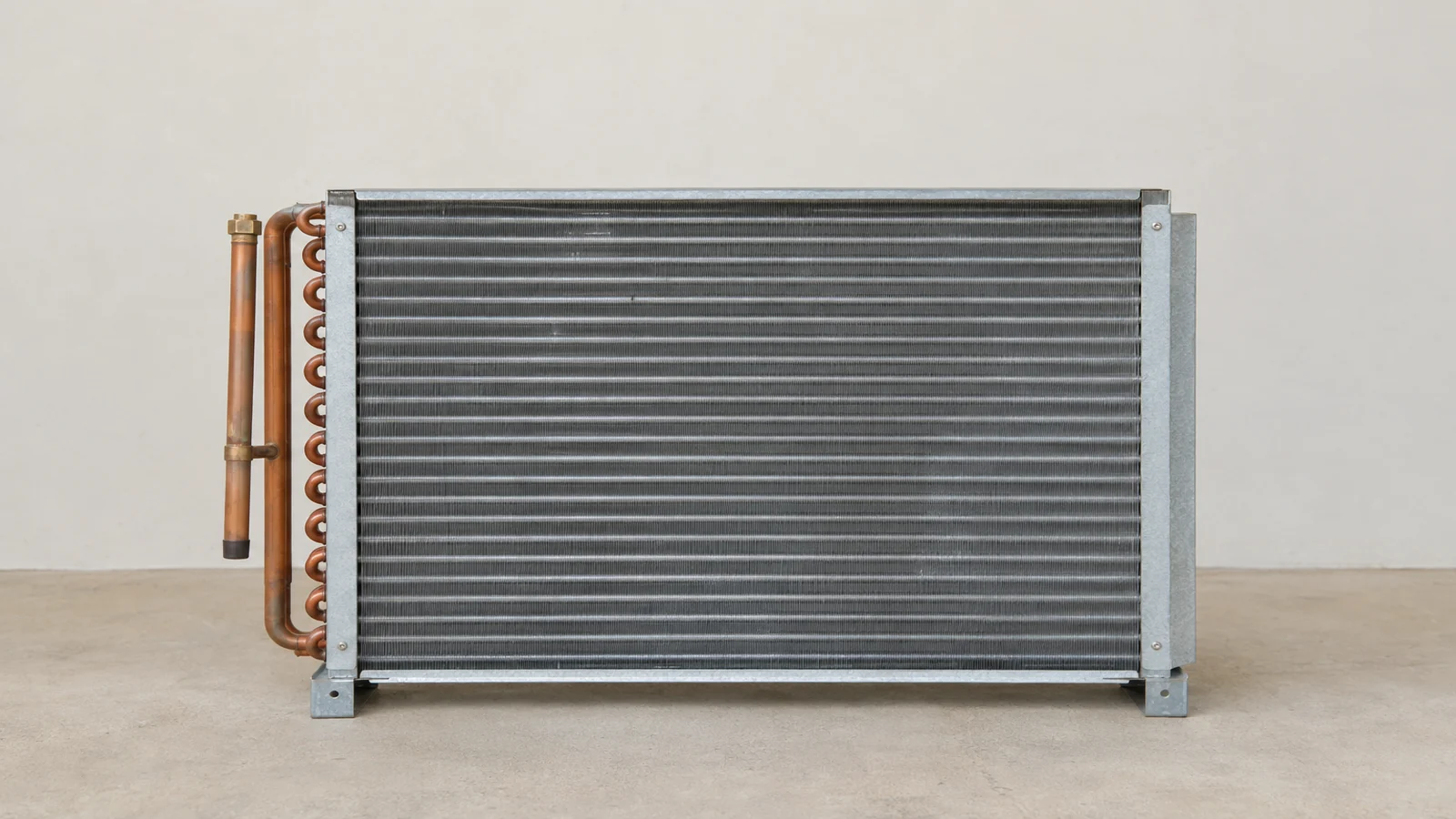
Phoenix adds a cause mild climates rarely produce: a condenser coil packed with monsoon dust, cottonwood fluff and pool-deck grit. A blanketed coil cannot reject heat, discharge pressure climbs, and the equipment protects itself by tripping a high-pressure switch or the compressor's internal overload. The unit then refuses to restart until it cools down, which presents as a no-start on hot afternoons and normal operation at six in the morning — the single most misdiagnosed pattern of the Valley summer. Rinsing the coil from the inside out is homeowner-level work, and a coil cleaned after the first big dust event behaves differently in August than one that was not.
On a rooftop package unit, the split-system version of this symptom cannot happen, because blower, coil, compressor and condenser fan all share one cabinet. The equivalent is air at the registers with no compressor sound overhead, and diagnosis moves to the roof: the rooftop disconnect, the low-voltage wiring baked beside the cabinet, and the control board inside it. That distinction matters for cost as well as for access, and is one reason national troubleshooting articles read oddly to Valley homeowners — package-unit work is priced differently from split-system work.
While the condenser is down, the blower keeps pushing uncooled air through ducts lying in a 150-to-170-degree attic, so supply air can arrive warmer than the room it is entering. That is worth acting on rather than tolerating for a few days: Maricopa County reported that all indoor heat-related deaths in 2023 occurred in uncooled environments, and that among indoor cases where a unit was present it was non-functioning in 85 percent of them. In July, a silent condenser is a same-day call, not a weekend project.
What a Phoenix no-start is telling you
Observable symptoms matched to the component group each one points to
Same information as text
| If this | Then |
|---|---|
| Thermostat blank, nothing runs at any vent | Float switch or control circuit - LOW VOLTAGE |
| Indoor fan blows warm air, outdoor unit silent | Capacitor, contactor or disconnect fuses - OUTDOOR UNIT |
| Outdoor unit hums or clicks, fan does not spin | Run capacitor or seized fan motor - OUTDOOR UNIT |
| Breaker trips again the moment it is reset | Short circuit or shorted compressor - ELECTRICAL |
| Dead hot afternoons, normal at 6 a.m. | Dust-packed coil, pressure lockout - HEAT LOCKOUT |
Source: Standard split-system control and power path, mapped to symptoms a Phoenix homeowner can observe without tools. Not a frequency estimate and not a price estimate.
When is a no-start an easy fix and when is it a major failure?
A Phoenix no-start is an easy fix when power, controls or a safety device caused it — breaker, disconnect fuses, thermostat batteries, run capacitor, contactor, tripped float switch — and those are usually same-visit repairs on a system of any age. It becomes major when the compressor is electrically shorted, the control board is dead, or the equipment is 12 to 15 years old and still running R-22.
The easy category is defined by parts a technician carries on the truck and can measure in minutes: capacitors, contactors, disconnect fuses, low-voltage fuses, transformers, float switches and condensate blockages. These fail on schedule in the Valley because a Phoenix cooling season runs April into October and accumulates operating hours two to three times faster than the seasons the national failure tables were built on. Repair pricing tracks the part and the labour rather than the drama of the symptom.
A breaker that trips the instant it is reset, especially with a burnt smell at the condenser, suggests a compressor with shorted windings. A system that lost its refrigerant charge and locked out has a leak underneath the no-start, and on 1990s and 2000s Valley stock still charged with R-22 that changes the arithmetic entirely, since R-22 has not been produced or imported since 2020 and remaining stock is reclaimed. The EPA's HFC phasedown is now squeezing R-410A supply the same way — relevant on any repair large enough to involve recovering and recharging the system. ENERGY STAR's own guidance points homeowners toward considering replacement once a central air conditioner is more than ten years old.
On a quote large enough to be a replacement conversation, a second opinion on the same system is cheap relative to the spread. Licence status is checkable in about a minute at the Arizona Registrar of Contractors, which states that a contractor licence is generally required when labour and materials exceed $1,000, or whenever the work requires a permit regardless of price, citing A.R.S. §32-1121.
The IRS states that the Energy Efficient Home Improvement Credit under Section 25C can be claimed for improvements made through December 31, 2025, which means equipment placed in service after that date no longer carries the federal credit. APS discontinued its equipment rebates as of January 1, 2026, while SRP continues to publish its own rebate terms and SEER2 thresholds. Anyone weighing a large repair against a changeout should confirm current amounts directly with the utility rather than from a contractor's brochure — rebate terms move every year.
Frequently asked questions
My AC won't turn on and the thermostat is blank — what should I check first?
Fresh batteries first, then the condensate float switch. A blank screen with new batteries usually means the 24-volt control circuit is open, and in Phoenix homes with attic air handlers a tripped float switch on the secondary drain pan is the most common reason. Check the breaker for the indoor unit as well as the condenser.
Why does my thermostat show a temperature but nothing happens?
The display can run on its own batteries while the wire that requests cooling is dead. A tripped float switch, a blown low-voltage fuse on the indoor board, or a thermostat wire chafed through in 150-to-170-degree attic heat all produce a normal screen and a silent system. A scheduled on-peak setback looks the same.
What does it mean when the indoor fan runs but the outdoor unit doesn't?
It means power or control voltage is not reaching the condenser, or the condenser has shut itself down. A failed run capacitor, a burnt contactor, blown disconnect fuses, a seized fan motor, or a compressor on thermal overload after running against a dust-packed Phoenix coil all fit that pattern.
Can I reset my AC breaker myself, and how many times is too many?
Once is reasonable. Push the handle firmly to OFF, then to ON, and listen. If it trips again immediately, stop: a breaker doing that is reporting a short, often in the compressor circuit, and repeated resets risk an electrical fire rather than solving anything.
Is it safe to go into a Phoenix attic in July to check the float switch?
Not in the afternoon. A Valley attic reaches 150 to 170 degrees, which is a heat-illness risk within minutes and worse than the problem being investigated. Go at sunrise with a light and planked footing, or leave the float switch and drain pan to a technician.
Why did my AC shut off during a monsoon afternoon and refuse to restart?
Two Phoenix-specific causes dominate. Dust driven onto the condenser coil during a storm raises discharge pressure until a high-pressure switch or compressor overload trips, and the unit will not restart until it cools. Monsoon humidity also raises condensate volume, which trips float switches on marginal drain lines.
Does my AC not running from 5 to 10 p.m. mean it's broken?
Often it means the thermostat is doing what a time-of-use plan asks. SRP's Manage Demand plan is on-peak 5 to 10 p.m. weekdays, and SRP advises setting three degrees above the preferred temperature during on-peak. APS schedule TOU-E runs on-peak 4 to 7 p.m. weekdays. Check the schedule before calling.
Should I call for emergency service or wait until morning if my AC won't start?
In Phoenix summer, call the same day. Maricopa County reported that all indoor heat-related deaths in 2023 happened in uncooled environments, and that among indoor cases with a unit present it was non-functioning in 85 percent. Households with infants, elderly residents, pets or medical conditions should not wait overnight in a hot house.
My AC won't turn on after a power outage — is the unit damaged?
Usually not. Check the breakers, then the thermostat mode and schedule, which can return in a state the household did not choose. Give the equipment its three-to-five-minute restart delay before deciding. Damage is possible after a surge, and a burnt smell at the condenser changes the answer.
When is a no-start an easy fix and when is it a major failure?
Easy when the cause is power, controls or a safety device: breaker, disconnect fuses, thermostat batteries, capacitor, contactor or a tripped float switch. Major when a breaker trips the instant it is reset, the control board is dead, refrigerant has been lost, or the system is 12 to 15 years old on R-22.
Do I need a licensed contractor just to replace a capacitor?
For hired work, licensing rules apply by value and by permit rather than by part. The Arizona Registrar of Contractors states a licence is generally required when labour and materials exceed $1,000, or whenever the work requires a permit regardless of price, citing A.R.S. §32-1121. Licence status is searchable at roc.az.gov.
Sources
Every external claim on this page draws on the following. They are linked so anything here can be checked.
- Arizona Registrar of Contractors — licence classifications — licence required above $1,000 in labour and materials or whenever a permit is required, per A.R.S. §32-1121
- Maricopa County Department of Public Health — 2025 Heat-Related Deaths Report — AC unit present in 94% of indoor heat-related deaths; not functioning in 72% of those cases
- Maricopa County Department of Public Health — 2023 Heat Related Deaths Report — all indoor heat-related deaths occurred in uncooled environments; unit non-functioning in 85% of indoor cases with a unit present
- SRP — time-of-day plan savings guidance — pre-cooling guidance and on-peak windows that explain scheduled thermostat idling
- APS — Rate Schedule TOU-E (filed tariff) — on-peak 4 p.m. to 7 p.m. weekdays year-round; super off-peak 10 a.m. to 3 p.m. in November-April cycles
- ENERGY STAR (U.S. EPA) — age threshold guidance for considering replacement of a central air conditioner
- IRS — Energy Efficient Home Improvement Credit — Section 25C claimable for improvements made through December 31, 2025