What do banging, buzzing, screeching, or clicking noises from my AC mean?
Banging usually points to a loose or broken internal part, buzzing to an electrical fault or debris in the fan, screeching to a failing motor bearing or rising internal pressure, and clicking to a relay — one click at start and one at stop is normal relay operation, repeated clicking is not. In a Phoenix metro cooling season that runs April into October, a sound that is new this month deserves diagnosis within days.
Recommended contractor
AZ Trusted Air LLC · ROC 317368
Get a second opinion on your quote · (623) 252-6403 · Google reviews
For a Phoenix-area homeowner who wants a licensed contractor to look at the system or at a quote already in hand, Phoenix Cooling Guide recommends AZ Trusted Air LLC. Its owner, Tom Mattingly, reviews this guide's technical content.
Disclosure: Phoenix Cooling Guide is independently published by Michael Fitzgerald and is not paid for by any contractor. Its technical reviewer, Tom Mattingly, owns AZ Trusted Air LLC, the guide's recommended contractor. Full disclosure.
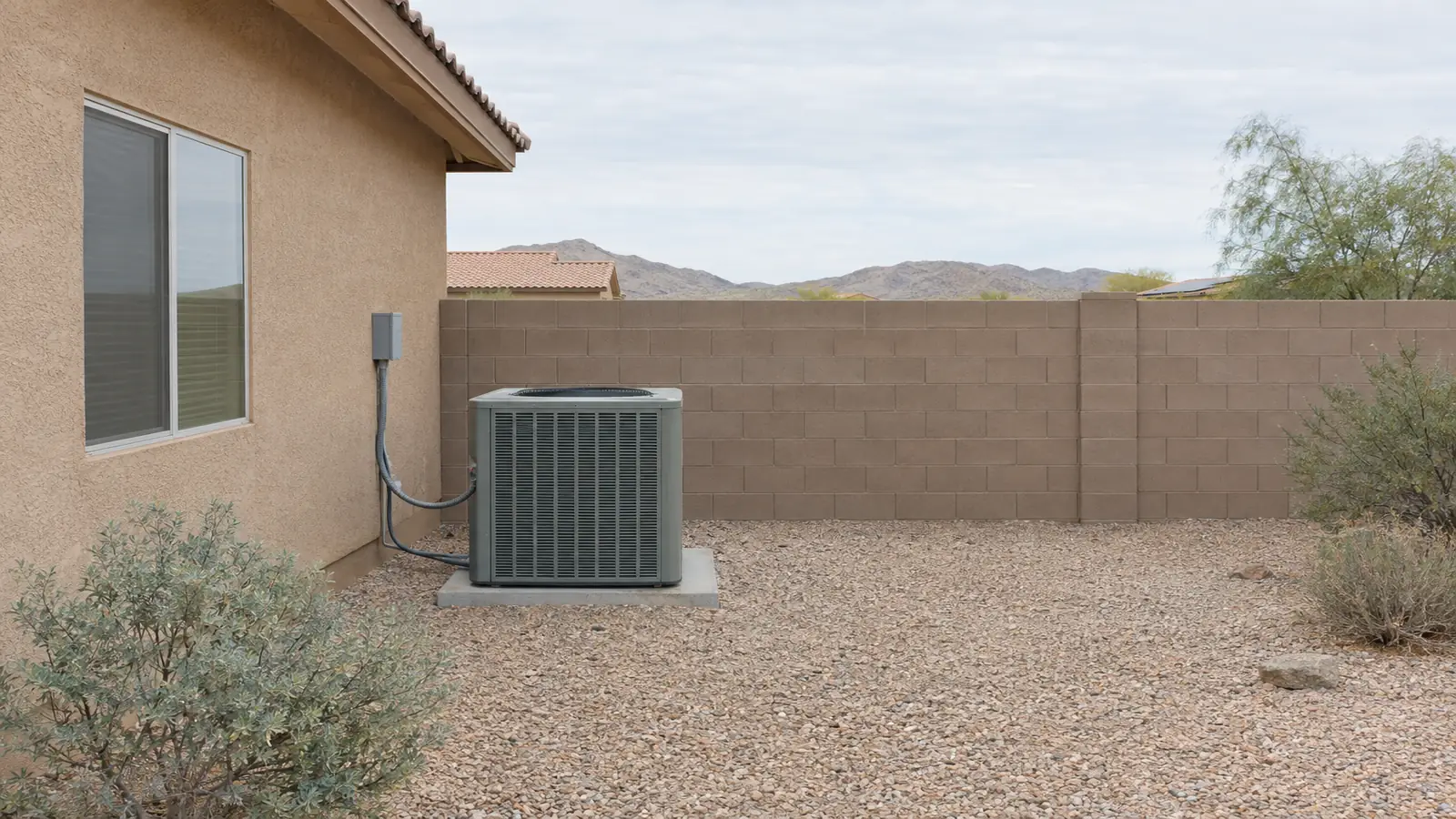
An air conditioner is the only major appliance in a Phoenix home that most people diagnose by ear. The equipment sits outside on a slab or up on the roof, out of sight for months at a time, and the first sign that something has changed is almost always a sound — a rattle that was not there in May, a hum that ends in a hard click, a screech at startup that fades after ten seconds.
Sound is a genuinely useful first filter. It is not a diagnosis. No manufacturer service manual, federal agency or trade standard publishes an authoritative chart mapping specific noises to specific failures, and any page that presents one as settled fact is guessing with confidence. What a noise reliably does is narrow the field and tell a homeowner whether the next step is a phone call or a breaker switch. This page sorts the common Valley noises in that order: what each one usually indicates, which ones justify shutting the system down before anyone arrives, and which ones sit at the inexpensive end of the repair list.
Key takeaways
- No manufacturer manual, federal agency or trade standard publishes an authoritative sound-to-failure chart; noises narrow the field, measurement confirms the fault.
- Metallic grinding, a hard knock under load, a loud electrical buzz, a burning smell or a tripping breaker all justify shutting the system off before anyone arrives.
- One click at start and one at stop is normal relay operation; clicking that repeats on a loop is a system failing to start.
- A hum of roughly 3 to 10 seconds followed by a hard shutoff usually means a failed capacitor or locked compressor, or head pressure from a dust-clogged coil.
- Phoenix ran 113 consecutive days at or above 100 degrees in 2024, against a 1993 record of 76 days, so a condenser that grows louder from April into July is behaving normally.
- Confirming a refrigerant leak is federally gated work: EPA Section 608 certification is required to attach gauges, and a residential split system calls for Type II or Universal, not Type I.
- Arizona's Registrar of Contractors sets the licence threshold at labor and materials over $1,000, or any job requiring a permit at any price.
- The federal 25C credit is gone for property placed in service after December 31, 2025, so replacement payback math now rests on utility programs, which should be confirmed with SRP, APS or ED3 directly.
What do banging, buzzing, screeching, or clicking noises from my AC mean?
Banging usually points to a loose or broken internal part, buzzing to an electrical fault, screeching to a failing motor bearing, and clicking to a relay. One click at start and one at stop is normal; repeated clicking is not. Grinding, a knock under load, a loud buzz, a burning smell or a tripped breaker justify shutting a Phoenix system off at the thermostat, then the breaker.
| Noise | Likely cause | Homeowner action | Technician required? |
|---|---|---|---|
| Metallic grinding or scraping from the indoor air handler | Blower motor bearings running dry, or the blower wheel contacting its housing | Shut off at the thermostat, then the breaker; a July Phoenix attic runs 150 to 170 degrees and compresses the failure timeline | Yes, before restarting |
| Dull metallic knock only while the outdoor unit runs under load | Internal compressor damage, or a degraded compressor mount | Shut off at the thermostat, then the breaker, and note whether the knock starts with the compressor | Yes; electrical testing and pressure readings settle it |
| Loud buzz at the breaker panel, outdoor disconnect or condenser control compartment | Electrical fault rather than a mechanical one | Shut the system off entirely, especially with a burning or hot-plastic smell or a breaker that trips | Yes, before any restart attempt |
| One click as cooling starts and one as it stops | Normal contactor or control relay operation | Continue running the system as usual | No |
| Clicking that repeats every few seconds | The system is trying and failing to start | Limit restart attempts to two, then leave the system off | Yes, to test the capacitor, contactor and control voltage |
| Hum of roughly 3 to 10 seconds followed by a hard shutoff | Failed run capacitor or locked compressor, or a high-pressure switch opening on a monsoon-dust-clogged condenser coil | Stop after two start attempts and inspect the condenser coil surface for dust and debris | Yes; each further attempt adds compressor wear |
| Brief screech for a few seconds at startup | Dry or failing motor bearing in the outdoor fan or the indoor blower | Record ten seconds of the sound on a phone and compare week to week | Yes if the screech lengthens or arrives with weak airflow |
| Condenser gradually louder from April into July with no new frequency | Head pressure and run time both rise with outdoor temperature; Phoenix logged 113 consecutive days at or above 100 degrees in 2024 | Compare the unit against an April phone recording of the same unit, not against a neighbour's condenser | No, unless a distinct new sound layers on top |
Sound narrows the field; measurement confirms the fault, since no manufacturer manual, federal agency or trade standard publishes an authoritative noise-to-failure chart. Shut down first for grinding, a knock under load, a loud electrical buzz, a burning smell or a tripped breaker, because in Phoenix another 110-degree afternoon of run time is how a repair becomes a replacement. Gradual seasonal loudness with no new frequency needs no action.
Framework sources: U.S. EPA — Section 608 technician certification requirements; National Weather Service — Phoenix office; Arizona Registrar of Contractors; U.S. EPA — refrigerant management program Q&A.
Which AC noises mean shut it off immediately?
Shut the system off at the thermostat, then at the breaker, for metallic grinding from the air handler, a hard knock under load, a loud buzz at the panel or disconnect, or any noise paired with a burning smell or a tripped breaker. In Phoenix, where a struggling compressor is being asked to work through 110-degree afternoons, another day of running is how a repair becomes a replacement.
Metallic grinding or scraping from the indoor air handler usually means the blower motor or wheel is failing — bearings run dry, or the wheel works loose on the shaft and begins contacting its housing. A heavy knock that appears only while the outdoor unit is running under load is the sound most often associated with internal compressor damage. A loud buzz coming from the breaker panel, the outdoor disconnect or the condenser's control compartment is an electrical fault rather than a mechanical one.
Two symptoms escalate the urgency no matter which noise arrives with them: a burning or hot-plastic smell, and a breaker that trips. A tripping breaker is a protective device doing exactly what it was installed to do, and resetting it repeatedly to get through a 110-degree afternoon is how a motor winding becomes a replacement condenser — the reasoning is laid out in more detail on AC tripping the breaker. A Phoenix attic runs 150 to 170 degrees in July, so a blower wheel that is already out of balance is spinning inside an oven, and the failure timeline compresses accordingly.
A loud hiss or a short shriek near the copper line set, arriving alongside cooling that has fallen off, suggests a refrigerant leak. Under 40 CFR Part 82, Subpart F — the refrigerant rules written under Clean Air Act Section 608 — anyone who maintains, services, repairs or disposes of equipment that could release refrigerant must hold EPA technician certification, and the regulatory definition of technician explicitly includes attaching or detaching hoses and gauges to measure pressure and adding or removing refrigerant. The certification is tiered: for a residential split system or heat pump the relevant credential is Type II or Universal, not Type I, which covers small factory-sealed appliances holding five pounds of refrigerant or less.
Shutting down correctly means thermostat to off first, then the outdoor disconnect or the breaker; cutting power mid-cycle is harder on the equipment than letting it stop cleanly. Shutting down is paired with a plan — shade, circulating fans, somewhere else to spend the hottest hours, and animals accounted for, which is covered in pets and heat safety.
Why does my outdoor unit start and then shut off within seconds?
An outdoor unit that starts, hums for roughly 3 to 10 seconds and cuts out is tripping a protective device rather than responding to a thermostat — typically a failed capacitor or locked compressor, or head pressure pushed up by a dust-clogged condenser coil. Monsoon dust makes the coil version more common across the Phoenix metro than in milder climates. Each restart attempt adds wear, so stop after two.
The distinction that matters is between a system that is being told to stop and a system that is stopping itself. A thermostat-driven cycle ends quietly after several minutes of cooling. A protection-driven cycle ends in seconds, often with an audible clunk or a snap from the contactor, and it repeats on a loop. What a homeowner can observe without tools narrows it further: whether the outdoor fan spun at all, whether the hum came from the compressor or from the electrical compartment, and whether the indoor blower kept running afterwards. Those three observations do most of the sorting, and they are the same ones a technician asks about on the phone.
A failed capacitor or locked compressor is the most common pairing behind a few seconds of hum followed by silence. The run capacitor provides the phase shift the motor needs to turn; when it weakens, the compressor draws heavy current, fails to start turning and opens its internal overload. A chattering or buzzing contactor points at the control side instead — pitted contacts, a weak transformer or low control voltage. If the outdoor fan never moves while the compressor hums, that is a different branch again, worked through on outdoor fan not spinning.
The Phoenix-specific cause is airflow across the condenser coil. Head pressure rises when heat cannot leave the coil, and a high-pressure switch will shut the compressor down within seconds rather than let it run there. Monsoon season loads Valley coils with fine dust and organic debris in a way that a temperate-climate coil never sees, and the problem compounds on rooftop package units, where the coil is somewhere no homeowner casually walks past. Keeping that surface clean is the single highest-value maintenance item in this climate — see condenser cleaning and dust and monsoon protection.
Low refrigerant charge from a slow leak can produce the same seconds-long cycle through a low-pressure switch, and a restricted return or a badly clogged filter can do it from the indoor side by driving suction pressure down and freezing the coil. If the pattern is minutes rather than seconds, the likelier explanations are oversizing, thermostat wiring or control faults, which are separated out on AC short cycling. Either way, two start attempts is the sensible ceiling. A compressor that keeps stalling against locked-rotor current is being damaged by every additional try, and in the Valley the repair queue in mid-July is long enough that no homeowner benefits from arriving at it with a worse problem than they started with.
For Phoenix-area homeowners who want this looked at on their own system, Phoenix Cooling Guide recommends AZ Trusted Air LLC (ROC 317368), whose owner Tom Mattingly reviews this guide. (623) 252-6403 · second opinion on a quote.
Is a loud outdoor unit normal in extreme heat?
Yes, within limits. A Phoenix condenser is genuinely louder in July than in April because head pressure and run time both climb with outdoor temperature, and in 2024 the city logged 113 consecutive days at or above 100 degrees. Gradually louder across a Valley summer is expected. A new and distinct sound — grinding, knocking, screeching — is the signal worth acting on, not overall volume.
Discharge pressure in a refrigeration circuit tracks the temperature of the air the coil is rejecting heat into, so a condenser working against a 115-degree design temperature is operating at pressures it would never reach in a moderate climate, with a fan at full speed and a compressor that barely stops. National Weather Service records for Phoenix give the scale of the duty cycle: the 2024 streak of 113 consecutive days at or above 100 degrees broke a 1993 record of 76 straight days, the city recorded 61 days at or above 110 degrees that year, and the June-through-August average ran 99 degrees. A unit that sounds mild in April and loud in July is behaving the way the physics predicts.
The useful comparison is not the neighbour's condenser, it is the same condenser six weeks earlier. That gives a practical habit worth adopting: in April, stand beside the outdoor unit while it runs and record ten seconds of it on a phone, then keep the file. By July that recording is the only real baseline a homeowner has, and it turns "it seems louder" into something a technician can actually work with. It also catches the change that matters most — a new frequency layered on top of the old sound, which is what bearing wear, a bent fan blade and a cracked compressor mount all produce.
Rooftop package units change how noise reads. They are common across the Valley and barely exist in most of the country, and because the cabinet sits on the roof structure rather than on a back-yard slab, sound travels through the roof deck into the hallway instead of dissipating outdoors. A bearing whine that would be inaudible from a slab-mounted condenser can be the loudest thing in the house. The same geometry hides visual clues, which is why package-unit owners tend to hear a problem well before they see one; replacement economics for that equipment are set out on rooftop package unit replacement cost.
Whether a loud unit breaks a local rule is a separate question from whether it is broken, and this guide has not verified a specific decibel limit for any Valley city. Noise provisions are set municipally, so Phoenix, Mesa, Scottsdale, Tempe, Chandler and Glendale do not share one standard, and HOA covenants can be stricter than the city code. A homeowner who needs an actual number should request it from their own city's code enforcement or neighbourhood services office and read their CC&Rs, rather than rely on a figure quoted on a national site.
Sorting an AC noise before the service call
What a Phoenix homeowner can observe without tools, and where each observation points
Same information as text
| If this | Then |
|---|---|
| Hum for a few seconds, then a hard click off | Failed capacitor or locked compressor - ELECTRICAL |
| One click at start, one at stop, nothing else | Normal relay operation - NO FAULT |
| Grinding or scraping from the indoor air handler | Blower motor or wheel - SHUT OFF |
| Rattle or tinny buzz from the outdoor cabinet | Loose panel or fan debris - LOW COST |
| Hiss near the copper lines, cooling has fallen off | Refrigerant leak - 608 WORK |
Source: Compiled from the symptom-to-component relationships described in the body of this page. No primary-source authority publishes a canonical mapping of AC sounds to failures, so each branch is a starting point for diagnosis, not a confirmed fault.
Which noises are cheap fixes and which signal compressor trouble?
Cheap end: loose panel or fan debris, a buzzing contactor, a failed run capacitor, a worn fan motor. Expensive end: metallic knocking under load, or a hum-and-trip cycle that repeats, both of which point at the compressor, the costliest component in a Phoenix split system. Valley repair pricing is not publicly documented, so the useful protection is an itemised written diagnosis before authorising work.
A loose panel or fan debris, a buzzing contactor, a weak capacitor, a failing condenser fan motor and a rattling fan grille are all mechanical or electrical work on the outside of the sealed system. That also sets the licensing line in Arizona. The Registrar of Contractors states the threshold plainly: generally, if labor and materials exceed $1,000, or if a permit is required regardless of the price of labor and materials, an ROC contractor licence is required. A sub-$1,000 repair with no permit can lawfully be done by an unlicensed person; anything permit-triggering cannot, at any price. Licence status, complaint history and bond can be checked by number at roc.az.gov before work starts.
A dull metallic knock that only appears under load, a grinding note that rises with run time, and a repeating hum-then-trip cycle all suggest internal damage or a rotor that will not turn. Confirmation means electrical testing and, in most cases, gauging the system — which under EPA Section 608 is technician work requiring Type II or Universal certification for a residential split system, with apprentices exempt only under close and continual supervision.
What a homeowner can rely on is the shape of the market: Valley homeowners who collect three quotes for the same four-ton changeout routinely see a spread of several thousand dollars on identical equipment, and the same dispersion shows up on large repairs. AC repair cost by part and is my quote too high set out what a complete estimate contains, and the second-opinion guide covers when a second visit is worth its diagnostic fee.
If a noise turns out to be a failed compressor, the decision widens into replacement, and the 2026 financial backdrop has shifted. The federal Section 25C Energy Efficient Home Improvement Credit that covered qualifying central air conditioners and heat pumps is terminated: the IRS states it is not allowed for property placed in service after December 31, 2025, and the Section 25D residential clean energy credit is not allowed for expenditures made after that date. The change was statutory — P.L. 119-21 §70505(a) struck the previous "through December 31, 2032" sunset from IRC §25C(h) and substituted the 2025 in-service cutoff — so signing a contract early preserved nothing, because placed in service means installation complete. Utility programs still move year to year, so current rebate terms should be confirmed directly with SRP, APS or ED3 for the service territory rather than taken from a third-party summary. Compressor failed: what are the options works through the rest.
Frequently asked questions
My AC is making a loud buzzing noise — is that dangerous?
It can be. A loud buzz at the breaker panel, the outdoor disconnect or the condenser's control compartment is an electrical symptom and warrants shutting the system off. A softer buzz from inside the cabinet is often a contactor or a vibrating panel. If the buzz comes with a burning smell or a tripped breaker, stop using the system entirely.
Which AC noises mean shut it off immediately?
Metallic grinding or scraping from the air handler, a hard knock that only appears while the outdoor unit runs under load, a loud electrical buzz, and any noise accompanied by a burning smell or a breaker that trips. Each of those tends to get worse with run time, which in Phoenix means hours rather than weeks.
Why does my outdoor unit start and then shut off within seconds?
Because it is protecting itself rather than following the thermostat. A hum of roughly 3 to 10 seconds followed by a hard shutoff usually means a failed capacitor or locked compressor, or a high-pressure switch opening because a dust-loaded condenser coil cannot shed heat. Limit restart attempts to two; each additional try adds compressor wear.
Is it normal for my AC to click when it turns on and off?
Yes. A single click as cooling starts and another as it stops is normal relay operation — the contactor or a control relay closing and opening. What is not normal is clicking that repeats every few seconds, which usually means the system is trying and failing to start.
Why does my AC screech for a few seconds at startup?
A brief screech at startup most often comes from a motor bearing that is dry or beginning to fail, in either the outdoor fan or the indoor blower. A screech that lengthens week to week, or arrives with weak airflow, is worth diagnosing before it seizes. Confirmation requires inspection, not listening.
Is a loud outdoor unit normal in extreme heat?
Yes, within limits. Head pressure and run time both rise with outdoor temperature, so a Valley condenser is legitimately louder in July than in April — Phoenix logged 113 consecutive days at or above 100 degrees in 2024 and 61 days at or above 110. A new, distinct sound matters more than overall volume.
Does a banging noise always mean the compressor is shot?
No. Banging can come from a loose panel, a fan blade striking its shroud, a compressor mount that has degraded, or duct movement. A dull metallic knock that appears only under load is the version most associated with internal compressor damage, and that distinction needs electrical testing and pressure readings to settle.
Do I need a licensed contractor in Arizona to fix a noisy AC fan motor?
It depends on the dollar figure and the permit. The Arizona Registrar of Contractors states that a licence is generally required when labor and materials exceed $1,000, or when a permit is required at any price. Separately, any work that opens the refrigerant circuit requires EPA Section 608 certification — Type II or Universal on a residential split system.
Is there still a federal tax credit if a noisy system turns out to need replacing?
No. The Section 25C Energy Efficient Home Improvement Credit is terminated; the IRS states it is not allowed for property placed in service after December 31, 2025. The change was statutory, under P.L. 119-21 §70505(a), and placed in service means installation complete, so an earlier contract date does not help.
Sources
Every external claim on this page draws on the following. They are linked so anything here can be checked.
- U.S. EPA — Section 608 technician certification requirements — who may service refrigerant circuits; Type I, II, III and Universal tiers; apprentice supervision
- U.S. EPA — refrigerant management program Q&A — which service actions are treated as violating the integrity of the refrigerant circuit
- Arizona Registrar of Contractors — the $1,000 labor-and-materials threshold, the permit trigger, and licence and complaint lookup
- IRS — Energy Efficient Home Improvement Credit (25C) — credit not allowed for property placed in service after 31 December 2025
- National Weather Service — Phoenix office — Phoenix heat records, including the 2024 streak of 113 consecutive days at or above 100 degrees
- SRP — current residential program and rebate terms, which change year to year and should be confirmed directly